Narumi Atsushi, Rachi Rioko, Yamazaki Hiromi, Kawaguchi Seigou, Kikuchi Moriya, Konno Hiroyuki, Osaki Tomohiro, Okamoto Yoshiharu, Shen Xiande, Kakuchi Toyoji, Kataoka Hiromi, Nomoto Akihiro, Yoshimura Tomokazu, Yano Shigenobu
Graduate School of Organic Materials Science, Yamagata University, Jonan 4-3-16, Yonezawa 992-8510, Japan.
Faculty of Engineering, Yamagata University, Jonan 4-3-16, Yonezawa 992-8510, Japan.
ACS Omega. 2021 Mar 8;6(10):7023-7033. doi: 10.1021/acsomega.0c06316. eCollection 2021 Mar 16.
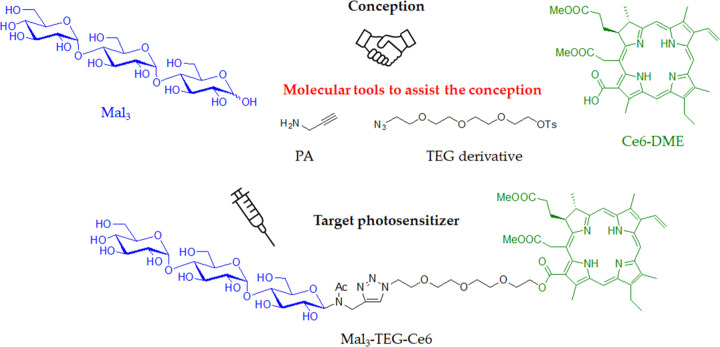
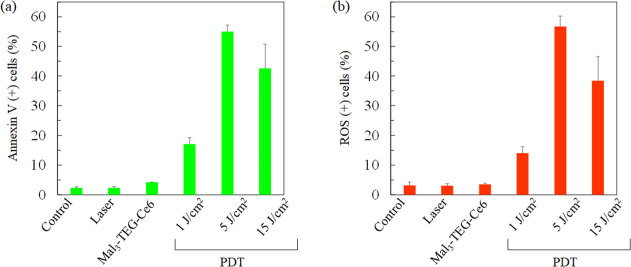
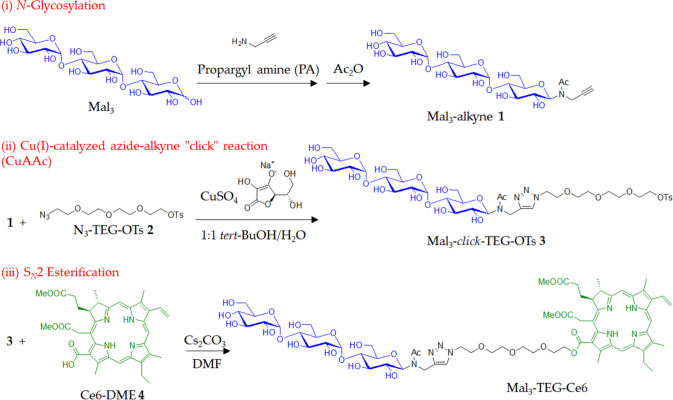
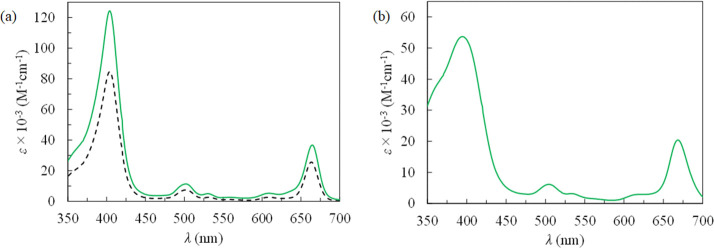
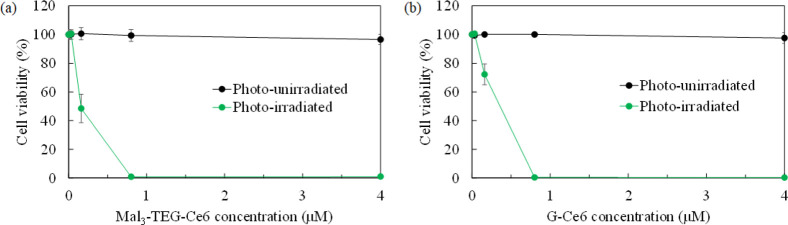
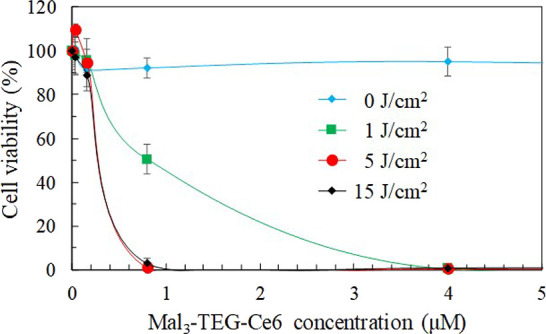
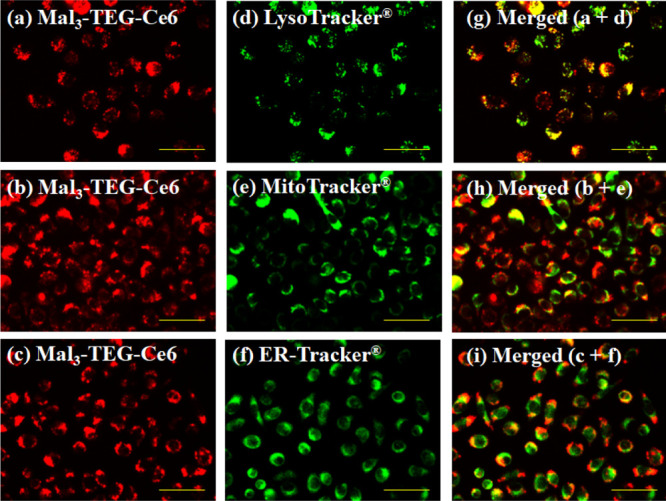
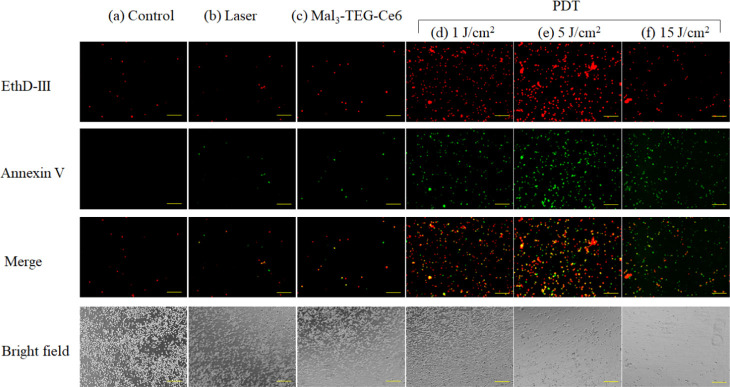
Glycoconjugated chlorins represent a promising class of compounds that meet the requirements for the third-generation photosensitizer (PS) for photodynamic therapy (PDT). We have focused on the use of glucose (Glc) to improve the performance of the PS based on the Warburg effect-a phenomenon where tumors consume higher Glc levels than normal cells. However, as a matter of fact, Glc-conjugation has a poor efficacy in hydrophilic modification; thus, the resultant PS is not suitable for intravenous injection. In this study, a Glc-based oligosaccharide, such as maltotriose (Mal), is conjugated to chlorin e6 (Ce6). The conjugation is assisted by two additional molecular tools, such as propargyl amine and a tetraethylene glycol (TEG) derivative. This route produced the target Mal-Ce6 conjugate linked the TEG spacer (Mal-TEG-Ce6), which shows the required photoabsorption properties in the physiological media. The PDT test using canine mammary carcinoma (SNP) cells suggested that the antitumor activity of Mal-TEG-Ce6 is extremely high. Furthermore, tests against mouse mammary carcinoma (EMT6) cells have been demonstrated, providing insights into the photocytotoxicity, subcellular localization, and analysis of cell death and reactive oxygen species (ROS) generation for the PDT system with Mal-TEG-Ce6. Both apoptosis and necrosis of the EMT6 cells occur by ROS that is generated the photochemical reaction between Mal-TEG-Ce6 and molecular oxygen. Consequently, Mal-TEG-Ce6 is shown to be a PS showing the currently desired properties.
糖缀合二氢卟吩是一类很有前景的化合物,满足光动力疗法(PDT)第三代光敏剂(PS)的要求。基于肿瘤细胞比正常细胞消耗更高水平葡萄糖的瓦伯格效应,我们专注于利用葡萄糖(Glc)来改善PS的性能。然而,事实上,Glc缀合在亲水性修饰方面效果不佳;因此,所得的PS不适合静脉注射。在本研究中,一种基于Glc的寡糖,如麦芽三糖(Mal),与二氢卟吩e6(Ce6)缀合。缀合过程借助另外两种分子工具,如炔丙胺和四甘醇(TEG)衍生物。该路线产生了连接TEG间隔基的目标Mal-Ce6缀合物(Mal-TEG-Ce6),其在生理介质中表现出所需的光吸收特性。使用犬乳腺癌(SNP)细胞的PDT测试表明,Mal-TEG-Ce6的抗肿瘤活性极高。此外,已经对小鼠乳腺癌(EMT6)细胞进行了测试,为含Mal-TEG-Ce6的PDT系统的光细胞毒性、亚细胞定位以及细胞死亡和活性氧(ROS)生成分析提供了见解。EMT6细胞的凋亡和坏死均由Mal-TEG-Ce6与分子氧之间的光化学反应产生的ROS引起。因此,Mal-TEG-Ce6被证明是一种具有当前所需特性的PS。