Lafia Sara, Kuhn Werner, Caylor Kelly, Hemphill Libby
ICPSR, University of Michigan, Ann Arbor, MI 48109, USA.
Department of Geography, University of California, Santa Barbara, CA 93106, USA.
Patterns (N Y). 2021 Feb 15;2(3):100210. doi: 10.1016/j.patter.2021.100210. eCollection 2021 Mar 12.
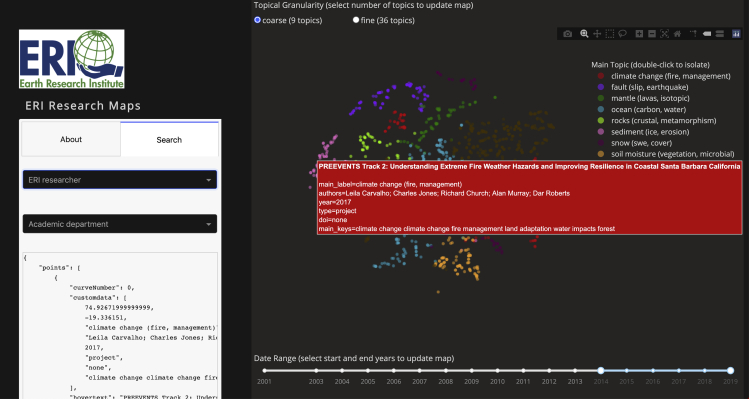
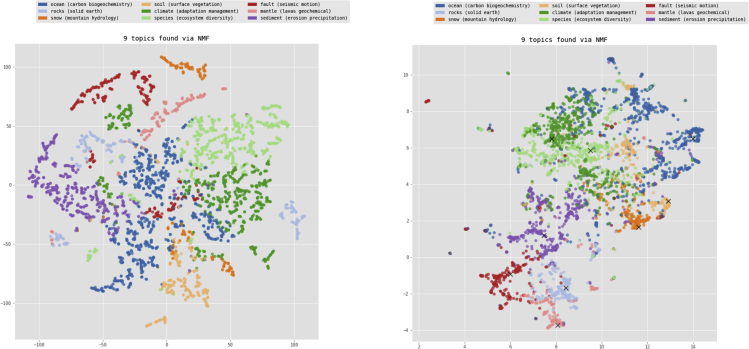
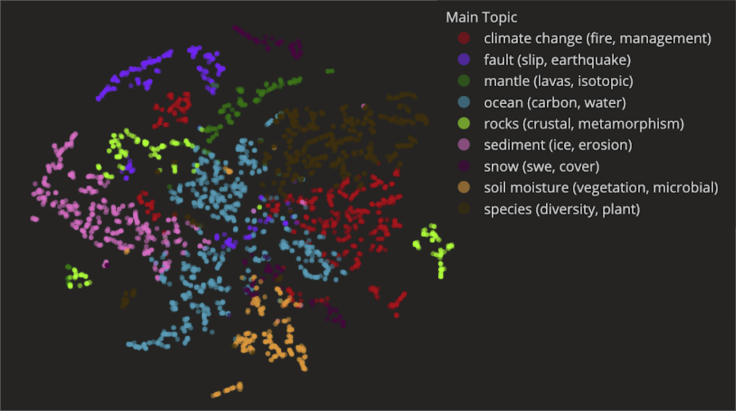
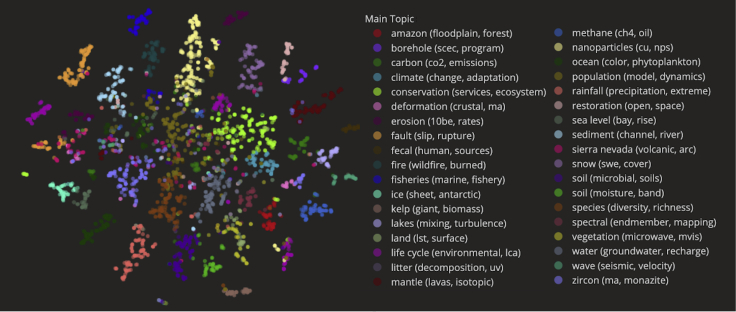
The institutional review of interdisciplinary bodies of research lacks methods to systematically produce higher-level abstractions. Abstraction methods, like the "distant reading" of corpora, are increasingly important for knowledge discovery in the sciences and humanities. We demonstrate how abstraction methods complement the metrics on which research reviews currently rely. We model cross-disciplinary topics of research publications and projects emerging at multiple levels of detail in the context of an institutional review of the Earth Research Institute (ERI) at the University of California at Santa Barbara. From these, we design science maps that reveal the latent thematic structure of ERI's interdisciplinary research and enable reviewers to "read" a body of research at multiple levels of detail. We find that our approach provides decision support and reveals trends that strengthen the institutional review process by exposing regions of thematic expertise, distributions and clusters of work, and the evolution of these aspects.
跨学科研究机构审查缺乏系统生成更高层次抽象概念的方法。像语料库的“远距离阅读”这样的抽象方法,对科学和人文领域的知识发现越来越重要。我们展示了抽象方法如何补充当前研究审查所依赖的指标。我们在加利福尼亚大学圣巴巴拉分校地球研究所(ERI)的机构审查背景下,对不同详细程度的多个层面出现的研究出版物和项目的跨学科主题进行建模。据此,我们设计科学地图,揭示ERI跨学科研究的潜在主题结构,并使审查人员能够在多个详细程度上“阅读”一组研究。我们发现,我们的方法提供决策支持,并通过揭示主题专业领域、工作分布和集群以及这些方面的演变,揭示加强机构审查过程的趋势。