Institute of Biology, Humboldt-Universität zu Berlin, Unter den Linden 6, 10099, Berlin, Germany.
Department of Biology, McGill University, Montreal, QC, H3A 1B1, Canada.
J Comp Physiol A Neuroethol Sens Neural Behav Physiol. 2021 May;207(3):369-379. doi: 10.1007/s00359-021-01470-w. Epub 2021 Mar 10.
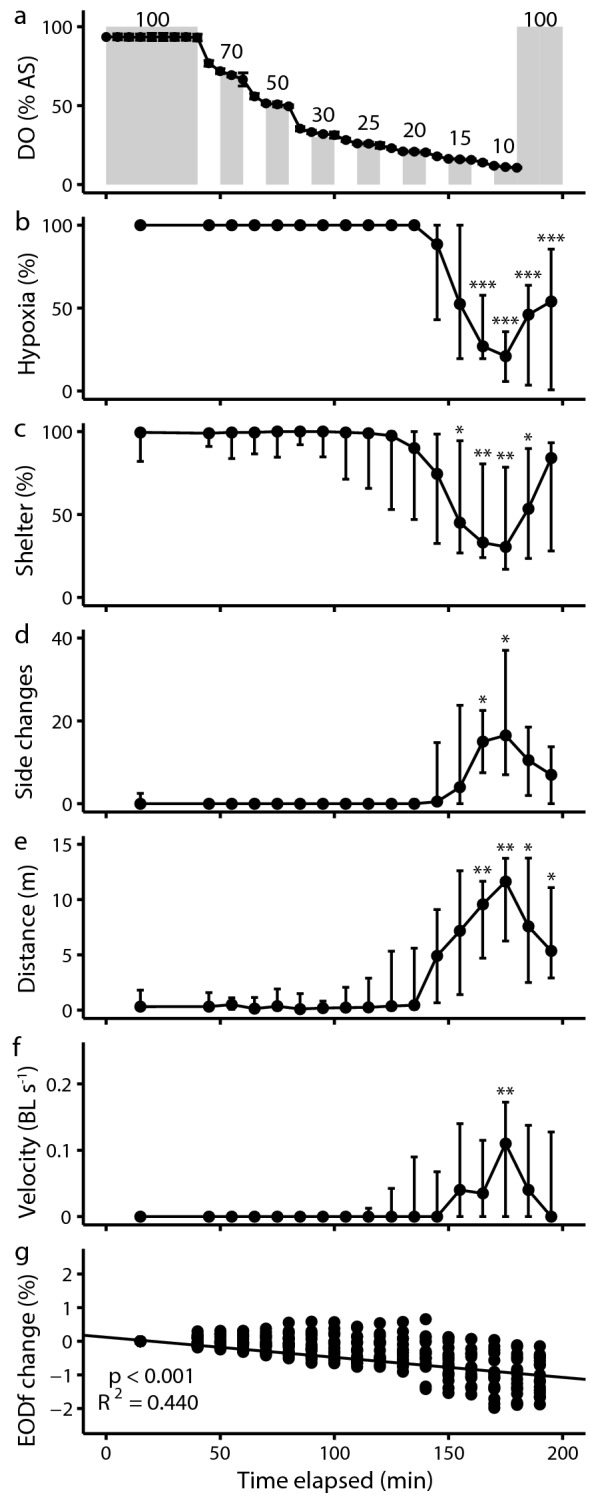
Anthropogenic environmental degradation has led to an increase in the frequency and prevalence of aquatic hypoxia (low dissolved oxygen concentration, DO), which may affect habitat quality for water-breathing fishes. The weakly electric black ghost knifefish, Apteronotus albifrons, is typically found in well-oxygenated freshwater habitats in South America. Using a shuttle-box design, we exposed juvenile A. albifrons to a stepwise decline in DO from normoxia (> 95% air saturation) to extreme hypoxia (10% air saturation) in one compartment and chronic normoxia in the other. On average, A. albifrons actively avoided the hypoxic compartment below 22% air saturation. Hypoxia avoidance was correlated with upregulated swimming activity. Following avoidance, fish regularly ventured back briefly into deep hypoxia. Hypoxia did not affect the frequency of their electric organ discharges. Our results show that A. albifrons is able to sense hypoxia at non-lethal levels and uses active avoidance to mitigate its adverse effects.
人为环境退化导致水生缺氧(溶解氧浓度低)的频率和普遍性增加,这可能会影响水生呼吸鱼类的栖息地质量。弱电黑色刀鱼,Apteronotus albifrons,通常分布在南美洲富含氧气的淡水生境中。使用穿梭箱设计,我们将幼年的 A. albifrons 暴露在一个隔间中的 DO 从正常氧(>95%空气饱和度)到极端缺氧(10%空气饱和度)的逐步下降,而在另一个隔间中则保持慢性正常氧。平均而言,A. albifrons 主动避免低于 22%空气饱和度的缺氧隔间。回避缺氧与游泳活动的上调有关。回避后,鱼会定期短暂冒险回到深缺氧区。缺氧不会影响它们电器官放电的频率。我们的结果表明,A. albifrons 能够在非致死水平下感知缺氧,并通过主动回避来减轻其不利影响。