Zhang Kun-Long, Yuan Hua, Wu Fei-Fei, Pu Xue-Yin, Liu Bo-Zhi, Li Ze, Li Kai-Feng, Liu Hui, Yang Yi, Wang Ya-Yun
Specific Lab for Mitochondrial Plasticity Underlying Nervous System Diseases, National Demonstration Center for Experimental Preclinical Medicine Education, Air Force Medical University, Xi'an, 710032, China.
Department of Rehabilitation Medicine, Xi-Jing Hospital, Air Force Medical University, Xi'an, 710032, China.
Pain Ther. 2021 Jun;10(1):315-332. doi: 10.1007/s40122-021-00252-1. Epub 2021 Mar 22.
The objective of this review is to systematically summarize the consensus on best practices for different NP conditions of the two most commonly utilized noninvasive brain stimulation (NIBS) technologies, repetitive transcranial magnetic stimulation (rTMS), and transcranial direct current stimulation (tDCS).
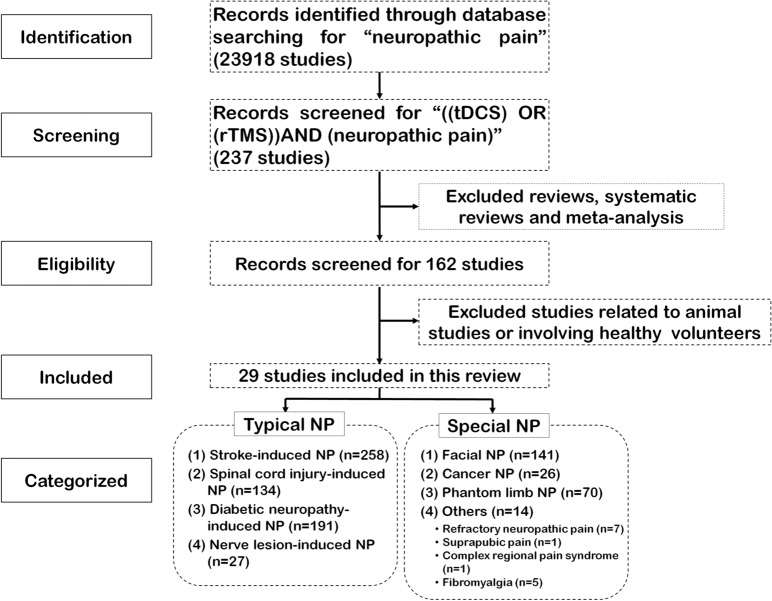
PubMed was searched according to the predetermined keywords and criteria. Only English language studies and studies published up to January 31, 2020 were taken into consideration. Meta-analyses, reviews, and systematic reviews were excluded first, and those related to animal studies or involving healthy volunteers were also excluded. Finally, 29 studies covering 826 NP patients were reviewed.
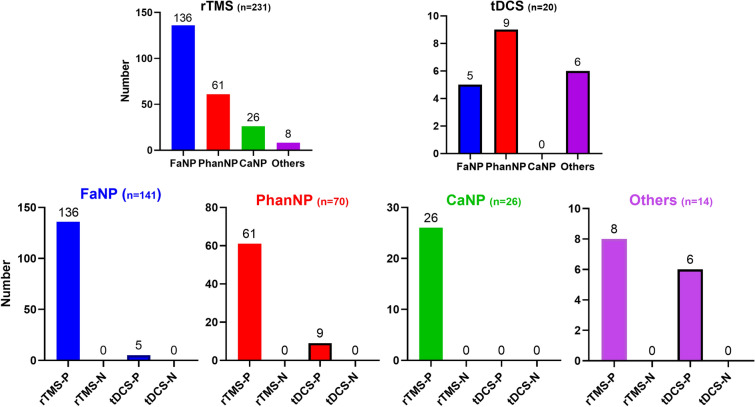
The results from the 24 enrolled studies and 736 NP patients indicate that rTMS successfully relieved the pain symptoms of 715 (97.1%) NP patients. Also, five studies involving 95 NP patients (81.4%) also showed that tDCS successfully relieved NP. In the included studied, the M1 region plays a key role in the analgesic treatment of NIBS. The motor evoked potentials (MEPs), the 10-20 electroencephalography system (EEG 10/20 system), and neuro-navigation methods are used in clinical practice to locate therapeutic targets. Based on the results of the review, the stimulation parameters of rTMS that best induce an analgesic effect are a stimulation frequency of 10-20 Hz, a stimulation intensity of 80-120% of RMT, 1000-2000 pulses, and 5-10 sessions, and the most effective parameters of tDCS are a current intensity of 2 mA, a session duration of 20-30 min, and 5-10 sessions.
Our systematically reviewed the evidence for positive and negative responses to rTMS and tDCS for NP patient care and underscores the analgesic efficacy of NIBS in patients with NP. The treatment of NP should allow the design of optimal treatments for individual patients.
本综述的目的是系统总结两种最常用的非侵入性脑刺激(NIBS)技术,即重复经颅磁刺激(rTMS)和经颅直流电刺激(tDCS),针对不同神经病理性疼痛(NP)情况的最佳实践共识。
根据预先确定的关键词和标准在PubMed上进行检索。仅考虑英文研究以及截至2020年1月31日发表的研究。首先排除荟萃分析、综述和系统评价,同时排除与动物研究相关或涉及健康志愿者的研究。最后,对29项涵盖826例NP患者的研究进行了综述。
来自24项纳入研究的736例NP患者的结果表明,rTMS成功缓解了715例(97.1%)NP患者的疼痛症状。另外,5项涉及95例NP患者(81.4%)的研究也表明tDCS成功缓解了NP。在所纳入的研究中,M1区域在NIBS的镇痛治疗中起关键作用。运动诱发电位(MEP)、10-20脑电图系统(EEG 10/20系统)和神经导航方法在临床实践中用于定位治疗靶点。基于综述结果,最能诱导镇痛效果的rTMS刺激参数为:刺激频率10-20Hz、刺激强度为静息运动阈值(RMT)的80-120%、1000-2000个脉冲以及5-10次治疗,而tDCS最有效的参数为:电流强度2mA、每次治疗持续时间20-30分钟以及5-10次治疗。
我们系统回顾了rTMS和tDCS对NP患者护理的阳性和阴性反应证据,并强调了NIBS对NP患者的镇痛疗效。NP的治疗应允许为个体患者设计最佳治疗方案。