VCA California Veterinary Specialists, Carlsbad, California, USA.
Department of Radiation Medicine and Applied Sciences, University of California San Diego, La Jolla, California, USA.
J Vet Intern Med. 2021 May;35(3):1480-1486. doi: 10.1111/jvim.16086. Epub 2021 Mar 23.
Limited data exist about the use, efficacy, and prognostic factors influencing outcome when CyberKnife is used to treat dogs with intracranial neoplasia.
To determine the prognosis and associated prognostic factors for dogs that were imaged, determined to have primary intracranial tumors, and treated with CyberKnife radiotherapy.
Fifty-nine dogs treated with CyberKnife radiotherapy for primary intracranial tumors.
Retrospective medical record review of cases from January 2010 to June 2016. Data extracted from medical records included signalment, weight, seizure history, tumor location, tumor type (based on imaging), gross tumor volume, planned tumor volume, treatment dates, radiation dose, recurrence, date of death, and cause of death.
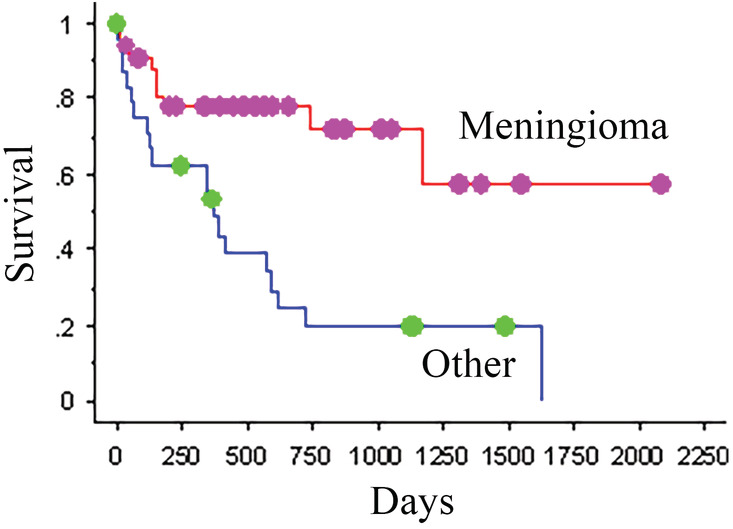
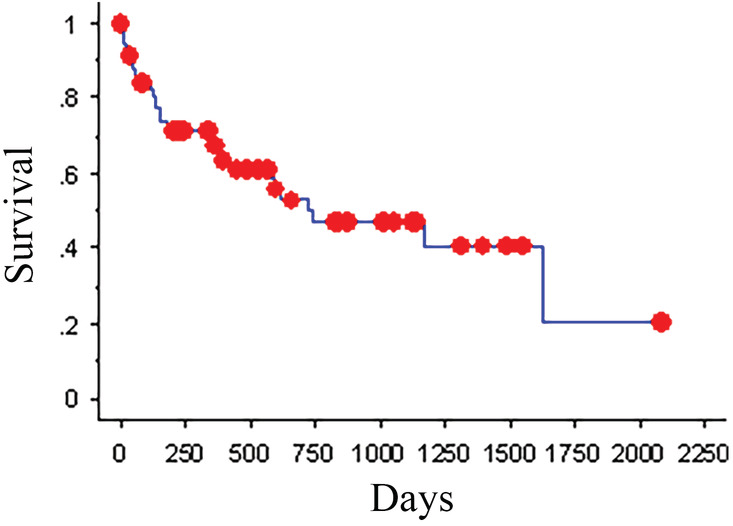
The median progression-free interval (PFI) was 347 days (range 47 to 1529 days), and the median survival time (MST) was 738 days (range 4 to 2079 days). Tumor location was significantly associated with PFI when comparing cerebrum (median PFI 357 days; range 47-1529 days) versus cerebellum (median PFI 97 days; range 97-168 days) versus brainstem (median PFI 266 days; range 30-1484 days), P = .03. Additionally, the presumed tumor type was significantly associated with MST (P < .001).
Use of Cyberknife and SRT might improve MST, compared with RT, in dogs with intracranial neoplasia.
有关使用 CyberKnife 治疗颅内肿瘤的犬的疗效和预后因素的数据有限。
确定接受 CyberKnife 放射治疗的犬的预后及其相关预后因素,这些犬被诊断为原发性颅内肿瘤。
59 只接受 CyberKnife 放射治疗的原发性颅内肿瘤犬。
对 2010 年 1 月至 2016 年 6 月期间的病例进行回顾性病历审查。从病历中提取的数据包括品种、体重、癫痫发作史、肿瘤位置、肿瘤类型(基于影像学)、大体肿瘤体积、计划肿瘤体积、治疗日期、辐射剂量、复发、死亡日期和死亡原因。
无进展间隔的中位数(PFI)为 347 天(范围 47 至 1529 天),中位生存期(MST)为 738 天(范围 4 至 2079 天)。当比较大脑(PFI 中位数 357 天;范围 47-1529 天)与小脑(PFI 中位数 97 天;范围 97-168 天)与脑干(PFI 中位数 266 天;范围 30-1484 天)时,肿瘤位置与 PFI 显著相关,P =.03。此外,假定的肿瘤类型与 MST 显著相关(P <.001)。
与 RT 相比,使用 Cyberknife 和 SRT 可能会提高颅内肿瘤犬的 MST。