Key Laboratory of Arrhythmias, Ministry of Education, Shanghai East Hospital, Tongji University School of Medicine, Shanghai, China.
Department of Cardiology, Shanghai East Hospital, Tongji University School of Medicine, Shanghai, China.
J Cell Mol Med. 2021 May;25(10):4732-4743. doi: 10.1111/jcmm.16437. Epub 2021 Mar 23.
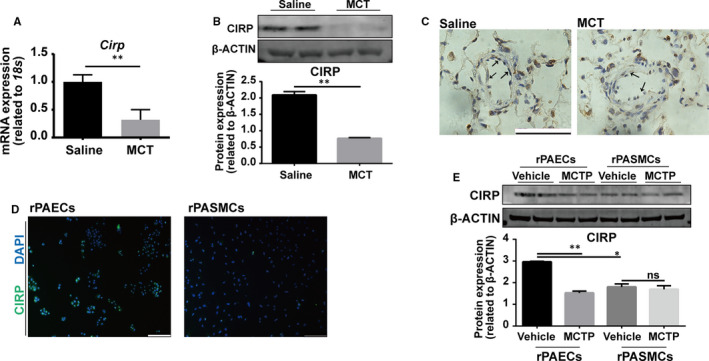
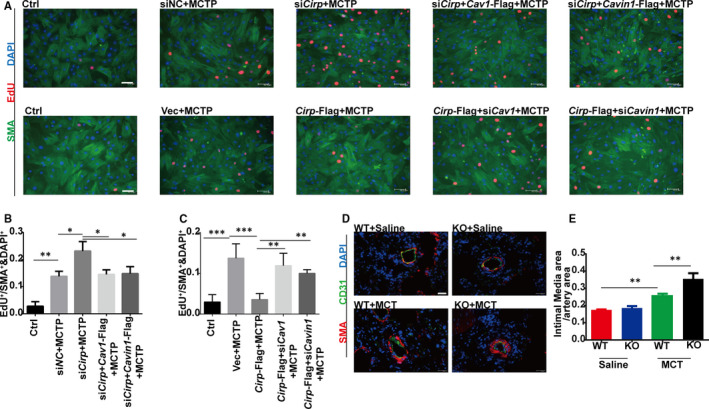
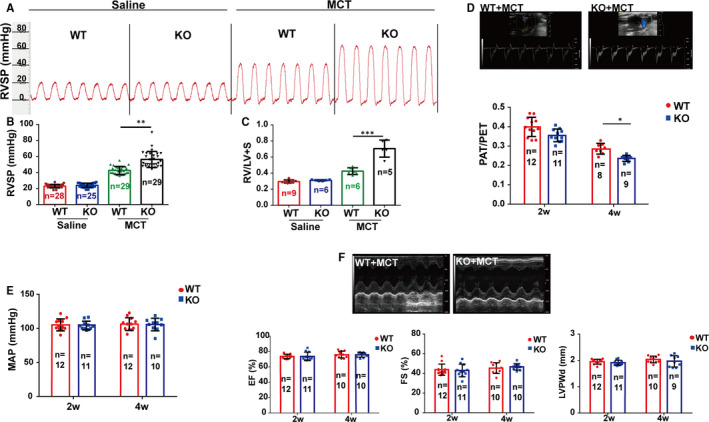
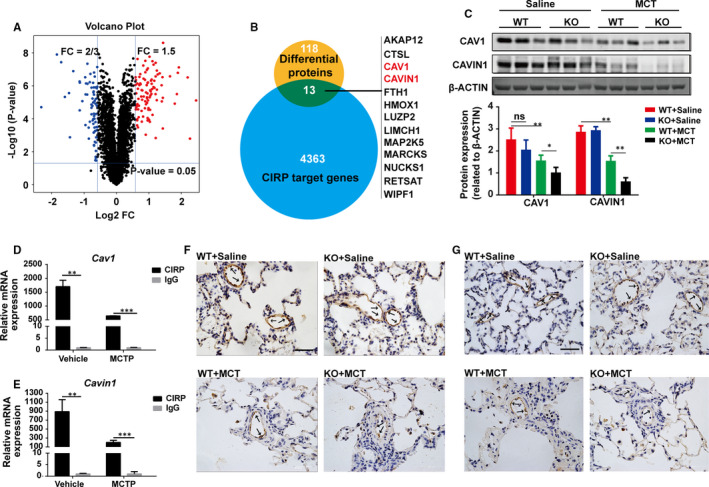
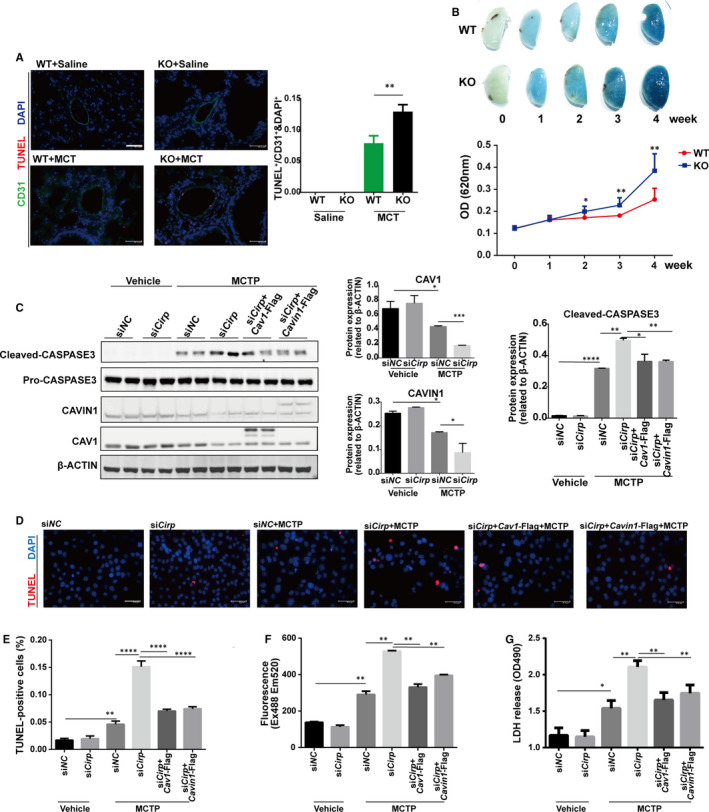
Cold-inducible RNA-binding protein (CIRP) was a crucial regulator in multiple diseases. However, its role in pulmonary artery hypertension (PAH) is still unknown. Here, we first established monocrotaline (MCT)-induced rat PAH model and discovered that CIRP was down-regulated predominantly in the endothelium of pulmonary artery after MCT injection. We then generated Cirp-knockout (Cirp-KO) rats, which manifested severer PAH with exacerbated endothelium damage in response to MCT. Subsequently, Caveolin1 (Cav1) and Cavin1 were identified as downstream targets of CIRP in MCT-induced PAH, and the decreased expression of these two genes aggravated the injury and apoptosis of pulmonary artery endothelium. Moreover, CIRP deficiency intensified monocrotaline pyrrole (MCTP)-induced rat pulmonary artery endothelial cells (rPAECs) injuries both in vivo and in vitro, which was counteracted by Cav1 or Cavin1 overexpression. In addition, CIRP regulated the proliferative effect of conditioned media from MCTP-treated rPAECs on rat pulmonary artery smooth muscle cells, which partially explained the exceedingly thickened pulmonary artery intimal media in Cirp-KO rats after MCT treatment. These results demonstrated that CIRP acts as a critical protective factor in MCT-induced rat PAH by directly regulating CAV1 and CAVIN1 expression, which may facilitate the development of new therapeutic targets for the intervention of PAH.
冷诱导 RNA 结合蛋白(CIRP)是多种疾病的关键调节因子。然而,其在肺动脉高压(PAH)中的作用尚不清楚。在这里,我们首先建立了野百合碱(MCT)诱导的大鼠 PAH 模型,并发现 MCT 注射后,CIRP 主要在肺动脉内皮中下调。然后,我们生成了 Cirp 基因敲除(Cirp-KO)大鼠,其在 MCT 反应中表现出更严重的 PAH 和加剧的内皮损伤。随后,鉴定出 CAV1 和 Cavin1 是 MCT 诱导的 PAH 中 CIRP 的下游靶标,这两个基因的表达减少加重了肺动脉内皮的损伤和凋亡。此外,CIRP 缺乏加剧了 MCTP 诱导的大鼠肺动脉内皮细胞(rPAECs)在体内和体外的损伤,而 Cav1 或 Cavin1 的过表达则拮抗了这一损伤。此外,CIRP 调节了 MCTP 处理的 rPAECs 条件培养基对大鼠肺动脉平滑肌细胞的增殖作用,这部分解释了 MCT 处理后 Cirp-KO 大鼠中肺动脉内膜中层极度增厚的原因。这些结果表明,CIRP 通过直接调节 CAV1 和 CAVIN1 的表达,在 MCT 诱导的大鼠 PAH 中发挥关键的保护作用,这可能为干预 PAH 提供新的治疗靶点。