Department of Pediatric Hematology and Oncology, St. Anna Children's Hospital, Vienna, Austria.
Department of Pediatrics and Adolescent Medicine, Medical University of Vienna, Vienna, Austria.
Cancer Rep (Hoboken). 2021 Oct;4(5):e1375. doi: 10.1002/cnr2.1375. Epub 2021 Mar 23.
Management of pediatric post-transplantation lymphoproliferative disorder (PTLD) after hematopoietic stem cell (HSCT) and solid organ transplantation (SOT) is challenging.
This study of 34 PTLD patients up to 19-years old diagnosed in Austria from 2000 to 2018 aimed at assessing initial characteristics, therapy, response, and outcome as well as prognostic markers of this rare pediatric disease.
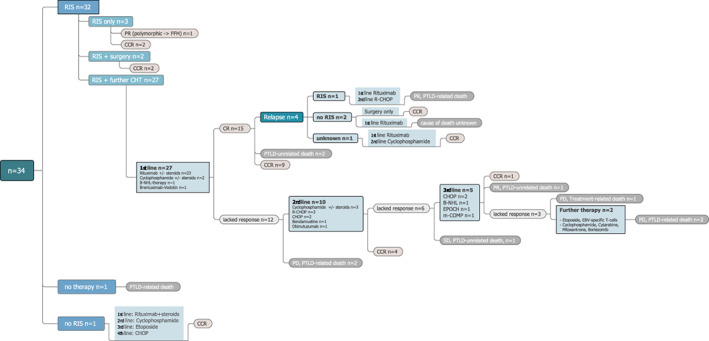
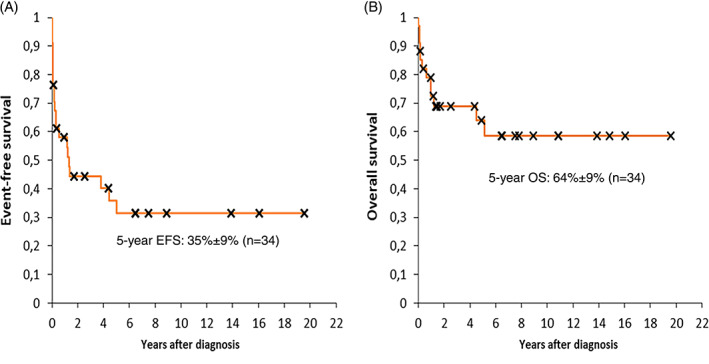
A retrospective data analysis was performed. Types of allografts were kidney (n = 12), liver (n = 7), heart (n = 5), hematopoietic stem cells (n = 4), lungs (n = 2), multi-visceral (n = 2), small intestine (n = 1), and vessels (n = 1). Eighteen/34 were classified as monomorphic PTLD, with DLBCL accounting for 15 cases. Polymorphic disease occurred in nine, and non-destructive lesions in six cases. One patient had a non-classifiable PTLD. Thirteen/34 patients are surviving event-free in first remission (non-destructive, n = 4/6; polymorphic, n = 4/9; monomorphic, n = 6/18). Fourteen/34 patients lacked complete response to first-line therapy, of whom seven died. Four/34 patients relapsed, of whom two died. In 3/34 patients, death occurred as a first event. The 5-year overall and event-free survival rates were 64% ± 9% and 35% ± 9% for the whole cohort. Among all parameters analyzed, only malignant disease as the indication for transplantation had a significantly poor influence on survival.
This study shows PTLD still to be a major cause of mortality following SOT or HSCT in children. A continued understanding of the molecular biology of the disease shall allow to decrease treatment intensity for lower risk patients and to identify patients who may benefit from newer therapy approaches to improve outcome and decrease morbidity.
造血干细胞(HSCT)和实体器官移植(SOT)后儿童移植后淋巴组织增生性疾病(PTLD)的治疗具有挑战性。
本研究回顾性分析了 2000 年至 2018 年在奥地利诊断的 34 例 19 岁以下的 PTLD 患者,旨在评估这种罕见儿科疾病的初始特征、治疗、反应和结果以及预后标志物。
进行了回顾性数据分析。同种异体移植物的类型为肾脏(n=12)、肝脏(n=7)、心脏(n=5)、造血干细胞(n=4)、肺(n=2)、多脏器(n=2)、小肠(n=1)和血管(n=1)。34 例中的 18 例被归类为单形性 PTLD,其中 15 例为弥漫性大 B 细胞淋巴瘤。9 例为多形性疾病,6 例为非破坏性病变。1 例患者为非典型性 PTLD。34 例患者中有 13 例在首次缓解中无事件生存(非破坏性,n=4/6;多形性,n=4/9;单形性,n=6/18)。14 例患者对一线治疗无完全反应,其中 7 例死亡。34 例中有 4 例患者复发,其中 2 例死亡。在 34 例患者中,有 3 例患者死亡为首发事件。全组 5 年总生存率和无事件生存率分别为 64%±9%和 35%±9%。在分析的所有参数中,只有恶性疾病作为移植适应证对生存有显著不良影响。
本研究表明,PTLD 仍然是儿童 SOT 或 HSCT 后死亡的主要原因。对疾病分子生物学的进一步了解,将允许降低低危患者的治疗强度,并确定可能受益于新治疗方法的患者,以改善预后并降低发病率。