Technical University of Munich, Lehrstuhl für Grünlandlehre, Alte Akademie 12, 85354, Freising-Weihenstephan, Germany.
Rothamsted Research, Sustainable Agriculture Sciences Department, Harpenden, Hertfordshire, AL5 2JQ, UK.
BMC Biol. 2021 Mar 24;19(1):50. doi: 10.1186/s12915-021-00988-4.
The anthropogenic increase of atmospheric CO concentration (c) is impacting carbon (C), water, and nitrogen (N) cycles in grassland and other terrestrial biomes. Plant canopy stomatal conductance is a key player in these coupled cycles: it is a physiological control of vegetation water use efficiency (the ratio of C gain by photosynthesis to water loss by transpiration), and it responds to photosynthetic activity, which is influenced by vegetation N status. It is unknown if the c-increase and climate change over the last century have already affected canopy stomatal conductance and its links with C and N processes in grassland.
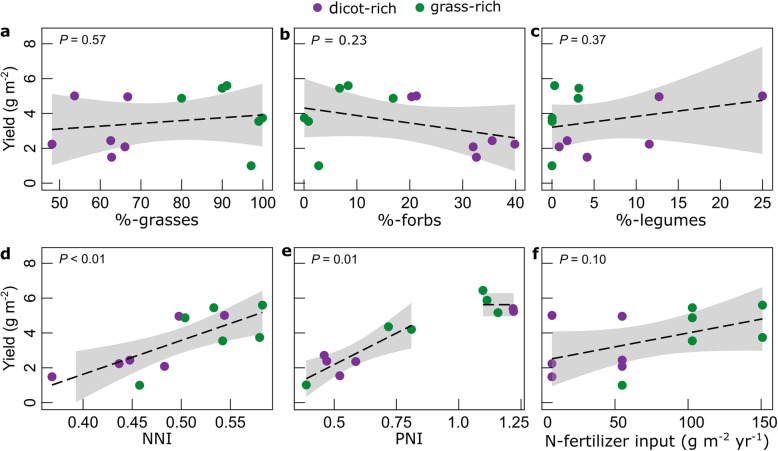
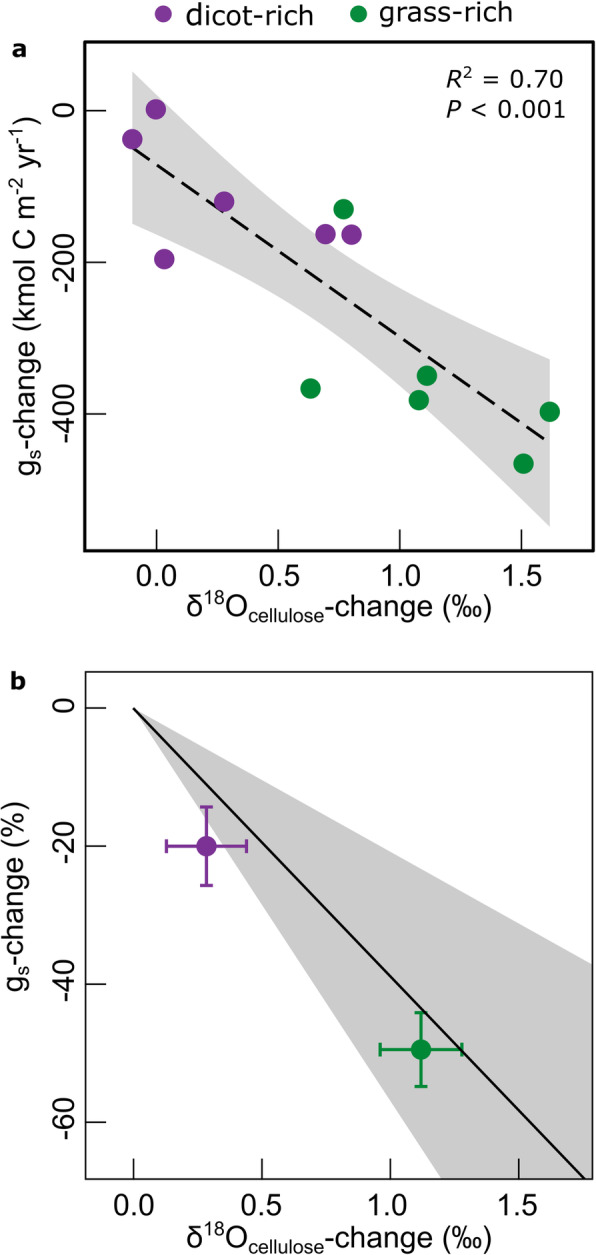
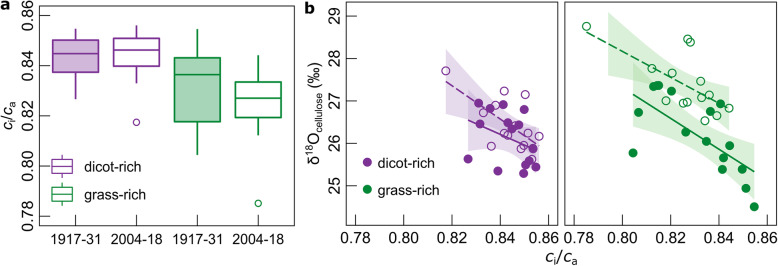
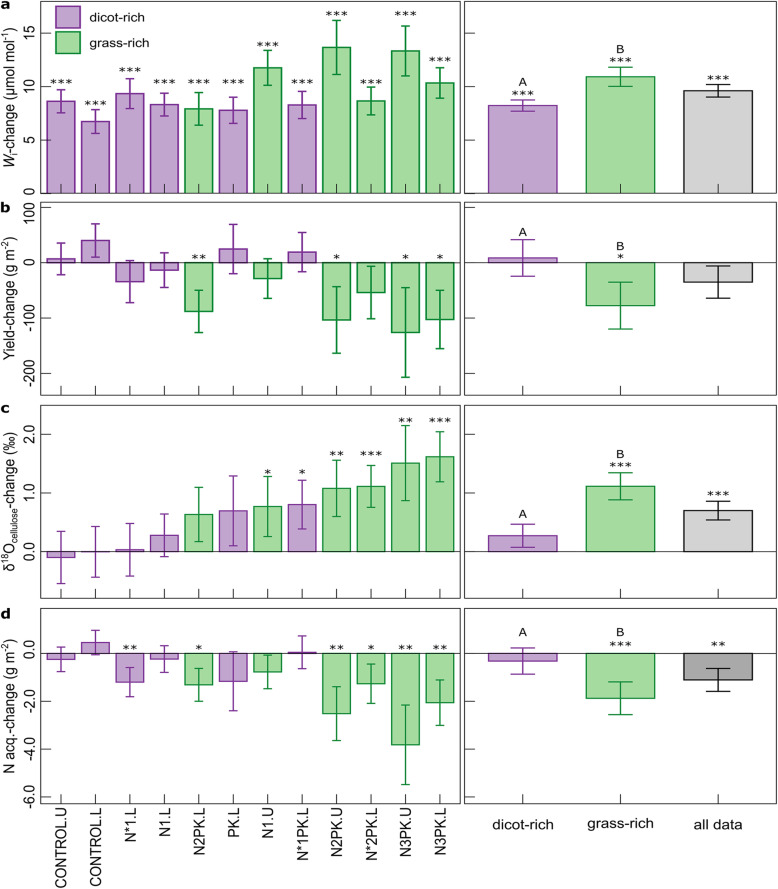
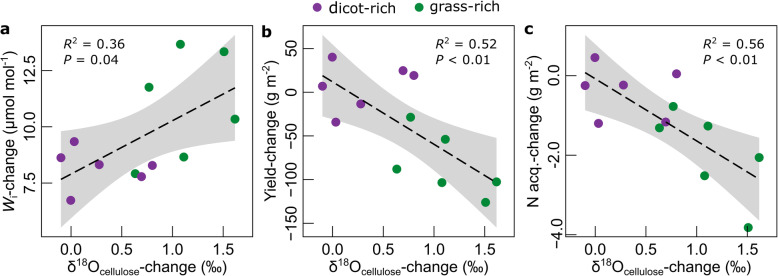
Here, we assessed two independent proxies of (growing season-integrating canopy-scale) stomatal conductance changes over the last century: trends of δO in cellulose (δO) in archived herbage from a wide range of grassland communities on the Park Grass Experiment at Rothamsted (U.K.) and changes of the ratio of yields to the CO concentration gradient between the atmosphere and the leaf internal gas space (c - c). The two proxies correlated closely (R = 0.70), in agreement with the hypothesis. In addition, the sensitivity of δO changes to estimated stomatal conductance changes agreed broadly with published sensitivities across a range of contemporary field and controlled environment studies, further supporting the utility of δO changes for historical reconstruction of stomatal conductance changes at Park Grass. Trends of δO differed strongly between plots and indicated much greater reductions of stomatal conductance in grass-rich than dicot-rich communities. Reductions of stomatal conductance were connected with reductions of yield trends, nitrogen acquisition, and nitrogen nutrition index. Although all plots were nitrogen-limited or phosphorus- and nitrogen-co-limited to different degrees, long-term reductions of stomatal conductance were largely independent of fertilizer regimes and soil pH, except for nitrogen fertilizer supply which promoted the abundance of grasses.
Our data indicate that some types of temperate grassland may have attained saturation of C sink activity more than one century ago. Increasing N fertilizer supply may not be an effective climate change mitigation strategy in many grasslands, as it promotes the expansion of grasses at the disadvantage of the more CO responsive forbs and N-fixing legumes.
大气 CO 浓度(c)的人为增加正在影响草原和其他陆地生物群落中的碳(C)、水和氮(N)循环。植物冠层气孔导度是这些耦合循环中的关键因素:它是植被水分利用效率的生理控制(光合作用获得的 C 与蒸腾作用损失的水的比值),并响应于受植被 N 状况影响的光合作用活性。目前尚不清楚上个世纪的 c 增加和气候变化是否已经影响了草原的冠层气孔导度及其与 C 和 N 过程的联系。
在这里,我们评估了过去一个世纪来(综合生长季节尺度的)冠层气孔导度变化的两个独立指标:罗瑟姆斯特德(英国)草地实验中广泛的草原群落的存档草料中纤维素(δO)中 δO 的趋势和大气与叶片内部气体空间之间 CO 浓度梯度的产量比(c - c)的变化。这两个指标密切相关(R=0.70),与假设一致。此外,δO 变化对估计的气孔导度变化的敏感性与一系列当代田间和受控环境研究中公布的敏感性基本一致,这进一步支持了 δO 变化在罗瑟姆斯特德历史上重建气孔导度变化的实用性。δO 趋势在斑块之间差异很大,表明在富含草的群落中气孔导度的降低幅度远大于富含双子叶植物的群落。气孔导度的降低与产量趋势、氮素获取和氮素营养指数的降低有关。尽管所有斑块都受到不同程度的氮限制或磷和氮共同限制,但长期气孔导度的降低与肥料制度和土壤 pH 基本无关,除了氮肥供应促进了草的丰度。
我们的数据表明,一个多世纪前,某些类型的温带草原可能已经达到了 C 汇活性的饱和。在许多草原中,增加氮肥供应可能不是一种有效的气候变化缓解策略,因为它促进了禾本科植物的扩张,而不利于对 CO 更敏感的草本植物和固氮豆科植物。