Aslani Hassan, Pashmtab Parisa, Shaghaghi Abdolreza, Mohammadpoorasl Asghar, Taghipour Hassan, Zarei Mahsa
Health and Environment Research Center, Tabriz University of Medical Sciences, Tabriz, Iran.
Department of Environmental Health Engineering, Tabriz University of Medical Sciences, Tabriz, Iran.
Health Promot Perspect. 2021 Feb 7;11(1):60-68. doi: 10.34172/hpp.2021.09. eCollection 2021.
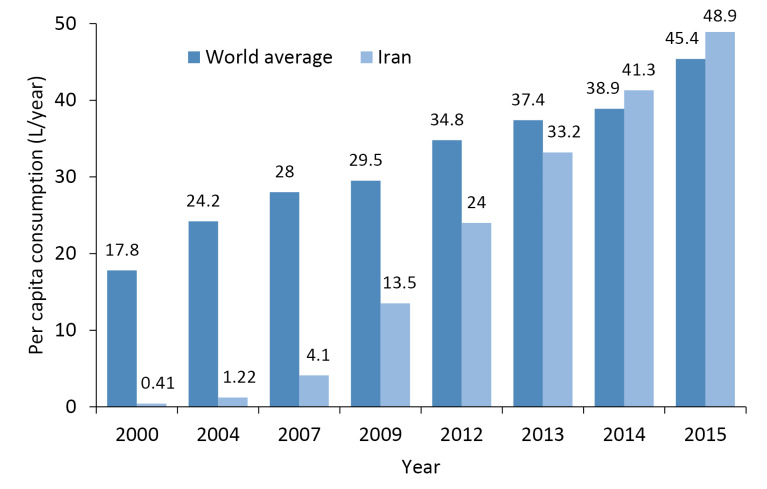
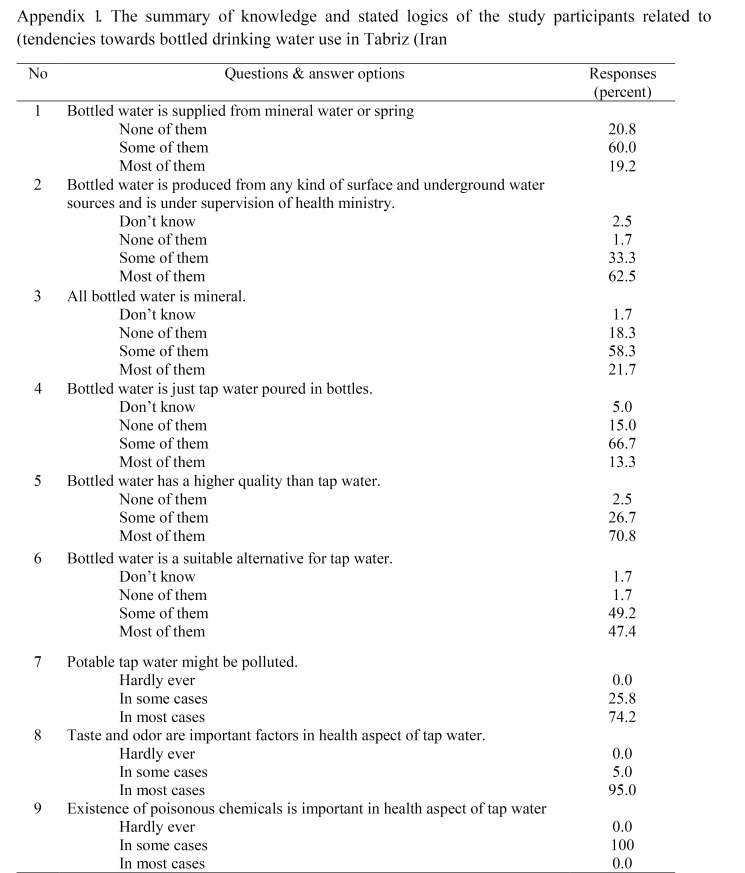
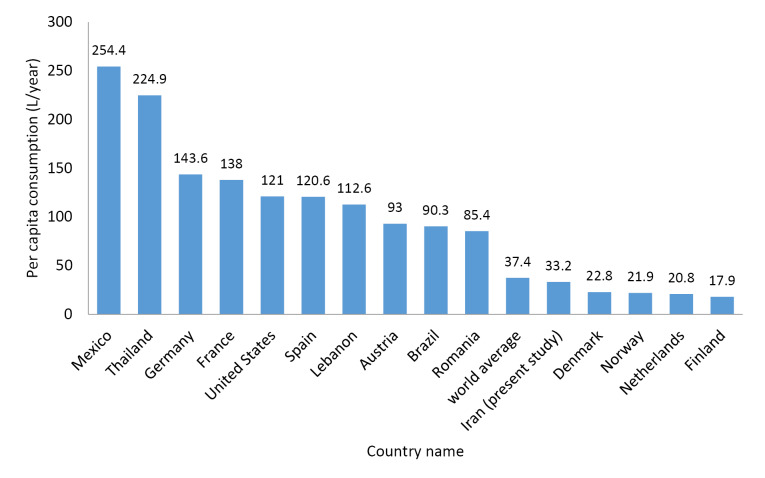
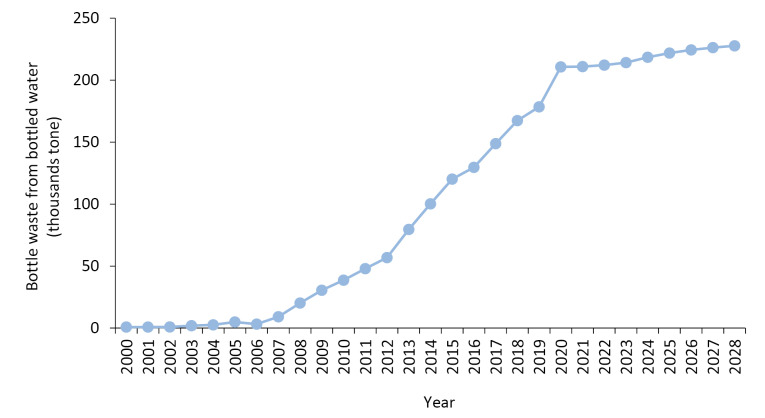
The main objective of this study was to investigate the logics behind tendencies towards bottled drinking water usage in spite of availability of treated tap water. The amount of waste bottle is also estimated in Iran and managing principles for resolving the issue presented. A questionnaire was used to survey the logics behind tendencies toward bottled drinking water consumption among 120 participants. In order to estimate the quantities of the PET wastes produced in the country, data about bottled water production rate as well as volume of the imported and exported drinking bottled water were collected from 1962 to 2015 and applied in the calculations. Findings suggested that about 0.026 to 3.86 billion liters (about 1.04 billion literson average) of bottled water was consumed annually between 2000 and 2015. Furthermore, bottled water consumption increased from 0.41 to 48.9 L/capita-year within the same time period. In the meantime, the plastic bottle waste generation rate rose from 12.84 to 1519.38 g/capita-year. There is no efficient and suitable system for managing and recycling waste bottles in the country. The perceived unreliability of tap water quality was the main reason of bottled water consumption among 74% of the respondents. To reduce bottled water consumption and the associated harmful environmental and health consequences, measures such as informing people, validating public water supply quality, preventive rules enactment, and establishing extended producer responsibility (EPR) are highly recommended.
本研究的主要目的是调查尽管有经过处理的自来水供应,但人们仍倾向于使用瓶装饮用水背后的逻辑。同时还估算了伊朗废瓶的数量,并提出了解决该问题的管理原则。通过问卷调查了120名参与者选择瓶装饮用水消费背后的逻辑。为了估算该国产生的聚对苯二甲酸乙二酯(PET)废物量,收集了1962年至2015年瓶装水生产率以及进出口瓶装饮用水量的数据,并将其应用于计算。研究结果表明,2000年至2015年期间,每年瓶装水消费量约为0.026至38.6亿升(平均约10.4亿升)。此外,同一时期内人均瓶装水消费量从0.41升/年增加到48.9升/年。与此同时,塑料瓶废物产生率从12.84克/人·年上升到1519.38克/人·年。该国没有高效且合适的废瓶管理和回收系统。74%的受访者表示,认为自来水水质不可靠是他们消费瓶装水的主要原因。为了减少瓶装水消费及其对环境和健康造成的有害影响,强烈建议采取诸如向人们宣传、验证公共供水质量、制定预防规则以及建立生产者延伸责任(EPR)等措施。