Department of Neurology, Helsinki University Hospital and University of Helsinki, Haartmaninkatu 4, 00290, Helsinki, Finland.
Department of Neurosurgery, Helsinki University Hospital and University of Helsinki, Topeliuksenkatu 5, 00260, Helsinki, Finland.
Acta Neurochir (Wien). 2021 May;163(5):1391-1401. doi: 10.1007/s00701-021-04808-0. Epub 2021 Mar 23.
The role of coagulopathy in patients with traumatic brain injury has remained elusive. In the present study, we aim to assess the prevalence of coagulopathy in patients with traumatic intracranial hemorrhage, their clinical features, and the effect of coagulopathy on treatment and mortality.
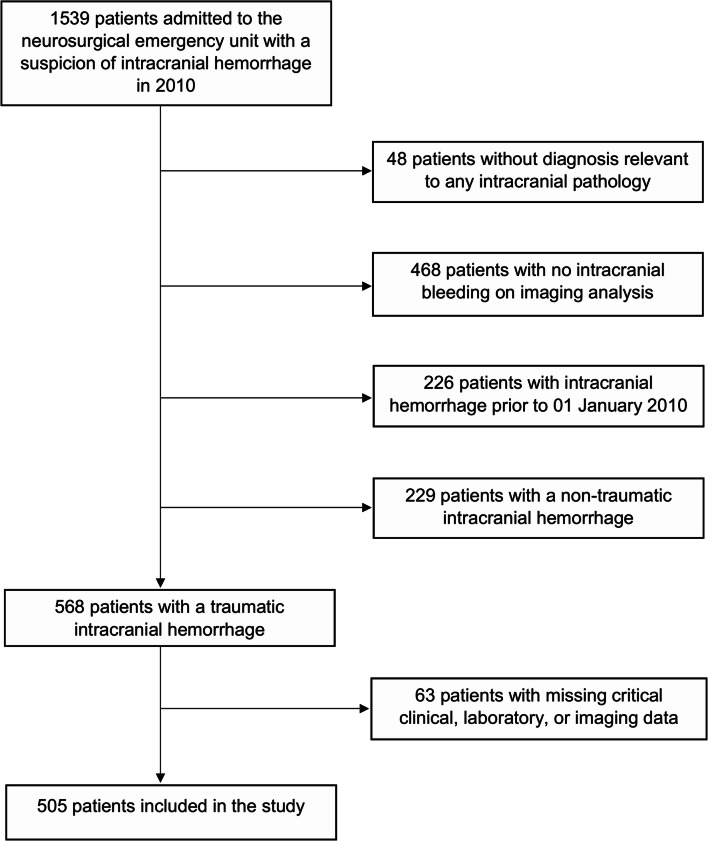
An observational, retrospective single-center cohort of consecutive patients with traumatic intracranial hemorrhage treated at Helsinki University Hospital between 01 January and 31 December 2010. We compared clinical and radiological parameters in patients with and without coagulopathy defined as drug- or disease-induced, i.e., antiplatelet or anticoagulant medication at a therapeutic dose, thrombocytopenia (platelet count < 100 E9/L), international normalized ratio > 1.2, or thromboplastin time < 60%. Primary outcome was 30-day all-cause mortality. Logistic regression analysis allowed to assess for factors associated with coagulopathy and mortality.
Of our 505 patients (median age 61 years, 65.5% male), 206 (40.8%) had coagulopathy. Compared to non-coagulopathy patients, coagulopathy patients had larger hemorrhage volumes (mean 140.0 mL vs. 98.4 mL, p < 0.001) and higher 30-day mortality (18.9% vs. 9.7%, p = 0.003). In multivariable analysis, older age, lower admission Glasgow Coma Scale score, larger hemorrhage volume, and conservative treatment were independently associated with mortality. Surgical treatment was associated with lower mortality in both patients with and without coagulopathy.
Coagulopathy was more frequent in patients with traumatic intracranial hemorrhage presenting larger hemorrhage volumes compared to non-coagulopathy patients but was not independently associated with higher 30-day mortality. Hematoma evacuation, in turn, was associated with lower mortality irrespective of coagulopathy.
凝血障碍在创伤性脑损伤患者中的作用仍不清楚。本研究旨在评估创伤性颅内出血患者凝血障碍的发生率、临床特征以及凝血障碍对治疗和死亡率的影响。
这是一项在赫尔辛基大学医院于 2010 年 1 月 1 日至 12 月 31 日期间连续收治的创伤性颅内出血患者中进行的观察性、回顾性单中心队列研究。我们比较了有和无凝血障碍的患者的临床和影像学参数,凝血障碍定义为药物或疾病引起的,即使用治疗剂量的抗血小板或抗凝药物、血小板计数<100×10^9/L、国际标准化比值>1.2 或凝血酶原时间<60%。主要结局为 30 天全因死亡率。逻辑回归分析用于评估与凝血障碍和死亡率相关的因素。
在我们的 505 名患者(中位年龄 61 岁,65.5%为男性)中,206 名(40.8%)有凝血障碍。与非凝血障碍患者相比,凝血障碍患者的出血量更大(平均 140.0 毫升比 98.4 毫升,p<0.001),30 天死亡率更高(18.9%比 9.7%,p=0.003)。多变量分析显示,年龄较大、入院格拉斯哥昏迷量表评分较低、出血量大和保守治疗与死亡率独立相关。手术治疗与凝血障碍患者和非凝血障碍患者的死亡率降低均相关。
与非凝血障碍患者相比,创伤性颅内出血患者的凝血障碍更常见,且出血量更大,但与较高的 30 天死亡率无独立相关性。血肿清除术无论凝血障碍与否,均与死亡率降低相关。