Department of Biomedical Sciences, College of Veterinary Medicine, University of Missouri, Columbia, Missouri and Dalton Cardiovascular Research Center, University of Missouri, Columbia, Missouri.
J Neurophysiol. 2021 May 1;125(5):1543-1551. doi: 10.1152/jn.00088.2021. Epub 2021 Mar 24.
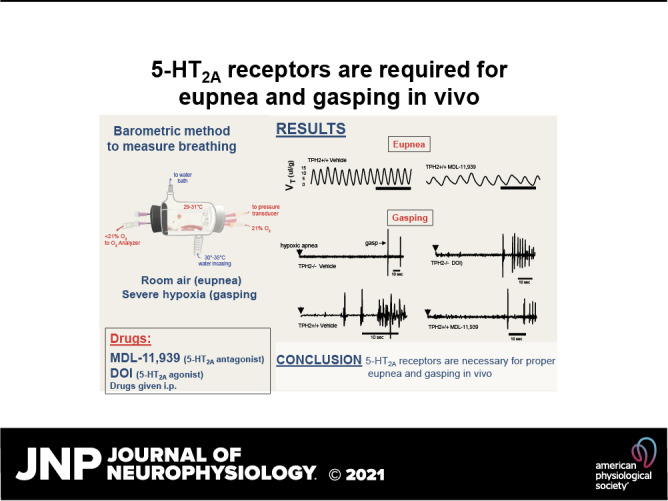
Eupnea and gasping in infancy depend on central nervous system (CNS) serotonin (5-hydroxytryptamine; 5-HT). Although previous in vitro preparations have provided some evidence that 5-HT acts through type 2 A receptors (5-HT) to facilitate eupnea and gasping, here the hypothesis addressed is that 5-HT receptor activation is necessary for eupnea and the proper generation of gasping in vivo. To test this, we administered 2,5-dimethoxy-4-iodoamphetamine (DOI; 0.25 mg/kg i.p.), a 5-HT agonist, 8-hydroxy-2-(di--propylamino)tetralin (8-OH-DPAT; 0.25 mg/kg i.p.), a 5-HT agonist, or vehicle (saline) to 7-9-day-old tryptophan hydroxylase 2 knockout (TPH2) mice. A second experiment assessed the effect of MDL-11,939 (MDL; 10 mg/kg i.p.), the specific 5-HT antagonist, or vehicle (DMSO) on the gasping of wild-type (TPH2) animals. Drugs were given 15 min prior to five episodes of severe hypoxia that elicited gasping. TPH2 breathed more slowly but had the same V̇e and V̇e/V̇o compared with TPH2. As previously reported, the gasping of TPH2 was significantly delayed ( < 0.001) and occurred at a significantly lower frequency compared with TPH2 ( = 0.04). For both genotypes, DOI hastened eupneic frequency but had no effect on V̇e or V̇e/V̇o. The gasping of TPH2, although unaffected by 8-OH-DPAT, was indistinguishable from the gasping of TPH2 following DOI. In TPH2, application of MDL led to hypoventilation ( = 0.01), a delay in the appearance of gasping ( = 0.005), and reduced gasp frequency ( = 0.05). These data show that, in vivo, 5-HT receptors facilitate both eupnea and gasping. As has been shown in vitro, 5-HT probably promotes gasping by exciting hypoxia-resistant pacemaker neurons. Previous in vitro studies suggest that 5-HT receptors contribute to eupnea and are necessary for fictive gasping. The current study shows that the impaired gasping displayed by neonatal TPH2 mice, deficient in CNS serotonin, is restored by 5-HT receptor activation. Following 5-HT blockade, wild-type mice hypoventilated and their gasping resembled that of TPH2 mice. This study shows that both eupnea and gasping in vivo rely on the activation of 5-HT receptors.
婴儿的呼吸和喘息依赖于中枢神经系统(CNS)的 5-羟色胺(5-HT)。尽管之前的体外研究提供了一些证据表明 5-HT 通过 2A 型受体(5-HT)发挥作用,促进呼吸和喘息,但这里提出的假设是,5-HT 受体的激活对于呼吸和喘息的正常产生是必要的。为了验证这一点,我们给 7-9 天大的色氨酸羟化酶 2 敲除(TPH2)小鼠注射 2,5-二甲氧基-4-碘苯丙胺(DOI;0.25mg/kg 腹腔注射),一种 5-HT 激动剂,8-羟基-2-(二--丙基氨基)四氢萘(8-OH-DPAT;0.25mg/kg 腹腔注射),一种 5-HT 激动剂,或载体(生理盐水)。第二个实验评估了 MDL-11,939(MDL;10mg/kg 腹腔注射),一种特定的 5-HT 拮抗剂,或载体(DMSO)对野生型(TPH2)动物喘息的影响。药物在五次严重缺氧引起喘息的发作前 15 分钟给予。TPH2 呼吸更慢,但与 TPH2 相比,VE 和 VE/VO 相同。如前所述,TPH2 的喘息明显延迟(<0.001),且频率明显低于 TPH2(=0.04)。对于两种基因型,DOI 均加速了呼吸频率,但对 VE 或 VE/VO 无影响。尽管 8-OH-DPAT 对 TPH2 的喘息没有影响,但它与 DOI 后 TPH2 的喘息无法区分。在 TPH2 中,应用 MDL 导致通气不足(=0.01),喘息出现延迟(=0.005),喘息频率降低(=0.05)。这些数据表明,在体内,5-HT 受体促进呼吸和喘息。与体外研究一样,5-HT 可能通过兴奋缺氧抗性起搏神经元来促进喘息。之前的体外研究表明,5-HT 受体有助于呼吸,并对虚拟喘息是必要的。本研究表明,中枢神经系统 5-HT 缺乏的新生 TPH2 小鼠的喘息受损,通过 5-HT 受体激活得到恢复。5-HT 阻断后,野生型小鼠通气不足,其喘息类似于 TPH2 小鼠。这项研究表明,体内的呼吸和喘息都依赖于 5-HT 受体的激活。