Department of Radiotherapy and Oncology, University Hospital Frankfurt, Goethe University, Frankfurt, Germany.
German Cancer Research Center (DKFZ), Heidelberg, Germany.
Eur Arch Otorhinolaryngol. 2021 Nov;278(11):4411-4421. doi: 10.1007/s00405-021-06652-5. Epub 2021 Mar 24.
Salivary gland carcinomas (SGC) cover a heterogeneous group of malignancies with a lack of data of high-level evidence.
Clinical data of 127 patients treated for SGC at a university cancer center between 2002 and 2017 were analyzed retrospectively. The association of clinicopathological characteristics, treatment modalities, adverse events, and outcome was assessed.
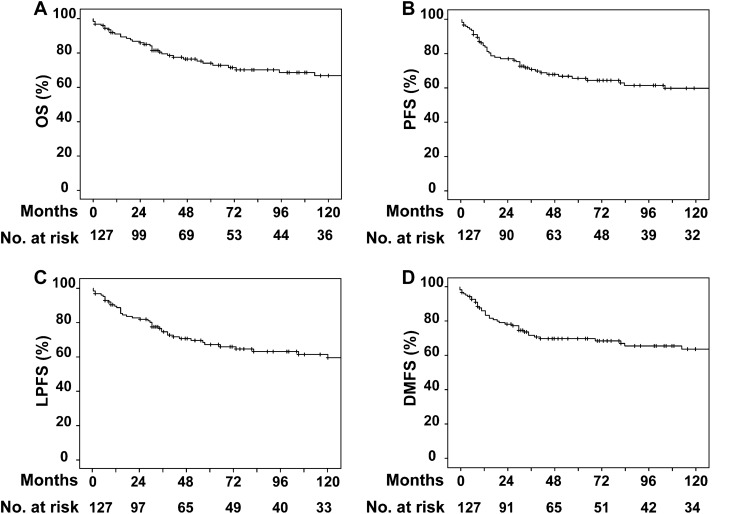
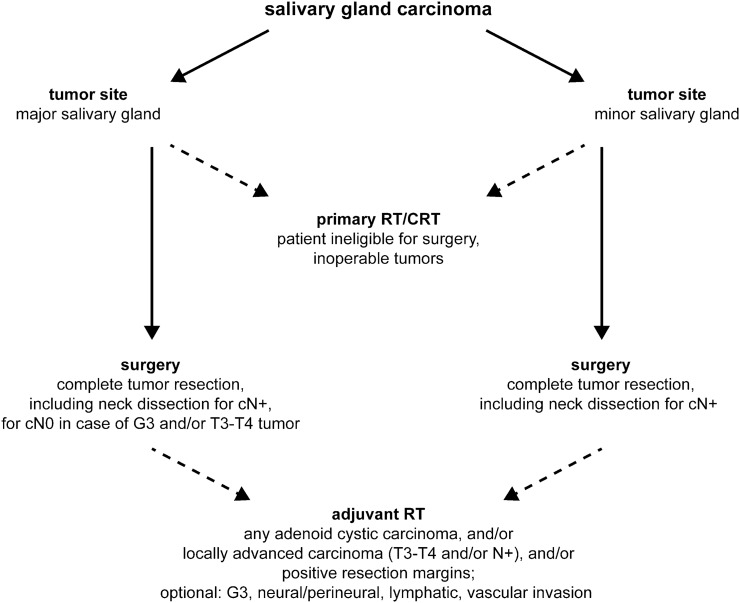
Patients received surgery (n = 65), surgery followed by (chemo-)radiotherapy (n = 56), or primary (chemo-)radiotherapy (n = 6). Injury to the cranial nerves or their branches was the most frequent surgical complication affecting 40 patients (33.1%). Ten year overall and progression-free survival rates were 73.2% and 65.4%, respectively. Parotid tumor site, advanced tumor, and positive nodal stage remained independent negative prognostic factors for overall survival, loco-regional and distant tumor control in multivariate analysis.
Optimizing treatment strategies for SGC, depending on distinct clinicopathological factors, remains challenging due to the low incidence rates of the disease.
唾液腺癌(SGC)是一组异质性恶性肿瘤,缺乏高水平证据的数据。
回顾性分析了 2002 年至 2017 年期间在一所大学癌症中心接受 SGC 治疗的 127 名患者的临床数据。评估了临床病理特征、治疗方式、不良事件和结果的相关性。
患者接受了手术(n=65)、手术加(放)化疗(n=56)或原发(放)化疗(n=6)治疗。颅神经或其分支损伤是最常见的手术并发症,影响了 40 名患者(33.1%)。10 年总生存率和无进展生存率分别为 73.2%和 65.4%。多因素分析显示,腮腺肿瘤部位、肿瘤晚期和阳性淋巴结分期是总生存、局部区域和远处肿瘤控制的独立预后不良因素。
由于疾病的低发病率,根据不同的临床病理因素优化 SGC 的治疗策略仍然具有挑战性。