University of Bergen, Bergen, Norway.
CEPR, London, UK.
Eur J Epidemiol. 2021 Aug;36(8):849-860. doi: 10.1007/s10654-021-00734-8. Epub 2021 Mar 24.
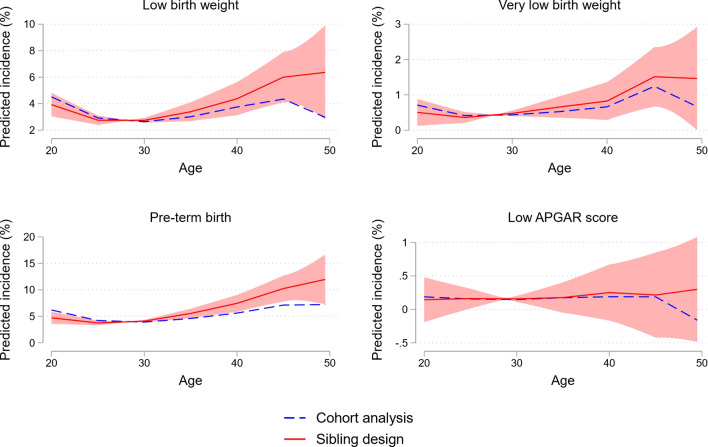
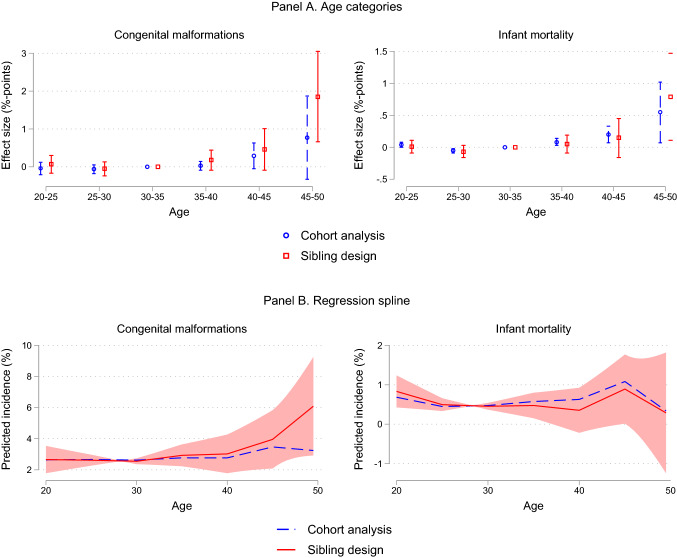
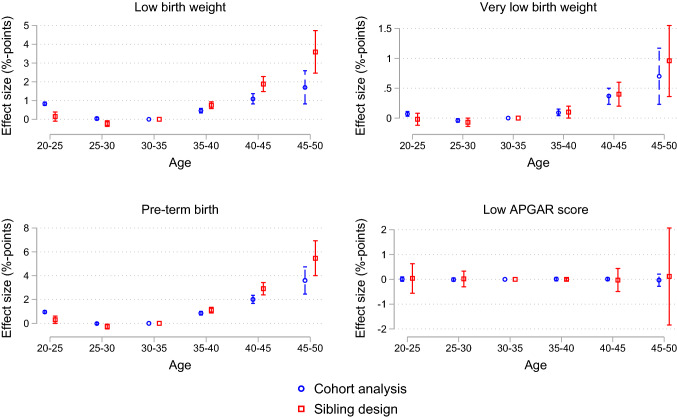
Higher parental age at childbearing has generated much attention as a potential risk factor for birth disorders; however, previous research findings are mixed. Existing studies have exploited variation in parental age across families, which is problematic because families differ not only in parental age but also in genetic and environmental factors. To isolate the effects of parental age, holding many genetic and environmental factors constant, we exploit the variation in parental age within families and compare outcomes for full siblings. The study data were retrieved from the Medical Birth Registry of Norway, which covers the entire population of births in Norway over an extended period (totaling 1.2 million births). Using variation in parental age when siblings were born, we find large and convex effects of increased parental age on the increased risk of birth disorders. To facilitate comparison with the existing literature, we also estimate the effects of parental age using variation in parental age across families and find that the effects are substantially weaker. We conclude that the existing literature may have underestimated the negative effects of parental aging on adverse offspring outcomes.
较高的生育年龄一直是生育障碍的潜在风险因素之一,引起了广泛关注;然而,先前的研究结果却存在差异。现有研究利用了家庭间父母年龄的差异,然而这种方法存在问题,因为家庭间不仅在父母年龄上存在差异,而且在遗传和环境因素上也存在差异。为了分离出父母年龄的影响,同时控制许多遗传和环境因素,我们利用了家庭内父母年龄的差异,并比较了全同胞的结果。该研究的数据来自挪威医学出生登记处,该登记处涵盖了挪威在一段时间内(总计 120 万例出生)的所有出生情况。我们利用兄弟姐妹出生时父母年龄的差异,发现父母年龄的增加与生育障碍风险的增加之间存在显著的凸性关系。为了便于与现有文献进行比较,我们还利用家庭间父母年龄的差异来估计父母年龄的影响,发现这些影响要小得多。我们的结论是,现有文献可能低估了父母年龄增长对后代不良结局的负面影响。