Ziemssen Tjalf, Albrecht Holger, Haas Judith, Klotz Luisa, Lang Michael, Lassek Christoph, Schmidt Stephan, Ettle Benjamin, Schulze-Topphoff Ulf
Zentrum für klinische Neurowissenschaften, Universitaetsklinikum Carl Gustav Carus Dresden, Dresden, Germany.
Praxis für Neurologie, Munich, Germany.
Front Neurol. 2021 Mar 3;12:637107. doi: 10.3389/fneur.2021.637107. eCollection 2021.
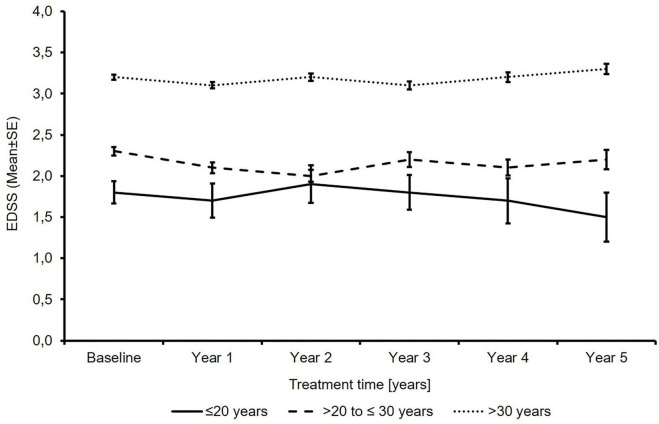
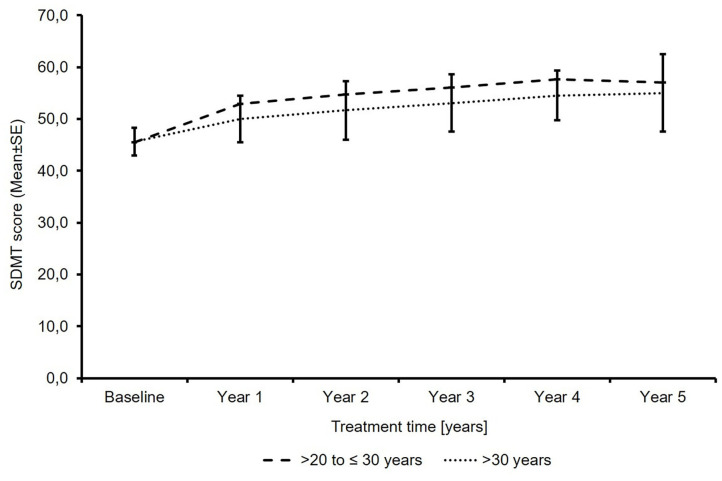
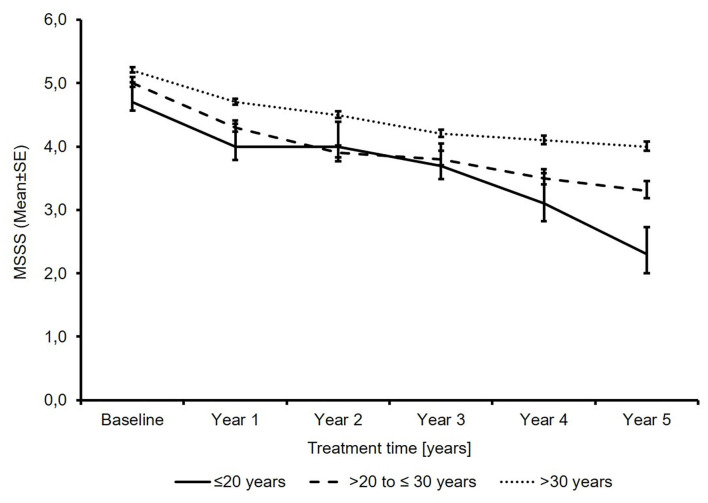
Fingolimod (Gilenya®) is approved for adult and pediatric patients with highly active relapsing-remitting multiple sclerosis (RRMS). The objective was to describe the effectiveness of fingolimod in young adults compared to older patients in clinical practice. PANGAEA is the largest prospective, multi-center, non-interventional, long-term study evaluating fingolimod in RRMS. We descriptively analyzed demographics, MS characteristics, and severity in two subgroups of young adults (≤20 and >20 to ≤30 years) and older patients (>30 years). Young adults had lower Expanded Disability Status Scale (EDSS) scores compared to older patients (1.8 and 2.3 vs. 3.2) at baseline. The mean EDSS scores remained stable over 5 years in all subgroups. Young adults had higher annual relapse rates (2.0 and 1.7 vs. 1.4) at study entry, which were reduced by approximately 80% in all subgroups over 5 years. The proportion of patients with no clinical disease activity in year 4 was 52.6 and 73.4 vs. 66.9% in patients ≤20, >20 to ≤30 years and >30 years, respectively. The symbol digit modalities test score increased by 15.25 ± 8.3 and 8.3 ± 11.3 (mean ± SD) from baseline in patients >20 to ≤30 and >30 years. Real-world evidence suggests a long-term treatment benefit of fingolimod in young RRMS patients.
芬戈莫德(捷灵亚®)已被批准用于治疗患有高度活动性复发缓解型多发性硬化症(RRMS)的成人和儿科患者。本研究的目的是描述在临床实践中,与老年患者相比,芬戈莫德在年轻成人患者中的有效性。泛大陆研究(PANGAEA)是评估芬戈莫德治疗RRMS的最大规模前瞻性、多中心、非干预性长期研究。我们对年轻成人(≤20岁和>20至≤30岁)和老年患者(>30岁)两个亚组的人口统计学、MS特征和严重程度进行了描述性分析。在基线时,年轻成人的扩展残疾状态量表(EDSS)评分低于老年患者(分别为1.8和2.3,而老年患者为3.2)。在所有亚组中,平均EDSS评分在5年内保持稳定。在研究开始时,年轻成人的年复发率较高(分别为2.0和1.7,而老年患者为1.4),但在5年内所有亚组的年复发率均降低了约80%。在第4年无临床疾病活动的患者比例在≤20岁、>20至≤30岁和>30岁的患者中分别为52.6%、73.4%和66.9%。在>20至≤30岁和>30岁的患者中,符号数字模态测试评分从基线开始分别增加了15.25±8.3和8.3±11.3(平均值±标准差)。真实世界证据表明,芬戈莫德对年轻RRMS患者具有长期治疗益处。