Azizi Babak, Amini Sabegh Zahra, Mahmoudi Mohammad, Rasouli Saifollah
Department of Physics, University of Zanjan, University Blvd., 45371-38791, Zanjan, Iran.
Department of Physics, Institute for Advanced Studies in Basic Sciences (IASBS), 45137-66731, Zanjan, Iran.
Sci Rep. 2021 Mar 25;11(1):6827. doi: 10.1038/s41598-021-86289-w.
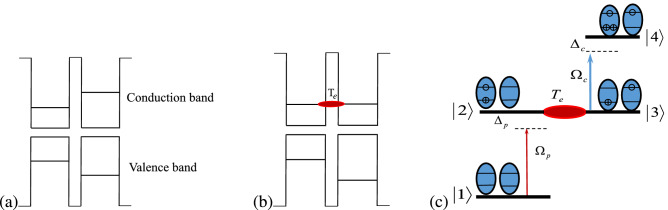
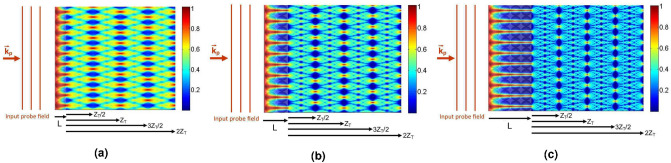
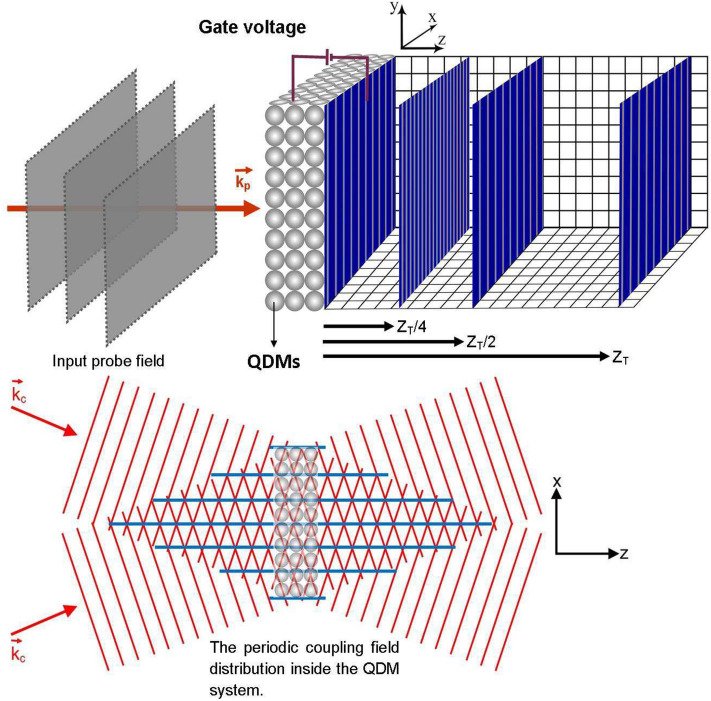
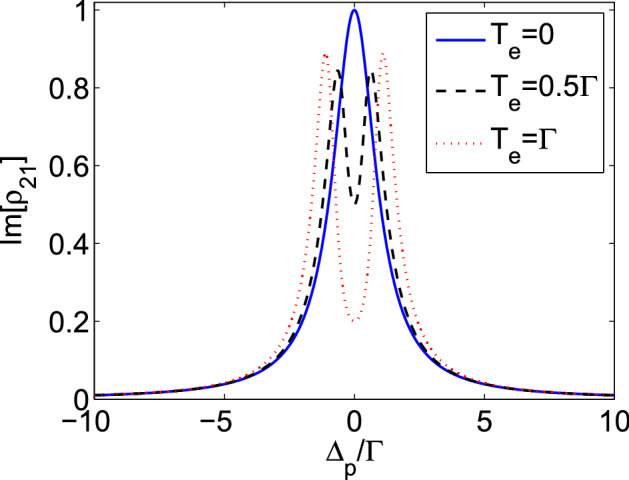
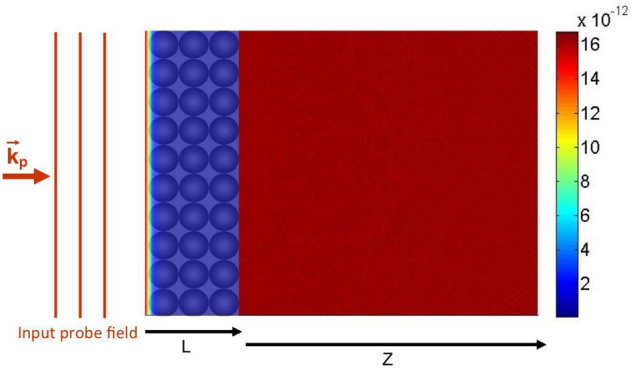
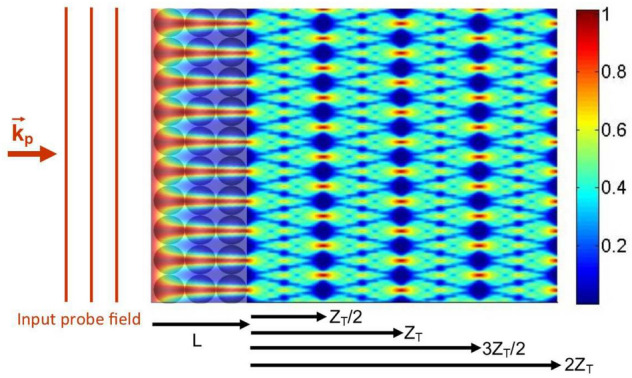
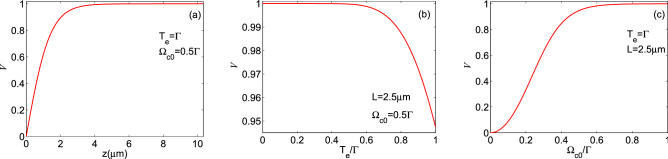
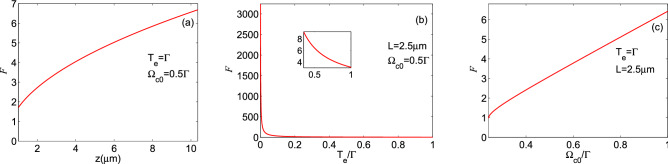
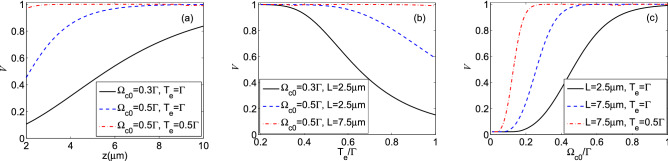
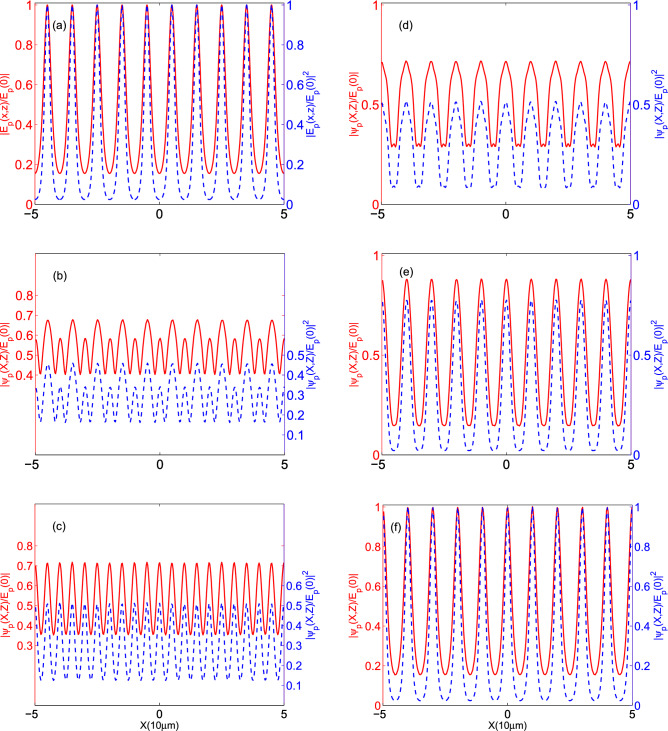
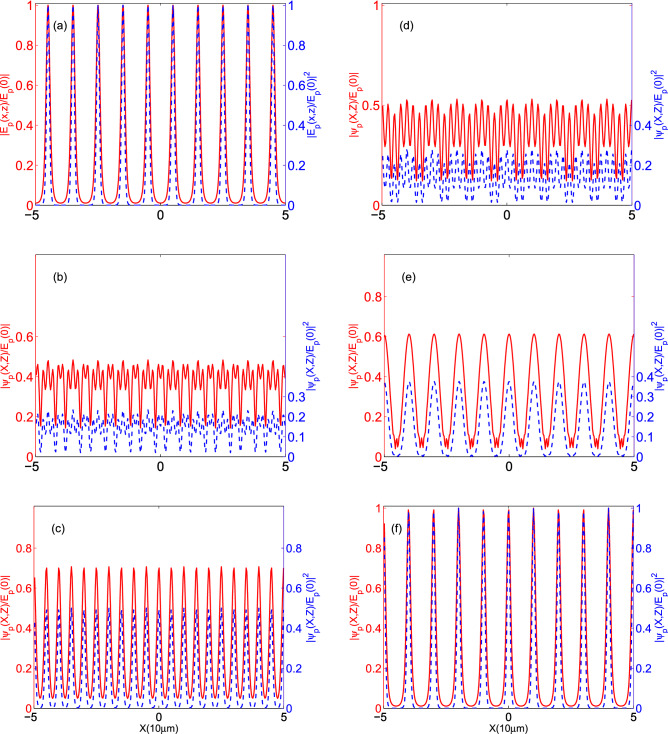
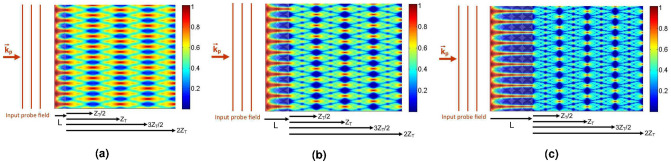
We investigate the reforming of a plane wave into a periodic waveform in its propagation through a structural asymmetry four-level quantum dot molecule (QDM) system that is induced by an inter-dot tunneling process and present the resulting tunneling-induced Talbot effect. The tunneling process between two neighborhood dots is provided with the aid of a gate voltage. Using a periodic coupling field the response of the medium to the propagating plane probe beam becomes periodic. The needed periodic coupling field is generated with the interference of two coherent plane waves having a small angle and propagating almost parallel to the probe beam direction. In the presence of the tunneling effect of an electron between two adjacent QDs, for the probe beam propagating through the QDM system, the medium becomes transparent where the coupling fields interfere constructively. As a result, the spatial periodicity of the coupling field modulates the passing plane probe beam. We determine the minimum length of the QDM system to generate a periodic intensity profile with a visibility value equal to 1 for the probe field at the exit plane of the medium. It is also shown that by increasing the propagation length of the probe beam through the QDM medium, the profile of the maximum intensity areas becomes sharper. This feature is quantified by considering a sharpness factor for the intensity profile of the probe beam at the transverse plane. Finally, we investigate free space propagation of the induced periodic field and present the Talbot images of the tunneling-induced periodic patterns at different propagation distances for different values of the QDM medium lengths. The presented dynamically designing method of the periodic coherent intensity patterns might find applications in science and technology. For instance, in optical lithography, the need to use micro/nanofabricated physical transmission diffraction gratings, in which preparation of them is expensive and time-consuming, can be eliminated.
我们研究了平面波在通过由点间隧穿过程诱导的结构不对称四能级量子点分子(QDM)系统传播时,如何重整为周期性波形,并展示了由此产生的隧穿诱导塔尔博特效应。借助栅极电压实现两个相邻量子点之间的隧穿过程。使用周期性耦合场,介质对传播的平面探测光束的响应变为周期性的。所需的周期性耦合场是由两个小角度且几乎平行于探测光束方向传播的相干平面波干涉产生的。在两个相邻量子点之间存在电子隧穿效应的情况下,对于通过QDM系统传播的探测光束,在耦合场相长干涉的地方介质变得透明。结果,耦合场的空间周期性调制了通过的平面探测光束。我们确定了QDM系统的最小长度,以便在介质出射平面处为探测场生成可见度值等于1的周期性强度分布。还表明,通过增加探测光束在QDM介质中的传播长度,最大强度区域的分布变得更尖锐。通过考虑探测光束在横向平面处强度分布的锐度因子来量化这一特征。最后,我们研究了诱导周期性场的自由空间传播,并展示了在不同传播距离下,针对不同QDM介质长度值的隧穿诱导周期性图案的塔尔博特图像。所提出的周期性相干强度图案的动态设计方法可能在科学技术中找到应用。例如,在光学光刻中,可以消除使用微/纳米制造的物理透射衍射光栅的需求,而制造这些光栅既昂贵又耗时。