Evolutionary Genetics Group, Department of Anthropology, University of Zurich, 8057, Zurich, Switzerland.
School of Biological Sciences, University of Bristol, Bristol, BS8 1TQ, UK.
Sci Rep. 2021 Mar 25;11(1):6901. doi: 10.1038/s41598-021-85583-x.
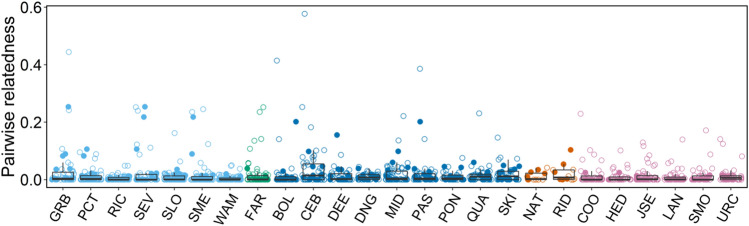
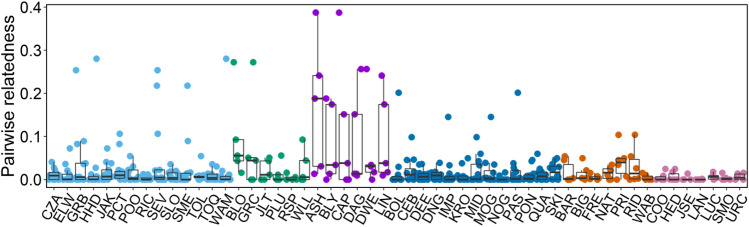
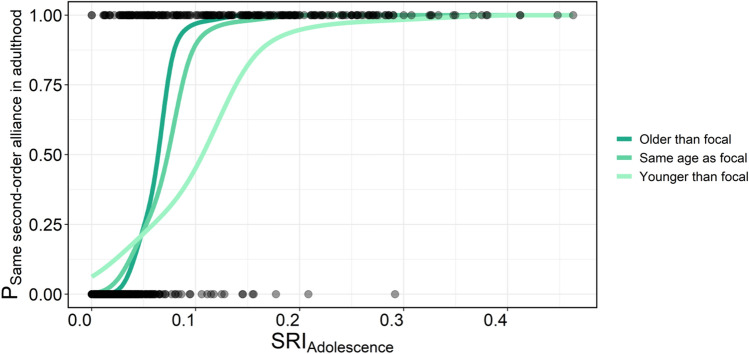
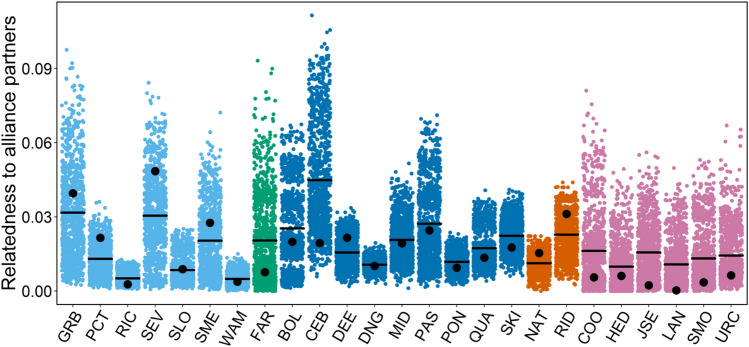
Investigations into cooperative partner choice should consider both potential and realised partners, allowing for the comparison of traits across all those available. Male bottlenose dolphins form persisting multi-level alliances. Second-order alliances of 4-14 males are the core social unit, within which 2-3 males form first-order alliances to sequester females during consortships. We compared social bond strength, relatedness and age similarity of potential and realised partners of individual males in two age periods: (i) adolescence, when second-order alliances are formed from all available associates, and (ii) adulthood, when first-order allies are selected from within second-order alliances. Social bond strength during adolescence predicted second-order alliance membership in adulthood. Moreover, males preferred same-aged or older males as second-order allies. Within second-order alliances, non-mating season social bond strength predicted first-order partner preferences during mating season consortships. Relatedness did not influence partner choice on either alliance level. There is thus a striking resemblance between male dolphins, chimpanzees and humans, where closely bonded non-relatives engage in higher-level, polyadic cooperative acts. To that end, our study extends the scope of taxa in which social bonds rather than kinship explain cooperation, providing the first evidence that such traits might have evolved independently in marine and terrestrial realms.
对合作伴侣选择的研究应同时考虑潜在和实际伴侣,以便在所有可用伴侣中比较特征。雄性宽吻海豚形成持久的多层次联盟。由 4-14 个雄性组成的二阶联盟是核心社会单位,其中 2-3 个雄性形成一阶联盟,在交配期间隔离雌性。我们比较了个体雄性在两个时期的潜在和实际伴侣的社会纽带强度、亲缘关系和年龄相似性:(i)青春期,此时二阶联盟由所有可用的同伴组成,以及(ii)成年期,此时一阶盟友从二阶联盟中选出。青春期的社会纽带强度预测了成年期的二阶联盟成员资格。此外,雄性更喜欢同龄或更年长的雄性作为二阶盟友。在二阶联盟中,非交配季节的社会纽带强度预测了交配季节交配时一阶伴侣的偏好。亲缘关系在两个联盟层面上都没有影响伴侣选择。因此,雄性海豚、黑猩猩和人类之间存在惊人的相似之处,在这些动物中,紧密结合的非亲属会进行更高层次的、多对合作行为。为此,我们的研究扩展了社会纽带而不是亲属关系解释合作的分类群范围,提供了第一个证据表明,这些特征可能在海洋和陆地领域独立进化。