Department of Chemistry and Stanford ChEM-H, Stanford University, Stanford, CA, USA.
Department of Bioengineering, Stanford University, Stanford, CA, USA.
Nat Chem Biol. 2021 Sep;17(9):937-946. doi: 10.1038/s41589-021-00770-1. Epub 2021 Mar 25.
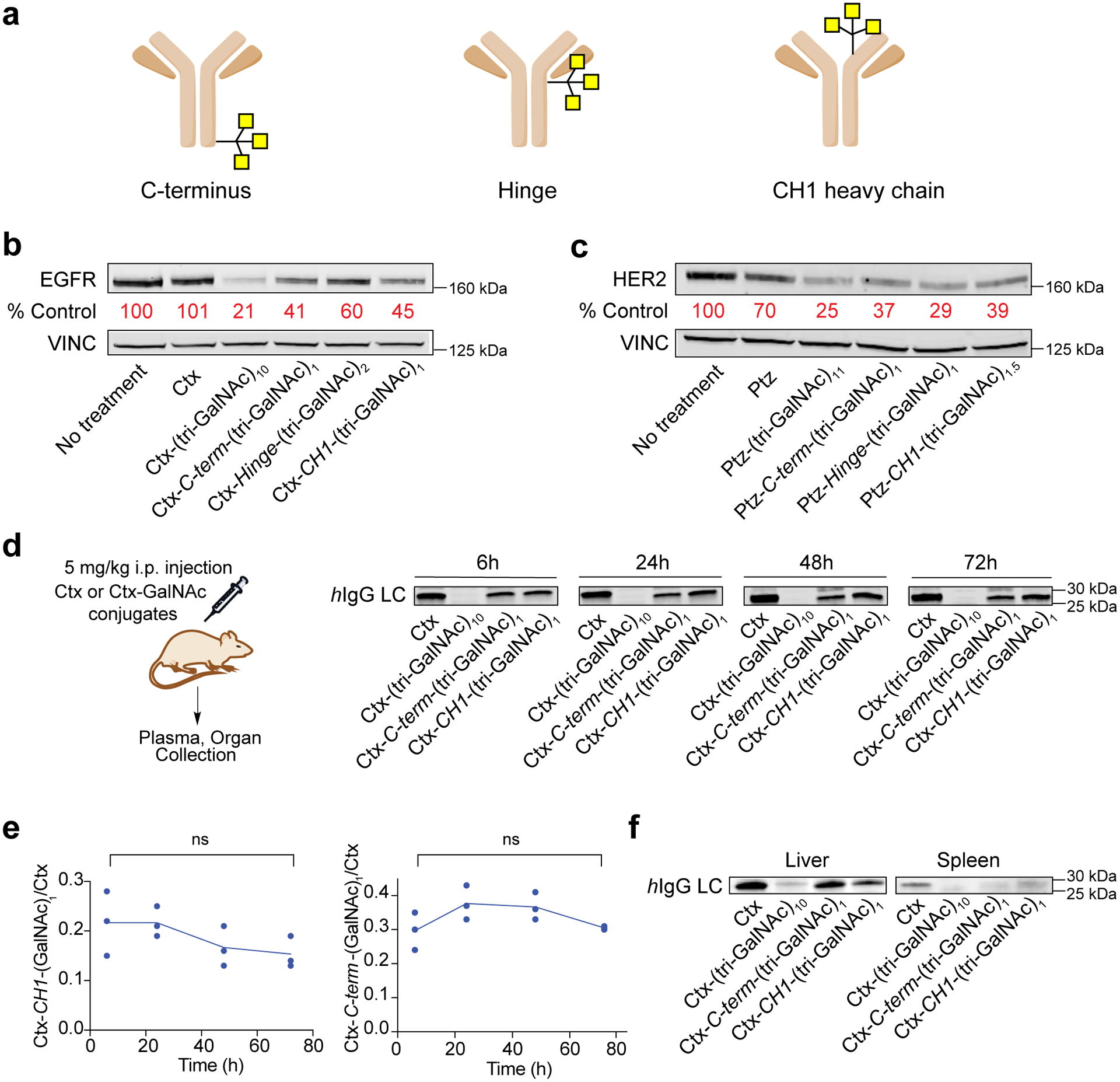
Selective protein degradation platforms have afforded new development opportunities for therapeutics and tools for biological inquiry. The first lysosome-targeting chimeras (LYTACs) targeted extracellular and membrane proteins for degradation by bridging a target protein to the cation-independent mannose-6-phosphate receptor (CI-M6PR). Here, we developed LYTACs that engage the asialoglycoprotein receptor (ASGPR), a liver-specific lysosome-targeting receptor, to degrade extracellular proteins in a cell-type-specific manner. We conjugated binders to a triantenerrary N-acetylgalactosamine (tri-GalNAc) motif that engages ASGPR to drive the downregulation of proteins. Degradation of epidermal growth factor receptor (EGFR) by GalNAc-LYTAC attenuated EGFR signaling compared to inhibition with an antibody. Furthermore, we demonstrated that a LYTAC consisting of a 3.4-kDa peptide binder linked to a tri-GalNAc ligand degrades integrins and reduces cancer cell proliferation. Degradation with a single tri-GalNAc ligand prompted site-specific conjugation on antibody scaffolds, which improved the pharmacokinetic profile of GalNAc-LYTACs in vivo. GalNAc-LYTACs thus represent an avenue for cell-type-restricted protein degradation.
选择性蛋白降解平台为治疗药物和生物研究工具提供了新的发展机会。第一个溶酶体靶向嵌合体(LYTAC)通过将靶蛋白与阳离子非依赖性甘露糖-6-磷酸受体(CI-M6PR)桥接,靶向细胞外和膜蛋白进行降解。在这里,我们开发了 LYTAC,它与肝特异性溶酶体靶向受体——去唾液酸糖蛋白受体(ASGPR)结合,以细胞类型特异性的方式降解细胞外蛋白。我们将结合物与三连接 N-乙酰半乳糖胺(tri-GalNAc)基序缀合,该基序与 ASGPR 结合以驱动蛋白的下调。与抗体抑制相比,GalNAc-LYTAC 对表皮生长因子受体(EGFR)的降解减弱了 EGFR 信号。此外,我们证明由与 tri-GalNAc 配体连接的 3.4 kDa 肽结合物组成的 LYTAC 可降解整合素并减少癌细胞增殖。用单个 tri-GalNAc 配体进行的降解促使抗体支架上发生特异性缀合,从而改善了 GalNAc-LYTAC 在体内的药代动力学特征。因此,GalNAc-LYTAC 代表了一种细胞类型受限的蛋白降解途径。