Pediatric Dermatology Unit, Department of Pediatrics and Dermatology and Venereology, University Hospital Lausanne and University of Lausanne, Lausanne, Switzerland.
Department of Dermatology, Pediatric Skin Center, University Children's Hospital Zurich, Zurich, Switzerland.
Front Immunol. 2021 Mar 9;12:656407. doi: 10.3389/fimmu.2021.656407. eCollection 2021.
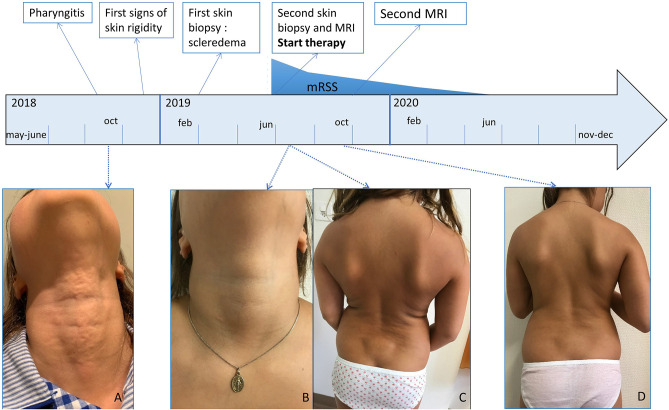
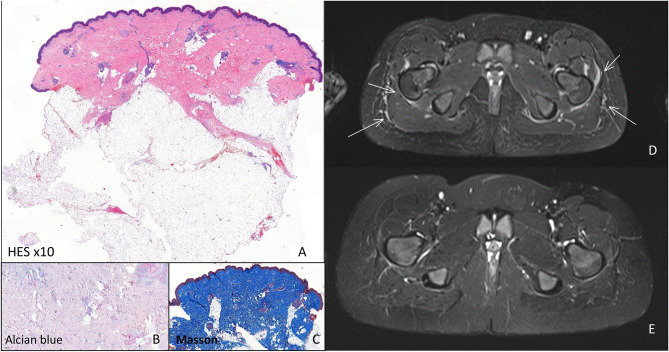
Pansclerotic morphea (PSM) is a rare skin disease characterized by progressive stiffening of the skin with or without the typical superficial skin changes usually seen in morphea (localized scleroderma). Standard therapy, consisting of a combination of systemic glucocorticoids and methotrexate or mycophenolate mofetil, does rarely stop disease progression, which may lead to severe cutaneous sclerosis and secondary contractures. Little is known about the efficacy of newer biologicals such as abatacept, a fusion protein antibody against CTLA-4, or tocilizumab, a fully humanized IL-6R antibody, in the treatment of this pathology. We present the case of an 8 years old girl with an unusual, progressive stiffening of the skin, which was eventually diagnosed as pansclerotic morphea. A treatment with systemic glucocorticoids and methotrexate combined with tocilizumab led to a good clinical response within 2 months after initiation. In this paper, we discuss differential diagnoses to be considered and this new promising treatment option based on a case review of the literature.
系统性硬斑病(PSM)是一种罕见的皮肤疾病,其特征为皮肤进行性硬化,伴有或不伴有硬斑病(局限性硬皮病)中常见的典型皮肤浅表变化。标准治疗包括全身糖皮质激素和甲氨蝶呤或霉酚酸酯的联合治疗,但很少能阻止疾病进展,这可能导致严重的皮肤硬化和继发性挛缩。关于新型生物制剂(如 CTLA-4 融合蛋白抗体阿巴西普或完全人源化 IL-6R 抗体托珠单抗)在治疗这种疾病中的疗效知之甚少。我们报告了一例 8 岁女孩皮肤进行性硬化的不典型病例,最终诊断为系统性硬斑病。全身糖皮质激素和甲氨蝶呤联合托珠单抗治疗在开始治疗后 2 个月内获得了良好的临床反应。本文通过文献复习病例讨论了需要考虑的鉴别诊断和这种新的有前途的治疗选择。