Department of Agricultural Economics, University of Nairobi, P.O Box 29053, Nairobi, Kenya.
Department of Animal Science, University of Nairobi, Nairobi, Kenya.
Trop Anim Health Prod. 2021 Mar 25;53(2):227. doi: 10.1007/s11250-021-02596-4.
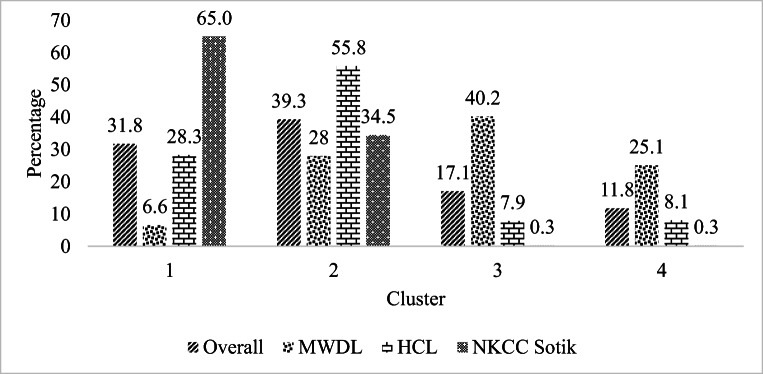
To enhance milk quantity and quality which have continued to decrease in Kenya, various stakeholders have intervened through promotion of technical dairy innovations at the farm level including improved cow feeding, health management, promotion of exotic breeds, and milking hygiene. At the milkshed level, stakeholders' focus has been on organizational innovations, specifically milk sale by farmers through groups. This study sought to characterize dairy innovations that have been adopted by farmers in the milkshed of three milk processors including New Kenya Co-operative Creameries Sotik (NKCC Sotik), Happy Cow Limited (HCL), and Mukurweini Wakulima Dairy Limited (MWDL), representing one state, private, and farmer-owned processor, respectively. Data were collected using a structured questionnaire from a sample of 1146 farmers (410, 382, and 354 in MWDL, HCL, and NKCC Sotik, respectively). A categorical principal components analysis was used to reduce 32 variables into four sets of uncorrelated components. Four categories were identified including principal component (PC) 1 (technical capacity), PC 2 (animal health management), PC 3 (organizational capacity), and PC 4 (milk hygiene). More farmers in the milkshed of MWDL adopted technical and organizational dairy innovations such as use of artificial insemination and milk sale through groups, respectively, than farmers in milkshed of NKCC and HCL. The county governments in the milkshed of HCL and NKCC Sotik need to strengthen cooperative societies to boost adoption of artificial insemination through arrangement in which milk is sold and payment of services offered on credit is settled from milk sale and ensure milk market availability throughout the year.
为了提高肯尼亚不断下降的牛奶产量和质量,各利益相关方通过在农场层面推广技术乳制品创新进行了干预,包括改进奶牛饲养、健康管理、推广外来品种和牛奶卫生。在牛奶流域层面,利益相关方的重点是组织创新,特别是农民通过团体销售牛奶。本研究旨在描述在三家牛奶加工商的牛奶流域中,农民采用的乳制品创新,这三家加工商分别是新肯尼亚合作乳品厂 Sotik(NKCC Sotik)、快乐牛有限公司(HCL)和穆库雷维尼瓦库利马乳业有限公司(MWDL),分别代表一个州、私人和农民所有的加工商。研究人员使用结构化问卷从一个样本中收集了 1146 名农民的数据(MWDL、HCL 和 NKCC Sotik 分别有 410、382 和 354 名农民)。采用分类主成分分析将 32 个变量减少为四组不相关的成分。确定了四个类别,包括主要成分 (PC) 1(技术能力)、PC 2(动物健康管理)、PC 3(组织能力)和 PC 4(牛奶卫生)。MWDL 牛奶流域的农民比 NKCC 和 HCL 牛奶流域的农民更多地采用了技术和组织乳制品创新,例如使用人工授精和通过团体销售牛奶。HCL 和 NKCC Sotik 牛奶流域的县政府需要加强合作社,通过安排在信用基础上销售牛奶和支付提供的服务来促进人工授精的采用,并确保全年都有牛奶市场供应。