Department of Neurosurgery, University of Groningen, University Medical Center Groningen, Hanzeplein 1, P.O. Box 30.001, 9700 VB, Groningen, The Netherlands.
Department of Radiology and Nuclear Medicine, Erasmus MC, Rotterdam, The Netherlands.
J Neurooncol. 2021 Jun;153(2):211-222. doi: 10.1007/s11060-021-03739-1. Epub 2021 Mar 26.
Meningioma recurrence rates can be reduced by optimizing surgical resection with the use of intraoperative molecular fluorescence guided surgery (MFGS). We evaluated the potential of the fluorescent tracer 800CW-TATE for MFGS using in vitro and in vivo models. It targets somatostatin receptor subtype 2 (SSTR), which is overexpressed in all meningiomas.
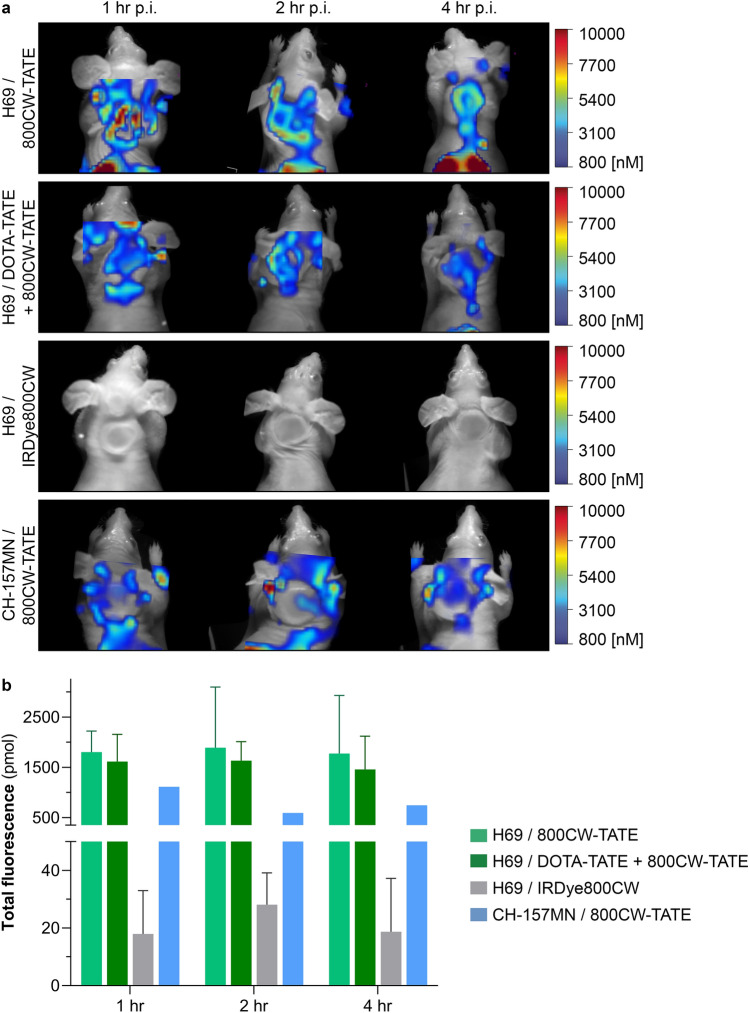
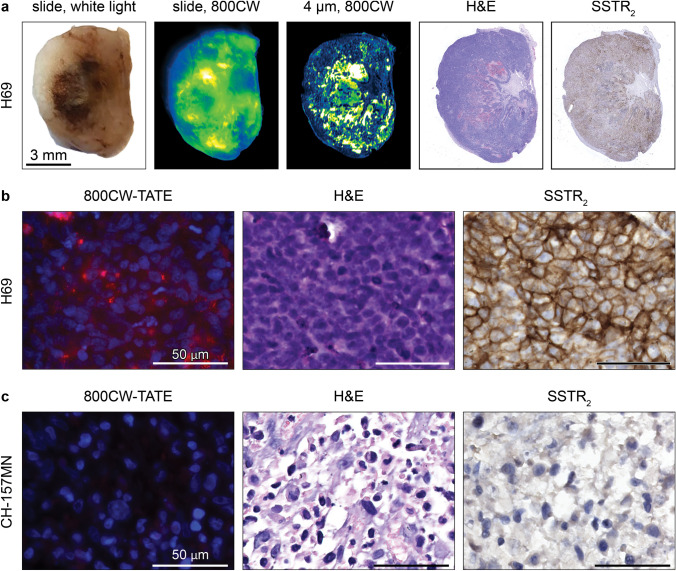
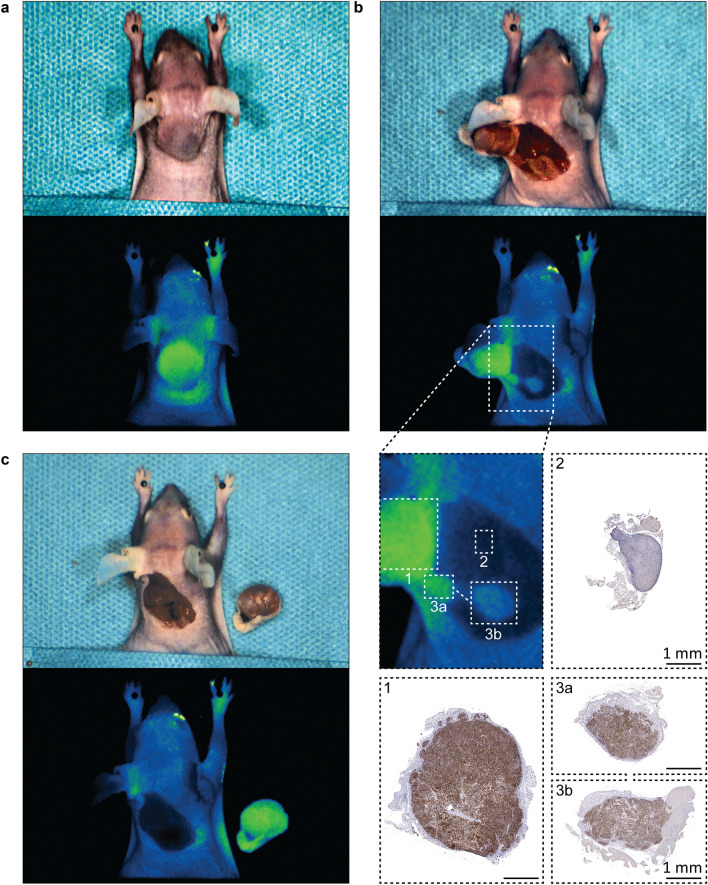
Binding affinity of 800CW-TATE was evaluated using [Lu] Lu-DOTA-Tyr-octreotate displacement assays. Tumor uptake was determined by injecting 800CW-TATE in (SSTR-positive) NCI-H69 or (SSTR-negative) CH-157MN xenograft bearing mice and FMT2500 imaging. SSTR-specific binding was measured by comparing tumor uptake in NCI-H69 and CH-157MN xenografts, blocking experiments and non-targeted IRDye800CW-carboxylate binding. Tracer distribution was analyzed ex vivo, and the tumor-to-background ratio (TBR) was calculated. SSTR expression was determined by immunohistochemistry (IHC). Lastly, 800CW-TATE was incubated on frozen and fresh meningioma specimens and analyzed by microscopy.
800CW-TATE binding affinity assays showed an IC value of 72 nM. NCI-H69 xenografted mice showed a TBR of 21.1. 800CW-TATE detection was reduced after co-administration of non-fluorescent DOTA-Tyr-octreotate or administration of IRDye800CW. CH-157MN had no tumor specific tracer staining due to absence of SSTR expression, thereby serving as a negative control. The tracer bound specifically to SSTR-positive meningioma tissues representing all WHO grades.
800CW-TATE demonstrated sufficient binding affinity, specific SSTR-mediated tumor uptake, a favorable biodistribution, and high TBR. These features make this tracer very promising for use in MFGS and could potentially aid in safer and a more complete meningioma resection, especially in high-grade meningiomas or those at complex anatomical localizations.
通过使用术中分子荧光引导手术(MFGS)优化手术切除,可以降低脑膜瘤的复发率。我们使用体外和体内模型评估荧光示踪剂 800CW-TATE 在 MFGS 中的应用潜力。它针对所有脑膜瘤过度表达的生长抑素受体亚型 2(SSTR)。
使用 [Lu]Lu-DOTA-Tyr-octreotate 置换测定法评估 800CW-TATE 的结合亲和力。通过向携带(SSTR 阳性)NCI-H69 或(SSTR 阴性)CH-157MN 异种移植物的小鼠中注射 800CW-TATE 并进行 FMT2500 成像,确定肿瘤摄取量。通过比较 NCI-H69 和 CH-157MN 异种移植物中的肿瘤摄取量、阻断实验和非靶向 IRDye800CW-羧酸结合来测量 SSTR 特异性结合。对肿瘤进行离体分析,并计算肿瘤与背景的比值(TBR)。通过免疫组织化学(IHC)测定 SSTR 的表达。最后,将 800CW-TATE 孵育在冷冻和新鲜脑膜瘤标本上,并通过显微镜进行分析。
800CW-TATE 结合亲和力测定显示 IC 值为 72 nM。NCI-H69 异种移植瘤小鼠的 TBR 为 21.1。与非荧光 DOTA-Tyr-octreotate 共给药或给予 IRDye800CW 后,800CW-TATE 的检测减少。由于缺乏 SSTR 表达,CH-157MN 没有肿瘤特异性示踪剂染色,因此作为阴性对照。该示踪剂特异性结合代表所有 WHO 分级的 SSTR 阳性脑膜瘤组织。
800CW-TATE 表现出足够的结合亲和力、特异性 SSTR 介导的肿瘤摄取、有利的生物分布和高 TBR。这些特征使该示踪剂非常有前途用于 MFGS,并可能有助于更安全、更完整地切除脑膜瘤,特别是在高级别脑膜瘤或复杂解剖部位的脑膜瘤。