Cree Bruce Ac, Cohen Jeffrey A, Reder Anthony T, Tomic Davorka, Silva Diego, Piani Meier Daniela, Laflamme Annik K, Ritter Shannon, Leppert David, Kappos Ludwig
UCSF Weill Institute for Neurosciences, Department of Neurology, University of California San Francisco, San Francisco, CA, USA.
Department of Neurology, Mellen Center for Multiple Sclerosis Treatment and Research, Neurological Institute, Cleveland Clinic, Cleveland, OH, USA.
Mult Scler. 2021 Dec;27(14):2219-2231. doi: 10.1177/13524585211000280. Epub 2021 Mar 26.
Disease-modifying therapies (DMTs) can reduce the risk of disability worsening in patients with relapsing forms of multiple sclerosis (RMS). High-efficacy DMTs can lead to confirmed or sustained disability improvement (CDI and SDI).
Post hoc analyses of data from the TRANSFORMS, FREEDOMS, and FREEDOMS II trials and their extensions assessed the effects of fingolimod (0.5-1.25 mg/day) on stabilizing or improving disability over ⩽8 years in participants with RMS. CDI and SDI rates were compared between participants initially randomized to fingolimod, interferon (IFNβ-1a), or placebo.
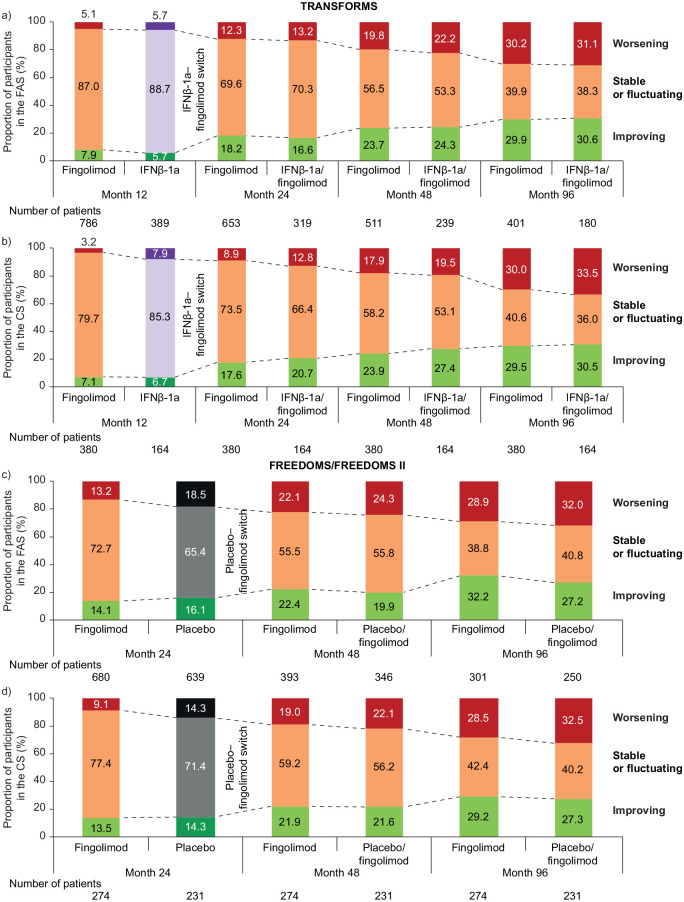
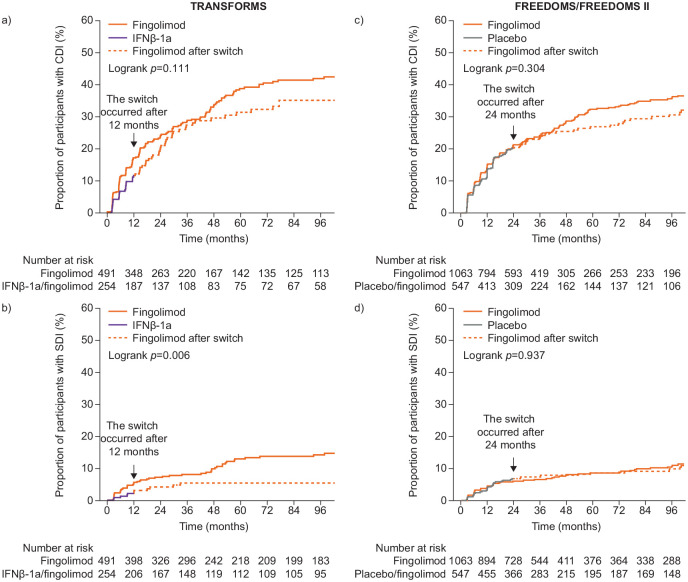
At 8 years' follow-up in TRANSFORMS, 35.1% (95% confidence interval [CI], 28.2%-43.1%) of assessed participants in the IFNβ-1a-fingolimod switch group and 41.9% (36.6%-47.6%) on continuous fingolimod experienced CDI; disability did not worsen in approximately 70%. Similar results were seen in the combined FREEDOMS population. Proportionally fewer TRANSFORMS participants achieved SDI in the IFNβ-1a-fingolimod switch group than on continuous fingolimod (5.4% [3.0%-9.5%] vs 14.2% [10.8%-18.4%], = 0.01).
CDI and SDI are outcomes of interest for clinical trials and for long-term follow-up of participants with RMS. Monitoring CDI and SDI in addition to disability worsening may facilitate understanding of the therapeutic benefit of RMS treatments.
疾病修饰疗法(DMTs)可降低复发型多发性硬化症(RMS)患者残疾恶化的风险。高效DMTs可带来确诊的或持续的残疾改善(CDI和SDI)。
对TRANSFORMS、FREEDOMS和FREEDOMS II试验及其扩展研究的数据进行事后分析,评估芬戈莫德(0.5 - 1.25毫克/天)对RMS参与者在8年及以内稳定或改善残疾状况的效果。比较最初随机分配至芬戈莫德、干扰素(IFNβ - 1a)或安慰剂组的参与者的CDI和SDI发生率。
在TRANSFORMS试验8年随访时,IFNβ - 1a - 芬戈莫德转换组中35.1%(95%置信区间[CI],28.2% - 43.1%)的评估参与者以及持续使用芬戈莫德组中41.9%(36.6% - 47.6%)的参与者经历了CDI;约70%的参与者残疾状况未恶化。在合并的FREEDOMS人群中也观察到了类似结果。与持续使用芬戈莫德组相比,TRANSFORMS试验中IFNβ - 1a - 芬戈莫德转换组实现SDI的参与者比例更低(5.4% [3.0% - 9.5%] 对14.2% [10.8% - 18.4%],P = 0.01)。
CDI和SDI是RMS临床试验及参与者长期随访中值得关注的结果。除了监测残疾恶化情况外,监测CDI和SDI可能有助于理解RMS治疗的疗效。