Department of Neurosurgery, 300 UCLA Stein Plaza, Suite 562, David Geffen School of Medicine at UCLA (University of California, Los Angeles), Los Angeles, CA, United States.
Department of Neurosurgery, 300 UCLA Stein Plaza, Suite 562, David Geffen School of Medicine at UCLA (University of California, Los Angeles), Los Angeles, CA, United States.
Neuroimage Clin. 2021;30:102628. doi: 10.1016/j.nicl.2021.102628. Epub 2021 Mar 13.
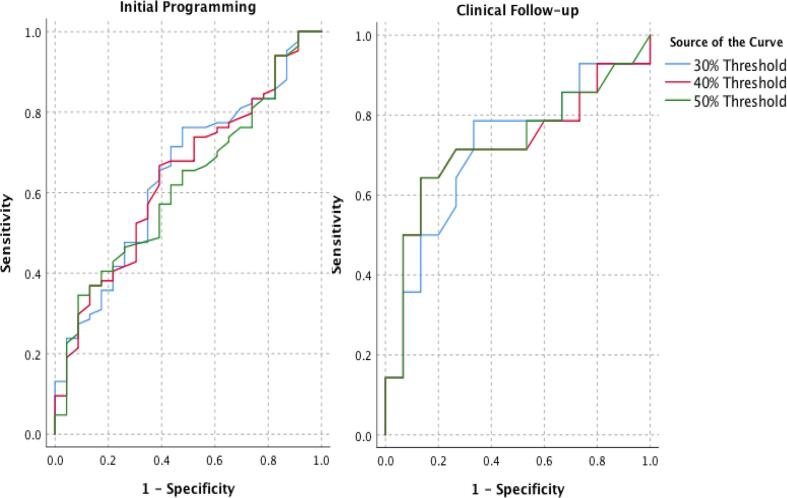
Deep brain stimulation (DBS) of the ventral intermediate nucleus (VIM-DBS) is a highly successful treatment for medication-refractory essential tremor (ET). Clinical outcomes are dependent on accurate targeting. Here, we aim to develop a framework for connectivity-guided DBS targeting by evaluating probabilistic tractography and clinical response at both initial programming (IP) and clinical follow-up (CF). Magnetic resonance imaging and clinical outcomes were evaluated in 23 ET patients who were treated by VIM-DBS at the University of California Los Angeles (20 at IP, 18 at CF, 14 at both). Lead-DBS was used to model the volume of tissue activated tissue (VTA) based on programming configurations at both IP and CF. Probabilistic tractography, calculated in FSL, was used to evaluate 1) clinically weighted whole brain connectivity of VTA; 2) connectivity between VTA and freesurfer-derived target regions of interest (ROI) including primary motor, premotor, and prefrontal cortices, and cerebellum; and 3) volume of intersection between VTA and probabilistic tractography-based segmentation of the thalamus. At IP, individual contacts were scored as high or low efficacy based on acute tremor improvement. At CF, clinical response was measured by percent of change of the Clinical Rating Scale for Tremor (CRST) compared to preoperative scores. Contributions from each target ROI to clinical response was measured using logistic regression for IP and linear regression for CF. The clinically weighted map of whole brain connectivity of VTA shows preferential connectivity to precentral gyrus and brainstem/cerebellum. The volume of intersection between VTA and thalamic segmentation map based on probabilistic connectivity to primary motor cortex was a significant predictor of contact efficacy at IP (OR = 2.26 per 100 mm of overlap, p = .04) and percent change in CRST at CF (β = 14.67 per 100 mm of overlap, p = .003). Targeting DBS to the area of thalamus most connected to primary motor cortex based on probabilistic tractography is associated with superior outcomes, providing a potential guide not only for lead targeting but also therapeutic programming.
深部脑刺激(DBS)的腹侧中间核(VIM-DBS)是治疗药物难治性原发性震颤(ET)的一种非常成功的方法。临床结果取决于准确的靶向。在这里,我们旨在通过评估初始编程(IP)和临床随访(CF)时的概率追踪和临床反应,为连接导向的 DBS 靶向开发一个框架。对在加利福尼亚大学洛杉矶分校接受 VIM-DBS 治疗的 23 名 ET 患者进行了磁共振成像和临床结果评估(20 名在 IP,18 名在 CF,14 名在两者)。使用 Lead-DBS 根据 IP 和 CF 时的编程配置来模拟激活组织的组织容积(VTA)。使用 FSL 计算概率追踪,以评估 1)VTA 的临床加权全脑连接;2)VTA 与来自 freesurfer 的目标感兴趣区域(ROI)之间的连接,包括初级运动、前运动和前额叶皮层以及小脑;以及 3)VTA 与基于概率追踪的丘脑分割之间的交集体积。在 IP 时,根据急性震颤改善情况,对各个触点的评分是高效或低效。在 CF 时,通过与术前评分相比的临床震颤评分量表(CRST)的百分比变化来测量临床反应。使用逻辑回归测量 IP 时每个目标 ROI 对临床反应的贡献,以及使用线性回归测量 CF 时的贡献。VTA 的全脑连接的临床加权图显示出与中央前回和脑干/小脑的优先连接。基于概率连接到初级运动皮层的 VTA 与丘脑分割图之间的交集体积是 IP 时触点疗效的重要预测指标(OR = 2.26 每 100 毫米重叠,p =.04)和 CF 时 CRST 的百分比变化(β = 14.67 每 100 毫米重叠,p =.003)。根据概率追踪术将 DBS 靶向到与初级运动皮层连接最密切的丘脑区域与更好的结果相关,这不仅为导联靶向,而且为治疗方案提供了潜在的指导。