Department of Cardiology, Nagano Municipal Hospital, Japan.
Intern Med. 2021 Sep 1;60(17):2741-2748. doi: 10.2169/internalmedicine.6871-20. Epub 2021 Mar 29.
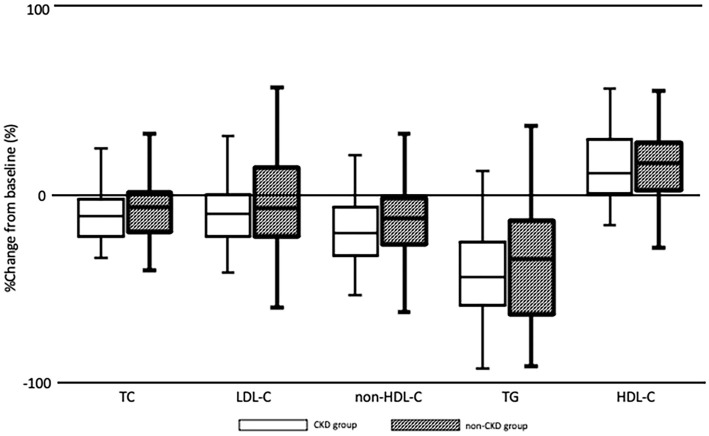
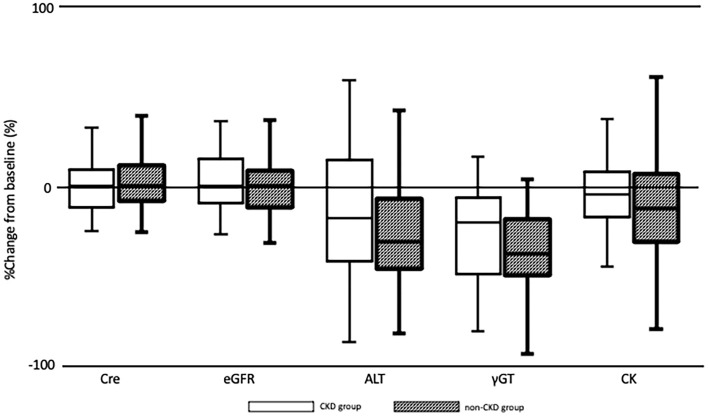
Objective Although lowering the low-density lipoprotein cholesterol (LDL-C) levels using statins can reduce cardiovascular risk, 70% of the cardiovascular risk remains despite treatment with statins. Several studies have shown that elevated triglyceride (TG)-rich lipoprotein is the primary therapeutic target for reducing the residual risk. However, conventional treatment with fibrates is frequently associated with adverse drug reactions, especially in patients with chronic kidney disease (CKD), and even with a reduction in TG. Pemafibrate is a novel selective peroxisome proliferator-activated receptor α modulator (SPPARMα) with fewer side effects and greater effectiveness that can overcome these challenges. We aimed to investigate the safety and efficacy of pemafibrate in patients with CKD and herein present a real-world profile of pemafibrate. Methods Between January 2019 and January 2020, 126 consecutive patients with hyperglyceridemia from two institutions (54 patients with CKD; 43%) who received pemafibrate were enrolled in this retrospective observational study. Blood samples were collected before (baseline) and at 24 weeks after commencing pemafibrate therapy. The primary endpoint was a decrease in the serum lipid levels. The secondary endpoints were the incidence of rhabdomyolysis, hepatargy, and an exacerbation of CKD. Results All patients, including 51% of patients who were concurrently taking statins, reported significantly reduced total cholesterol, non-high-density lipoprotein-cholesterol (non-HDL-C), LDL-C, and TG, and increased HDL-C (p<0.05). The subgroup of patients with CKD showed similar results without increased HDL-C. No adverse events were observed in any patients. Conclusion Pemafibrate has a good safety profile and efficacy for treating patients with serum lipid abnormalities, including those with CKD.
尽管使用他汀类药物降低低密度脂蛋白胆固醇(LDL-C)水平可以降低心血管风险,但即使使用他汀类药物治疗,仍有 70%的心血管风险存在。多项研究表明,升高的甘油三酯(TG)丰富脂蛋白是降低残余风险的主要治疗靶点。然而,常规使用贝特类药物治疗常伴有不良反应,特别是在慢性肾脏病(CKD)患者中,甚至在降低 TG 时也是如此。Pemafibrate 是一种新型选择性过氧化物酶体增殖物激活受体α调节剂(SPPARMα),具有更少的副作用和更大的疗效,可以克服这些挑战。我们旨在研究 pemafibrate 在 CKD 患者中的安全性和疗效,并在此介绍 pemafibrate 的真实世界概况。
在 2019 年 1 月至 2020 年 1 月期间,我们从两家机构招募了 126 名连续患有高甘油三酯血症的患者(54 例 CKD 患者;43%),这些患者接受了 pemafibrate 治疗。在开始使用 pemafibrate 治疗前(基线)和 24 周后收集血液样本。主要终点是血清脂质水平的降低。次要终点是横纹肌溶解、肝毒性和 CKD 恶化的发生率。
所有患者,包括 51%同时服用他汀类药物的患者,总胆固醇、非高密度脂蛋白胆固醇(non-HDL-C)、LDL-C 和 TG 显著降低,HDL-C 显著升高(p<0.05)。CKD 患者亚组也显示出相似的结果,HDL-C 没有增加。任何患者均未观察到不良反应。
Pemafibrate 具有良好的安全性和疗效,可用于治疗包括 CKD 患者在内的血脂异常患者。