Sorour Hend K, Hosny Reham A, Elmasry Dalia M A
Reference Laboratory for Veterinary Quality Control on Poultry Production, Animal Health Research Institute, Agricultural Research Center, Giza, Egypt.
Nanotechnology Research Unit, Animal Health Research Institute, Agricultural Research Center, Giza, Egypt.
Vet World. 2021 Feb;14(2):483-491. doi: 10.14202/vetworld.2021.483-491. Epub 2021 Feb 23.
is one of the multiple drug-resistant intestinal pathogens causing necrotic enteritis disease, leading to great economic losses in poultry farms. This study aimed to evaluate the potential use of peppermint oil and its microemulsion (ME) as an alternative to antibiotics to control necrotic enteritis in broiler chickens.
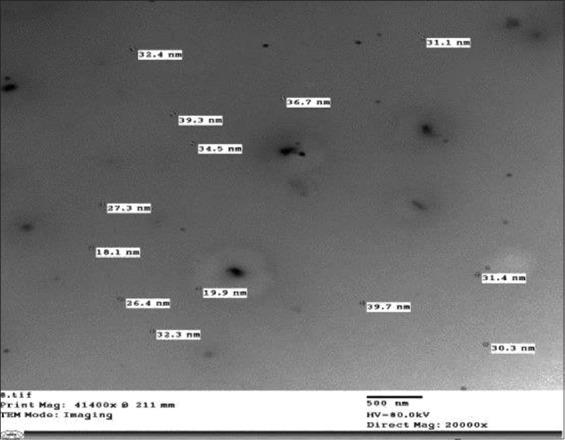
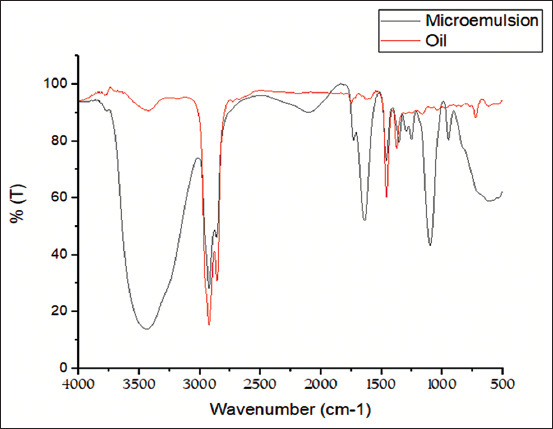
Peppermint oil ME formulation (15% oil/water) was prepared and characterized by zeta potential, Fourier transform infrared, high-resolution transmission electron microscopy, and liquid chromatography-mass spectrometry (LC-MS/MS). The minimal inhibitory concentrations of the peppermint oil and its ME were investigated. A total of 80 commercial one day old Arbor Acres broiler chickens were randomly assigned to four groups of 20 birds each. The four groups were the negative control, positive control, peppermint oil (0.5 mL/mL water/10 days old), and its ME (0.25 mL/mL water/10 days old) groups. was orally provided at concentration of 1×10 CFU/mL on days 14, 15, and 16. Clinical signs and mortality were observed daily. Growth performance, gross lesions and cecal samples were investigated and examined on days 21, 28, and 35.
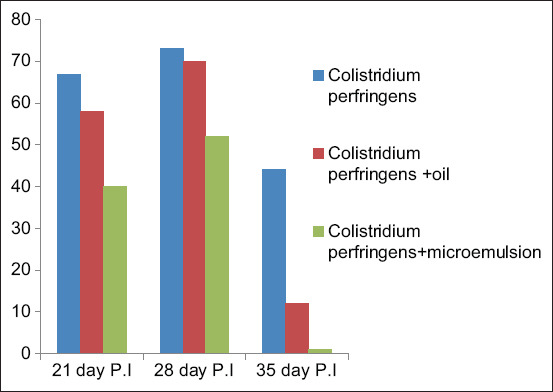
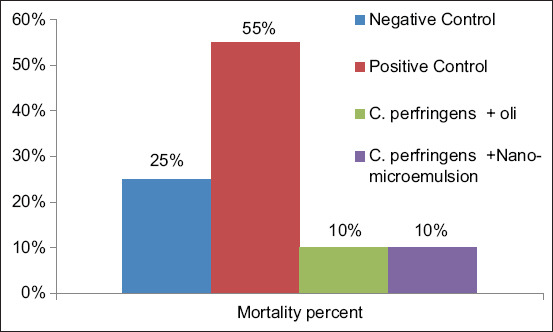
Peppermint oil ME formulation has a polydispersity index, zeta potential and droplet size of 0.234, -24 mV±4.19, and 29.96±1.56 nm, respectively. LC-MS/MS analysis of oil and ME revealed common presence of phenolic compounds such as rosmorinic (360.31 g/mol), chlorogenic acid (354.31 g/mol), hesperidin (610.56 g/mol), and luteolin 7-O-β-glucuronide (462.1 g/mol). The treated groups with peppermint oil and ME showed lower lesions, mortality and colony-forming units in addition to higher growth performance (p < 0.05) compared to the positive control group.
Our study suggests the potential efficacy of peppermint oil and ME in the reduction of necrotic enteritis lesions and count.
是引起坏死性肠炎疾病的多重耐药肠道病原体之一,给家禽养殖场造成巨大经济损失。本研究旨在评估薄荷油及其微乳剂(ME)作为抗生素替代品控制肉鸡坏死性肠炎的潜在用途。
制备薄荷油ME制剂(15%油/水),并通过zeta电位、傅里叶变换红外光谱、高分辨率透射电子显微镜和液相色谱-质谱联用(LC-MS/MS)进行表征。研究了薄荷油及其ME的最低抑菌浓度。总共80只1日龄的商品艾维茵肉鸡随机分为四组,每组20只。四组分别为阴性对照组、阳性对照组、薄荷油组(0.5 mL/mL水/10日龄)及其ME组(0.25 mL/mL水/10日龄)。在第14、15和16天以1×10 CFU/mL的浓度口服给药。每天观察临床症状和死亡率。在第21、28和35天调查并检查生长性能、大体病变和盲肠样本。
薄荷油ME制剂的多分散指数、zeta电位和液滴大小分别为0.234、-24 mV±4.19和29.96±1.56 nm。对油和ME的LC-MS/MS分析显示,共同存在酚类化合物,如迷迭香酸(360.31 g/mol)、绿原酸(354.31 g/mol)、橙皮苷(610.56 g/mol)和木犀草素7-O-β-葡萄糖醛酸苷(462.1 g/mol)。与阳性对照组相比,薄荷油和ME处理组除生长性能更高外(p < 0.05),病变、死亡率和菌落形成单位更低。
我们的研究表明薄荷油和ME在减少坏死性肠炎病变和计数方面具有潜在疗效。