Satomi Takuya, Kawano Seiji, Inaba Tomoki, Nakagawa Masahiro, Mouri Hirokazu, Yoshioka Masao, Tanaka Shoichi, Toyokawa Tatsuya, Kobayashi Sayo, Tanaka Takehiro, Kanzaki Hiromitsu, Iwamuro Masaya, Kawahara Yoshiro, Okada Hiroyuki
Department of Gastroenterology and Hepatology, Okayama University Graduate School of Medicine, Dentistry, and Pharmaceutical Sciences, Okayama 700-8558, Okayama, Japan.
Department of Gastroenterology, Kagawa Prefectural Central Hospital, Takamatsu 760-8557, Kagawa, Japan.
World J Gastroenterol. 2021 Mar 21;27(11):1043-1054. doi: 10.3748/wjg.v27.i11.1043.
Recent improvements in the prognosis of patients with esophageal cancer have led to the increased occurrence of gastric tube cancer (GTC) in the reconstructed gastric tube. However, there are few reports on the treatment results of endoscopic submucosal dissection (ESD) for GTC.
To evaluate the efficacy and safety of ESD for GTC after esophagectomy in a multicenter trial.
We retrospectively investigated 48 GTC lesions in 38 consecutive patients with GTC in the reconstructed gastric tube after esophagectomy who had undergone ESD between January 2005 and December 2019 at 8 institutions participating in the Okayama Gut Study group. The clinical indications of ESD for early gastric cancer were similarly applied for GTC after esophagectomy. ESD specimens were evaluated in 2-mm slices according to the Japanese Classification of Gastric Carcinoma with curability assessments divided into curative and non-curative resection based on the Gastric Cancer Treatment Guidelines. Patient characteristics, treatment results, clinical course, and treatment outcomes were analyzed.
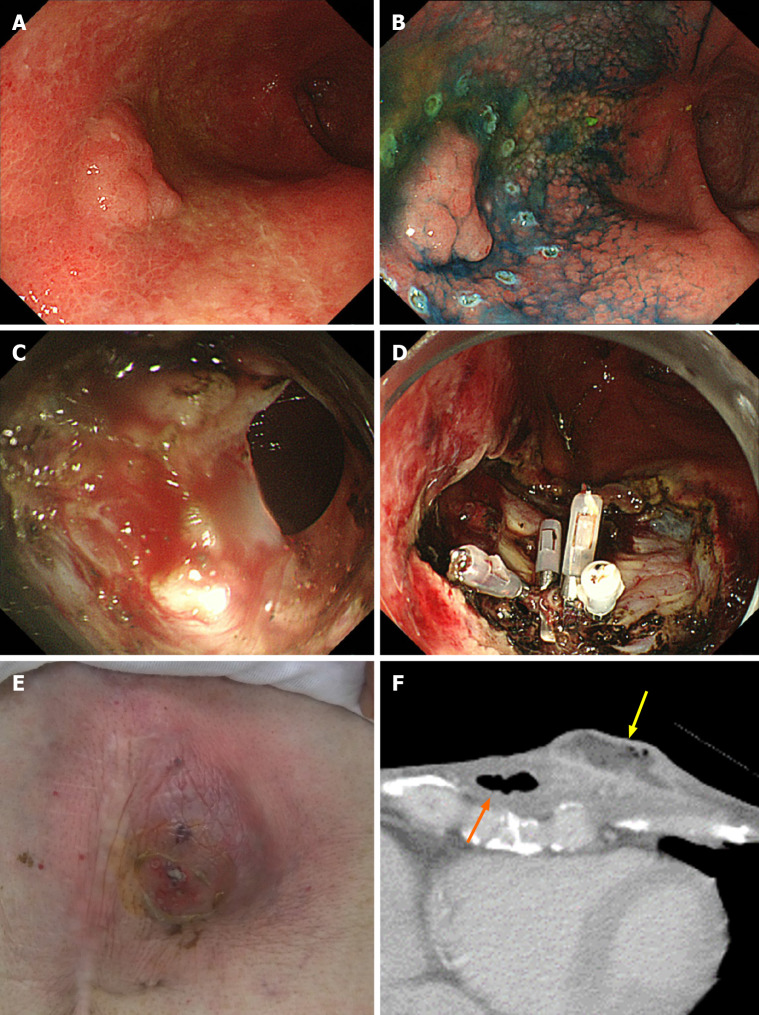
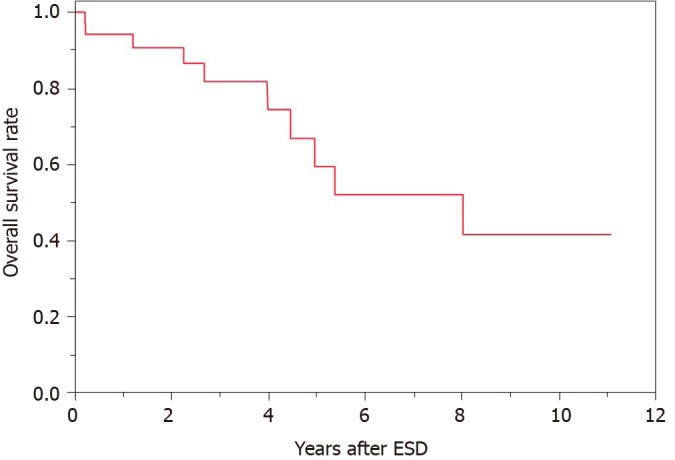
The median age of patients was 71.5 years (range, 57-84years), and there were 34 men and 4 women. The median observation period after ESD was 884 d (range, 8-4040 d). The median procedure time was 81 min (range, 29-334 min), the resection rate was 91.7% (44/48), and the curative resection rate was 79% (38/48). Complications during ESD were seen in 4% (2/48) of case, and those after ESD were seen in 10% (5/48) of case. The survival rate at 5 years was 59.5%. During the observation period after ESD, 10 patients died of other diseases. Although there were differences in the procedure time between institutions, a multivariate analysis showed that tumor size was the only factor associated with prolonged procedure time.
ESD for GTC after esophagectomy was shown to be safe and effective.
食管癌患者预后的近期改善导致重建胃管中胃管癌(GTC)的发生率增加。然而,关于内镜黏膜下剥离术(ESD)治疗GTC的结果报道较少。
在一项多中心试验中评估ESD治疗食管癌切除术后GTC的疗效和安全性。
我们回顾性调查了2005年1月至2019年12月期间在冈山肠道研究组的8家机构接受ESD的38例连续食管癌切除术后重建胃管中GTC患者的48个GTC病变。早期胃癌ESD的临床指征同样适用于食管癌切除术后的GTC。根据日本胃癌分类,将ESD标本切成2毫米薄片进行评估,根据《胃癌治疗指南》将治愈性评估分为治愈性和非治愈性切除。分析患者特征、治疗结果、临床病程和治疗结局。
患者的中位年龄为71.5岁(范围57 - 84岁),男性34例,女性4例。ESD后的中位观察期为884天(范围8 - 4040天)。中位手术时间为81分钟(范围29 - 334分钟),切除率为91.7%(44/48),治愈性切除率为79%(38/48)。ESD期间并发症发生率为4%(2/48),ESD后并发症发生率为10%(5/48)。5年生存率为59.5%。在ESD后的观察期内,10例患者死于其他疾病。尽管各机构之间手术时间存在差异,但多因素分析显示肿瘤大小是与手术时间延长相关的唯一因素。
食管癌切除术后ESD治疗GTC是安全有效的。