Sun Yanbo, Luo Jing, Qian Chuan, Luo Lan, Xu Manqi, Min Haiyan, Cen Yunyun
Department of Gastrointestinal Surgery, The Second Affiliated Hospital of Kunming Medical University, Kunming, 650101, People's Republic of China.
Department of Gastrointestinal Surgery, The First People's Hospital of Qujing, Qujing, 655000, People's Republic of China.
Infect Drug Resist. 2021 Mar 18;14:1105-1113. doi: 10.2147/IDR.S295077. eCollection 2021.
Many studies have suggested that indexes of nutritional status, such as body mass index (BMI), serum albumin (ALB), serum pre-albumin (PA), and hemoglobin, may be used as risk factors for the prognosis of HIV or lymphoma. Therefore, this study aimed to retrospectively analyze and explore the value of nutritional status in the prognostic assessment of patients with AIDS-related lymphoma (ARL).
In this retrospective study, the clinical data of 69 patients with ARL were collected. All patients had a definite diagnosis of non-Hodgkin lymphoma by pathological examination and met the requirements of the Hematopoietic and Lymphocytic Tissue Tumor Classification (2016) established by the World Health Organization. Patients who did not receive standard chemotherapy, those with incomplete medical records, and those with an unclear pathological diagnosis were excluded. The patients were divided into two groups (survival and death) according to the prognostic outcome, and their clinical characteristics and prognoses were discussed by relevant statistical methods.
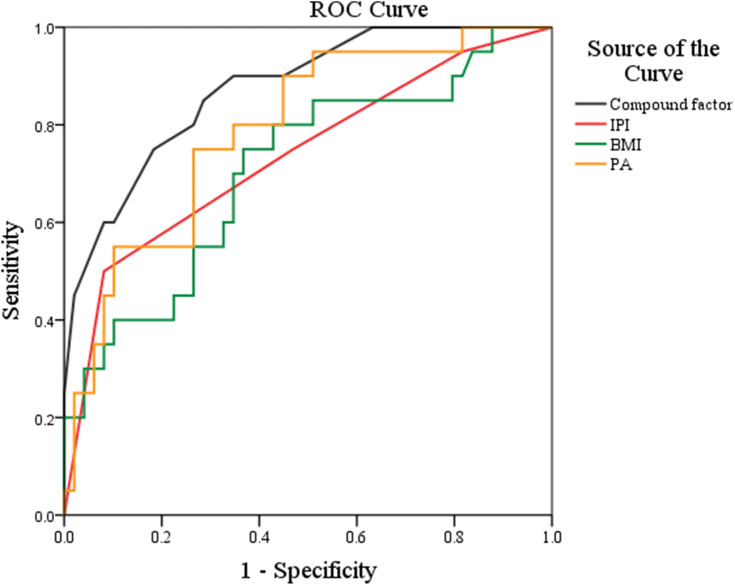
During the three-year follow-up period, 20 (28.99%) patients died, and 49 (71.01%) survived. The one-year cumulative survival rate was 78.26%. A univariate analysis found that the prognosis was associated with the International Prognostic Index (IPI) score, BMI, ALB, PA, and CD4 T lymphocyte count. The Cox risk proportional regression analysis showed that the IPI score, BMI, and PA were the independent risk factors for survival; their combination had a greater ability to forecast the clinical outcome (area under the curve = 0.874, P < 0.001).
In this study, at the time of the visit, the patients with ARL tended to be in the advanced stages of disease and, therefore, at high risk of mortality. Therefore, their nutritional status might be of great value to the prognostic assessment. The combination of BMI, PA, and IPI scores could be used for risk stratification and better screening of high-risk patients.
许多研究表明,营养状况指标,如体重指数(BMI)、血清白蛋白(ALB)、血清前白蛋白(PA)和血红蛋白,可能用作HIV或淋巴瘤预后的危险因素。因此,本研究旨在回顾性分析并探讨营养状况在艾滋病相关淋巴瘤(ARL)患者预后评估中的价值。
在这项回顾性研究中,收集了69例ARL患者的临床资料。所有患者均经病理检查确诊为非霍奇金淋巴瘤,且符合世界卫生组织制定的《造血与淋巴细胞组织肿瘤分类(2016)》的要求。排除未接受标准化化疗的患者、病历不完整的患者以及病理诊断不明确的患者。根据预后结果将患者分为两组(生存组和死亡组),并采用相关统计方法对其临床特征和预后进行讨论。
在三年的随访期内,20例(28.99%)患者死亡,49例(71.01%)存活。一年累积生存率为78.26%。单因素分析发现,预后与国际预后指数(IPI)评分、BMI、ALB、PA和CD4 T淋巴细胞计数有关。Cox风险比例回归分析显示,IPI评分、BMI和PA是生存的独立危险因素;它们的组合预测临床结局的能力更强(曲线下面积 = 0.874,P < 0.001)。
在本研究中,就诊时ARL患者往往处于疾病晚期,因此死亡风险较高。因此,他们的营养状况可能对预后评估具有重要价值。BMI、PA和IPI评分的组合可用于风险分层和更好地筛查高危患者。