Department of Endocrinology, Affiliated Hospital of Beihua University, Jilin 132012, China.
J Healthc Eng. 2021 Mar 12;2021:6678454. doi: 10.1155/2021/6678454. eCollection 2021.
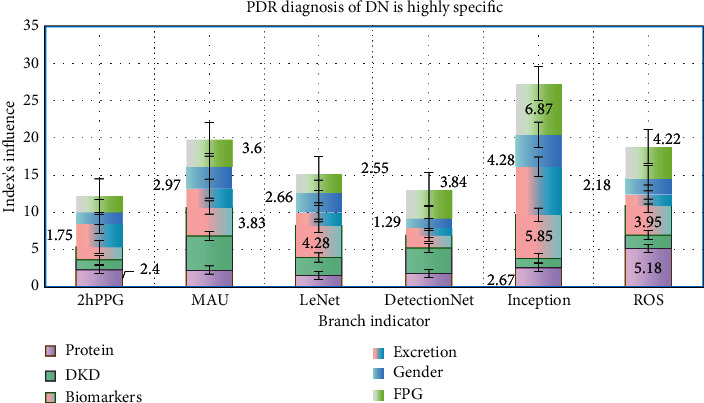
As the scale and depth of artificial intelligence network models continue to increase, their accuracy in albumin recognition tasks has increased rapidly. However, today's small medical datasets are the main reason for the poor recognition of artificial intelligence techniques in this area. The sample size in this article is based on the data analysis and research on urine albumin detection of diabetes in the EI database. It is assumed that the observation group has at least 20 mg UAER difference from the control group, and the standard deviation of the UAER change from baseline to 12 weeks is 30 mg. Therefore, the sample size of the two groups is 77 cases. Assuming that the rate of loss to follow-up during the follow-up period is 20%, at least 92 patients are needed. The final enrollment in this study is 100 patients. Studies have shown that DR is used as an indicator to diagnose NDRD, and its OR value is as high as 28.198, indicating that non-DR can be used as an indicator to distinguish DN from NDRD. The meta-analysis found that DR has a sensitivity of 0.65 and a specificity of 0.75 in distinguishing DN from NDRD in patients with type 2 diabetes, and it is emphasized that PDR is highly specific in the diagnosis of DN. Using a meta-analysis to systematically analyze 45 studies, it was found that the sensitivity of DR to diagnose DN was 0.67, the specificity was 0.78, and the specificity of PDR to predict DN was 0.99, indicating that DR is a good indicator for predicting DN, and the team's latest research has also verified this point of view. They have established a new model for diagnosing DN. In addition to including traditional proteinuria, glycosylated hemoglobin, FR, blood pressure, and other indicators into the diagnostic model, it will also include the presence or absence of DR. The final external verification accuracy rate of this model is 0.875.
随着人工智能网络模型的规模和深度不断增加,其在白蛋白识别任务中的准确性迅速提高。然而,目前的小医学数据集是人工智能技术在这一领域识别能力较差的主要原因。本文的样本量基于 EI 数据库中糖尿病尿白蛋白检测的数据分析和研究。假设观察组与对照组的 UAER 差异至少为 20mg,并且从基线到 12 周 UAER 变化的标准差为 30mg。因此,两组的样本量为 77 例。假设在随访期间失访率为 20%,则至少需要 92 例患者。本研究最终共纳入 100 例患者。研究表明,DR 作为 NDRD 的诊断指标,其 OR 值高达 28.198,提示非 DR 可作为鉴别 DN 与 NDRD 的指标。荟萃分析发现,DR 在鉴别 2 型糖尿病患者 DN 与 NDRD 时的灵敏度为 0.65,特异性为 0.75,强调 PDR 在 DN 的诊断中具有高度特异性。采用荟萃分析系统分析 45 项研究发现,DR 诊断 DN 的灵敏度为 0.67,特异性为 0.78,PDR 预测 DN 的特异性为 0.99,提示 DR 是预测 DN 的良好指标,研究团队的最新研究也验证了这一观点。他们建立了一种新的诊断 DN 的模型。除了将传统的蛋白尿、糖化血红蛋白、FR、血压等指标纳入诊断模型外,还将 DR 的有无纳入其中。该模型的最终外部验证准确率为 0.875。