Jiménez-Lobato Vania, Núñez-Farfán Juan
Escuela Superior de Desarrollo Sustentable, Universidad Autónoma de Guerrero, Cátedras CONACYT, México.
Laboratorio de Genética Ecológica y Evolución, Departamento de Ecología Evolutiva, Instituto de Ecología, Universidad Nacional Autónoma de México, Ciudad de México, Distrito Federal, Mexico.
PeerJ. 2021 Mar 19;9:e10698. doi: 10.7717/peerj.10698. eCollection 2021.
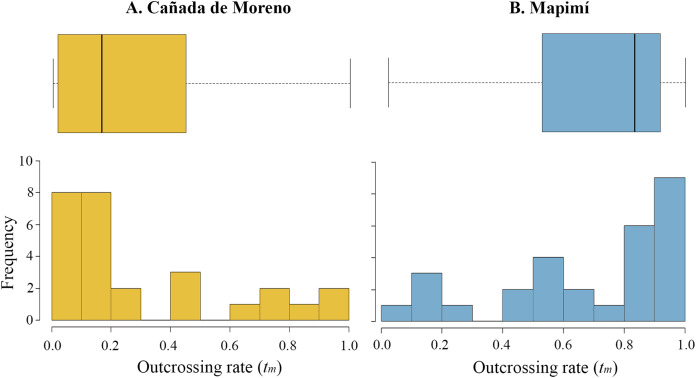
Plant mating system determines, to a great extent, the demographic and genetic properties of populations, hence their potential for adaptive evolution. Variation in plant mating system has been documented between phylogenetically related species as well between populations of a species. A common evolutionary transition, from outcrossing to selfing, is likely to occur under environmental spatial variation in the service of pollinators. Here, we studied two phenotypically (in floral traits) and genetically (in neutral molecular markers) differentiated populations of the annual, insect-pollinated, plant in Mexico, that differ in the service of pollinators (Mapimí and Cañada Moreno). First, we determined the populations' parameters of phenotypic in herkogamy, outcrossing and selfing rates with microsatellite loci, and assessed between generation (adults and seedlings) inbreeding, and inbreeding depression. Second, we compared the relationships between parameters in each population. Results point strong differences between populations: plants in Mapimí have, on average, approach herkogamy, higher outcrossing rate ( = 0.68), lower primary selfing rate ( = 0.35), and lower inbreeding at equilibrium ( = 0.24) and higher inbreeding depression (δ = 0.25), than the populations of Cañada. Outcrossing seems to be favored in Mapimí while selfing in Cañada. The relationship between and were negatively associated with herkogamy in Mapimí; here, progenies derived from plants with no herkogamy or reverse herkogamy had higher selfing rate and inbreeding coefficient than plants with approach herkogamy. The difference - is positively related to primary selfing rate () only in Cañada Moreno which suggests inbreeding depression in selfing individuals and then genetic purging. In conclusion, mating system evolution may occur differentially among maternal lineages within populations of , in which approach herkogamy favors higher outcrossing rates and low levels of inbreeding and inbreeding depression, while no herkogamy or reverse herkogamy lead to the evolution of the "selfing syndrome" following the purge of deleterious alleles despite high inbreeding among individuals.
植物交配系统在很大程度上决定了种群的人口统计学和遗传特性,进而决定了它们适应性进化的潜力。植物交配系统的变异在系统发育相关的物种之间以及同一物种的不同种群之间都有记录。一种常见的进化转变,即从异交到自交,很可能在传粉者服务的环境空间变异下发生。在这里,我们研究了墨西哥一年生、昆虫传粉植物的两个在表型(花部性状)和遗传(中性分子标记)上有差异的种群,它们在传粉者服务方面存在差异(马皮米和卡尼亚达莫雷诺)。首先,我们用微卫星位点确定了种群在雌雄异位、异交率和自交率方面的表型参数,并评估了代际(成体和幼苗)间的近亲繁殖以及近亲繁殖衰退。其次,我们比较了每个种群中各参数之间的关系。结果表明种群之间存在显著差异:与卡尼亚达种群相比,马皮米的植物平均接近雌雄异位,异交率更高( = 0.68),初级自交率更低( = 0.35),平衡时的近亲繁殖率更低( = 0.24),近亲繁殖衰退更高(δ = 0.25)。在马皮米似乎有利于异交,而在卡尼亚达则有利于自交。在马皮米, 与 的关系与雌雄异位呈负相关;在这里,来自无雌雄异位或反向雌雄异位植物的后代比接近雌雄异位的植物具有更高的自交率和近亲繁殖系数。 - 的差异仅在卡尼亚达莫雷诺与初级自交率()呈正相关,这表明自交个体存在近亲繁殖衰退,进而发生遗传清除。总之,交配系统进化可能在 种群内的母系谱系间存在差异,其中接近雌雄异位有利于更高的异交率以及低水平的近亲繁殖和近亲繁殖衰退,而无雌雄异位或反向雌雄异位则导致尽管个体间近亲繁殖率高,但在有害等位基因清除后“自交综合征”的进化。