Bazan Jose G, DiCostanzo Dominic, Hock Karen, Jhawar Sachin, Kuhn Karla, Lindsey Kylee, Tedrick Kayla, Healy Erin, Beyer Sasha, White Julia R
Department of Radiation Oncology, The Ohio State University Comprehensive Cancer Center and Stefanie Spielman Comprehensive Breast Center - Arthur G. James Cancer Hospital and Solove Research Institute, The Ohio State University, Columbus, OH, United States.
Department of Physical Therapy, The Ohio State University Comprehensive Cancer Center and Stefanie Spielman Comprehensive Breast Center - Arthur G. James Cancer Hospital and Solove Research Institute, The Ohio State University, Columbus, OH, United States.
Front Oncol. 2021 Mar 11;11:617926. doi: 10.3389/fonc.2021.617926. eCollection 2021.
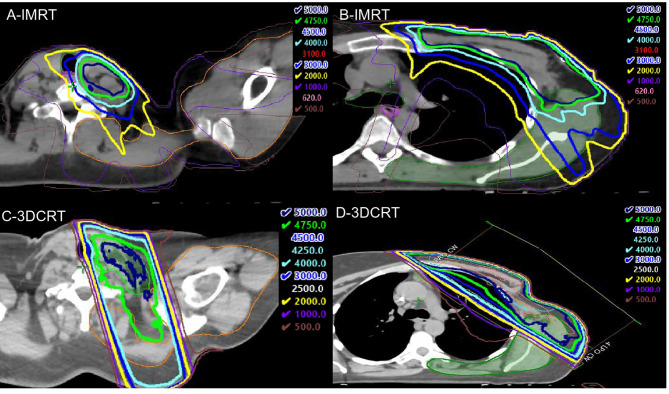
BACKGROUND/PURPOSE: Shoulder/arm morbidity is a late complication of breast cancer treatment with surgery and regional nodal irradiation (RNI). We set to analyze the impact of radiation technique [intensity modulated radiation therapy (IMRT) or 3D conformal radiation therapy (3DCRT)] on radiation dose to the shoulder with a hypothesis that IMRT use results in smaller volume of shoulder receiving radiation. We explored the relationship of treatment technique on long-term patient-reported outcomes using the quick disabilities of the arm, shoulder, and hand (q-DASH) questionnaire.
MATERIALS/METHODS: We identified patients treated with adjuvant RNI (50 Gy/25 fractions) from 2013 to 2018. We retrospectively contoured the shoulder organ-at-risk (OAR) from 2 cm above the ipsilateral supraclavicular (SCL) planning target volume (PTV) to the inferior SCL PTV slice and calculated the absolute volume of shoulder OAR receiving 5-50 Gy (V5-V50). We identified patients that completed a q-DASH questionnaire ≥6 months from the end of RNI.
We included 410 RNI patients: 54% stage III, 72% mastectomy, 35% treated with IMRT. IMRT resulted in significant reductions in the shoulder OAR volume receiving 20-50 Gy 3DCRT. In total, 82 patients completed the q-DASH. The mean (SD) q-DASH=25.4 (19.1) and tended to be lower with IMRT 3DCRT: 19.6 (16.4) 27.8 (19.8), p=0.078.
We found that IMRT reduces radiation dose to the shoulder and is associated with a trend toward reduced q-DASH scores ≥6 months post-RNI in a subset of our cohort. These results support prospective evaluation of IMRT as a technique to reduce shoulder morbidity in breast cancer patients receiving RNI.
背景/目的:肩部/手臂并发症是乳腺癌手术及区域淋巴结照射(RNI)治疗后的晚期并发症。我们旨在分析放射技术[调强放射治疗(IMRT)或三维适形放射治疗(3DCRT)]对肩部放射剂量的影响,假设使用IMRT会使接受放射的肩部体积更小。我们使用手臂、肩部和手部快速功能障碍(q-DASH)问卷探讨了治疗技术与患者长期报告结局之间的关系。
材料/方法:我们确定了2013年至2018年接受辅助RNI(50 Gy/25次分割)治疗的患者。我们回顾性勾画了从同侧锁骨上(SCL)计划靶体积(PTV)上方2 cm至SCL PTV下方切片的肩部危及器官(OAR),并计算了接受5 - 50 Gy(V5 - V50)的肩部OAR绝对体积。我们确定了在RNI结束后≥6个月完成q-DASH问卷的患者。
我们纳入了410例RNI患者:54%为III期,72%接受乳房切除术,35%接受IMRT治疗。与3DCRT相比,IMRT使接受20 - 50 Gy照射的肩部OAR体积显著减少。共有82例患者完成了q-DASH问卷。平均(标准差)q-DASH = 25.4(19.1),IMRT组往往低于3DCRT组:19.6(16.4)对27.8(19.8),p = 0.078。
我们发现IMRT降低了肩部的放射剂量,并且在我们队列的一部分患者中,与RNI后≥6个月q-DASH评分降低的趋势相关。这些结果支持对IMRT作为一种降低接受RNI的乳腺癌患者肩部并发症的技术进行前瞻性评估。