Potter Huntington, Woodcock Jonathan H, Boyd Timothy D, Coughlan Christina M, O'Shaughnessy John R, Borges Manuel T, Thaker Ashesh A, Raj Balaibail A, Adamszuk Katarzyna, Scott David, Adame Vanesa, Anton Paige, Chial Heidi J, Gray Helen, Daniels Joseph, Stocker Michelle E, Sillau Stefan H
Department of Neurology University of Colorado School of Medicine Aurora Colorado USA.
University of Colorado Alzheimer's and Cognition Center Aurora Colorado USA.
Alzheimers Dement (N Y). 2021 Mar 24;7(1):e12158. doi: 10.1002/trc2.12158. eCollection 2021.
Inflammatory markers have long been observed in the brain, cerebrospinal fluid (CSF), and plasma of Alzheimer's disease (AD) patients, suggesting that inflammation contributes to AD and might be a therapeutic target. However, non-steroidal anti-inflammatory drug trials in AD and mild cognitive impairment (MCI) failed to show benefit. Our previous work seeking to understand why people with the inflammatory disease rheumatoid arthritis are protected from AD found that short-term treatment of transgenic AD mice with the pro-inflammatory cytokine granulocyte-macrophage colony-stimulating factor (GM-CSF) led to an increase in activated microglia, a 50% reduction in amyloid load, an increase in synaptic area, and improvement in spatial memory to normal. These results called into question the consensus view that inflammation is solely detrimental in AD. Here, we tested our hypothesis that modulation of the innate immune system might similarly be used to treat AD in humans by investigating the ability of GM-CSF/sargramostim to safely ameliorate AD symptoms/pathology.
A randomized, double-blind, placebo-controlled trial was conducted in mild-to-moderate AD participants (NCT01409915). Treatments (20 participants/group) occurred 5 days/week for 3 weeks plus two follow-up (FU) visits (FU1 at 45 days and FU2 at 90 days) with neurological, neuropsychological, blood biomarker, and imaging assessments.
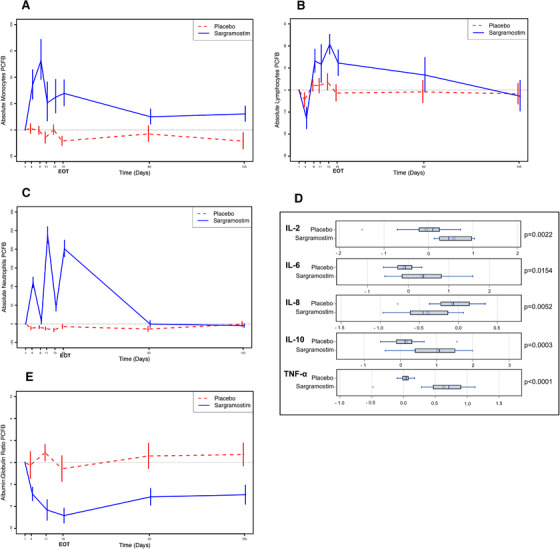
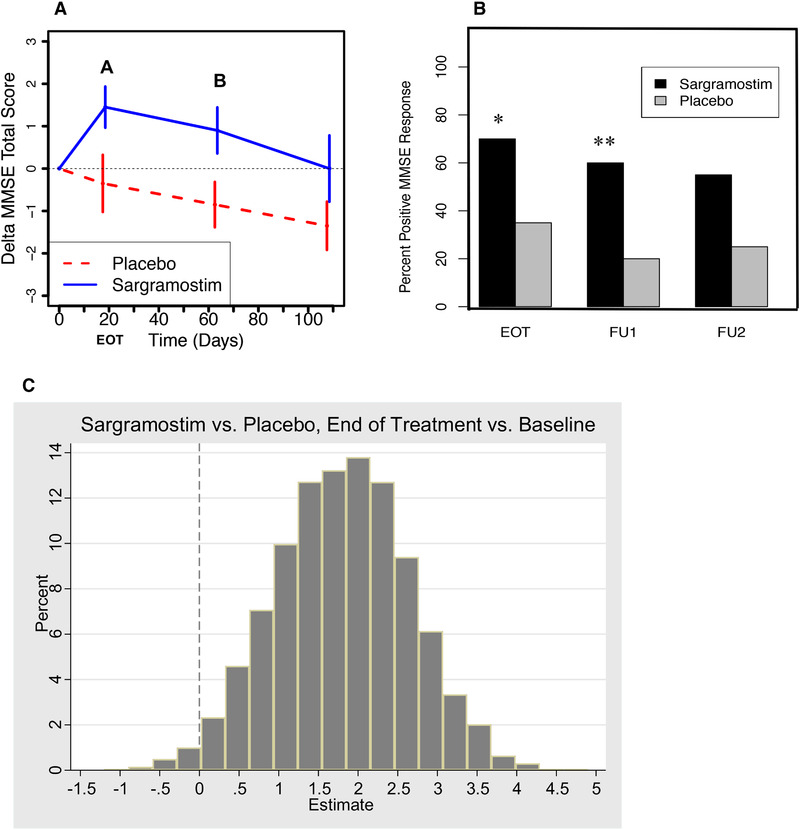
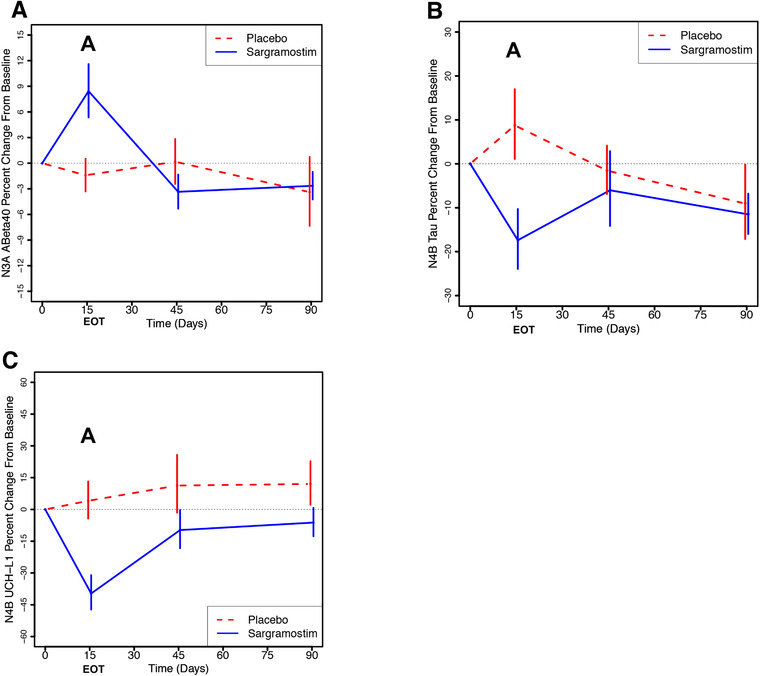
Sargramostim treatment expectedly changed innate immune system markers, with no drug-related serious adverse events or amyloid-related imaging abnormalities. At end of treatment (EOT), the Mini-Mental State Examination score of the sargramostim group increased compared to baseline ( = .0074) and compared to placebo ( = .0370); the treatment effect persisted at FU1 ( = .0272). Plasma markers of amyloid beta (Aβ40 [decreased in AD]) increased 10% ( = .0105); plasma markers of neurodegeneration (total tau and UCH-L1) decreased 24% ( = .0174) and 42% ( = .0019), respectively, after sargramostim treatment compared to placebo.
The innate immune system is a viable target for therapeutic intervention in AD. An extended treatment trial testing the long-term safety and efficacy of GM-CSF/sargramostim in AD is warranted.
长期以来,在阿尔茨海默病(AD)患者的大脑、脑脊液(CSF)和血浆中均观察到炎症标志物,这表明炎症与AD的发生有关,可能是一个治疗靶点。然而,针对AD和轻度认知障碍(MCI)的非甾体抗炎药试验未能显示出益处。我们之前致力于探究为何患有炎症性疾病类风湿性关节炎的人对AD具有抵抗力的研究发现,用促炎细胞因子粒细胞巨噬细胞集落刺激因子(GM-CSF)对转基因AD小鼠进行短期治疗,可导致活化小胶质细胞增加、淀粉样蛋白负荷降低50%、突触面积增加以及空间记忆改善至正常水平。这些结果对炎症在AD中仅有有害作用的共识观点提出了质疑。在此,我们通过研究GM-CSF/沙格司亭安全改善AD症状/病理的能力,来检验我们的假设,即调节先天性免疫系统可能同样可用于治疗人类AD。
在轻度至中度AD参与者中进行了一项随机、双盲、安慰剂对照试验(NCT01409915)。治疗(每组20名参与者)每周进行5天,共3周,外加两次随访(FU)就诊(45天时的FU1和90天时的FU2),同时进行神经学、神经心理学、血液生物标志物和影像学评估。
沙格司亭治疗预期会改变先天性免疫系统标志物,未出现与药物相关的严重不良事件或与淀粉样蛋白相关的影像学异常。在治疗结束(EOT)时,沙格司亭组的简易精神状态检查评分与基线相比有所增加(P = 0.0074),与安慰剂组相比也有所增加(P = 0.0370);治疗效果在FU1时持续存在(P = 0.0272)。淀粉样β蛋白(Aβ40[在AD中降低])的血浆标志物增加了10%(P = 0.0105);与安慰剂相比,沙格司亭治疗后神经变性的血浆标志物(总tau和UCH-L1)分别降低了24%(P = 0.0174)和42%(P = 0.0019)。
先天性免疫系统是AD治疗干预的一个可行靶点。有必要进行一项扩展治疗试验,以测试GM-CSF/沙格司亭在AD中的长期安全性和有效性。