Xie Zhihui, McGrath Cody, Sankaran Jeyantt, Styner Maya, Little-Letsinger Sarah, Dudakovic Amel, van Wijnen Andre J, Rubin Janet, Sen Buer
Department of Medicine University of North Carolina Chapel Hill NC USA.
Department of Orthopedic Surgery and Biochemistry and Molecular Biology Mayo Clinic Rochester MN USA.
JBMR Plus. 2021 Jan 20;5(3):e10450. doi: 10.1002/jbm4.10450. eCollection 2021 Mar.
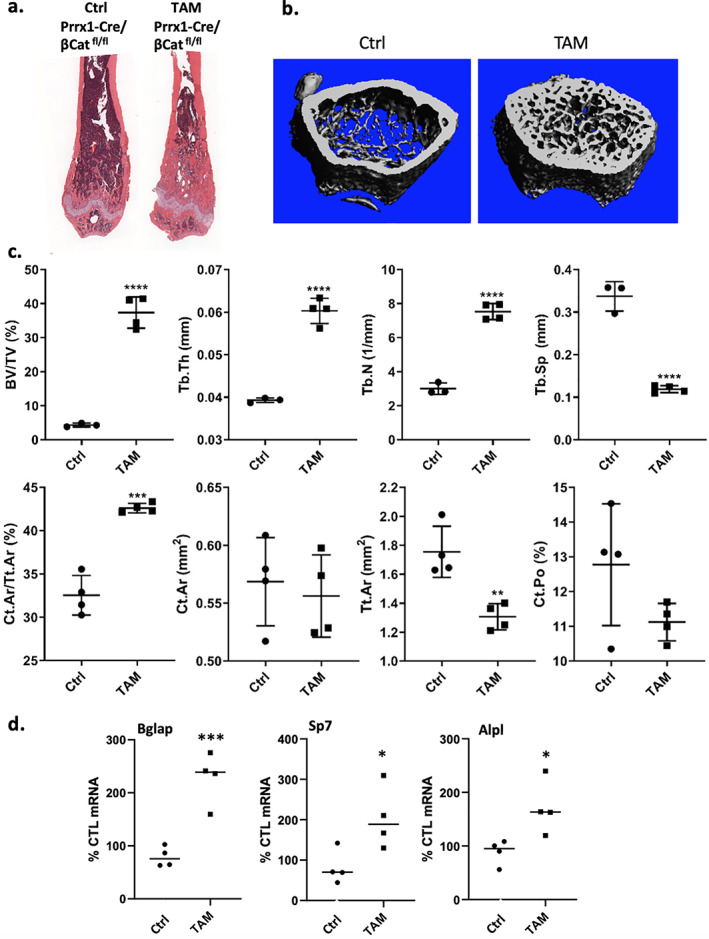
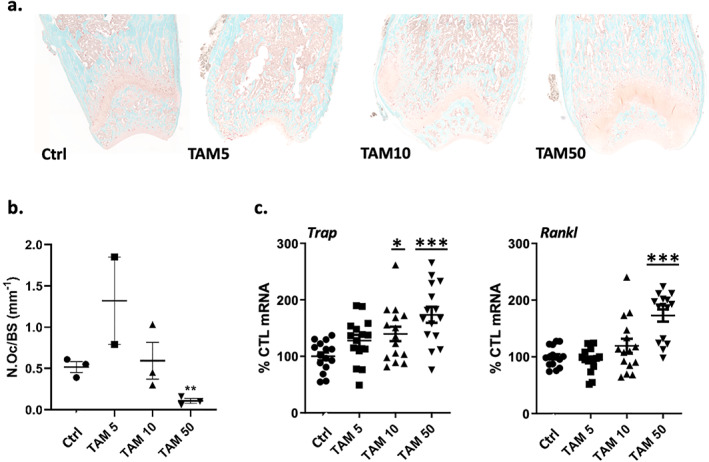
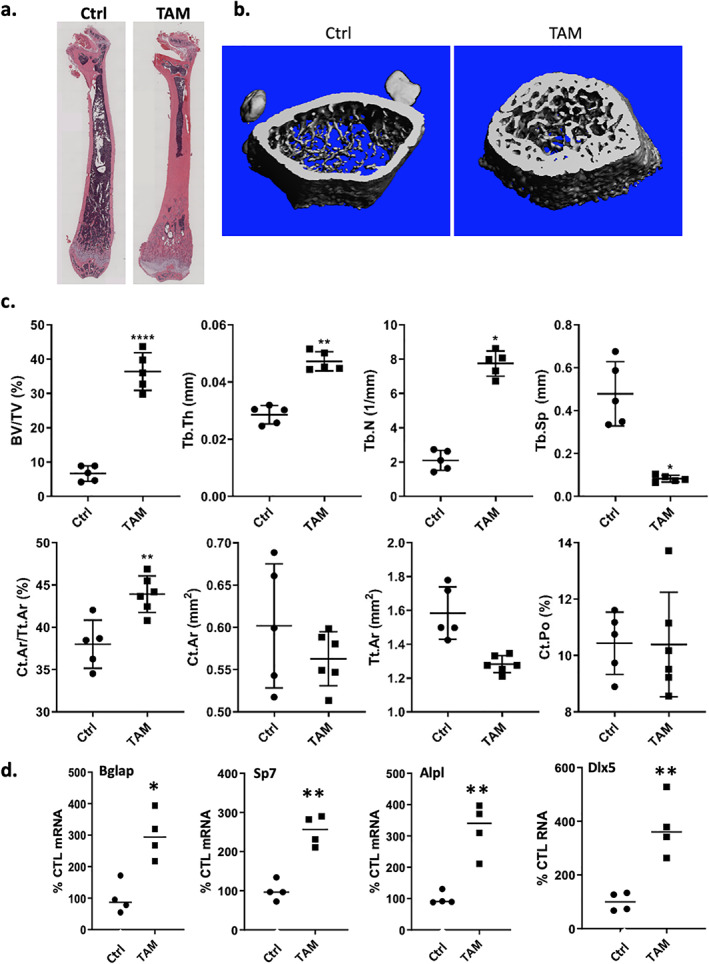
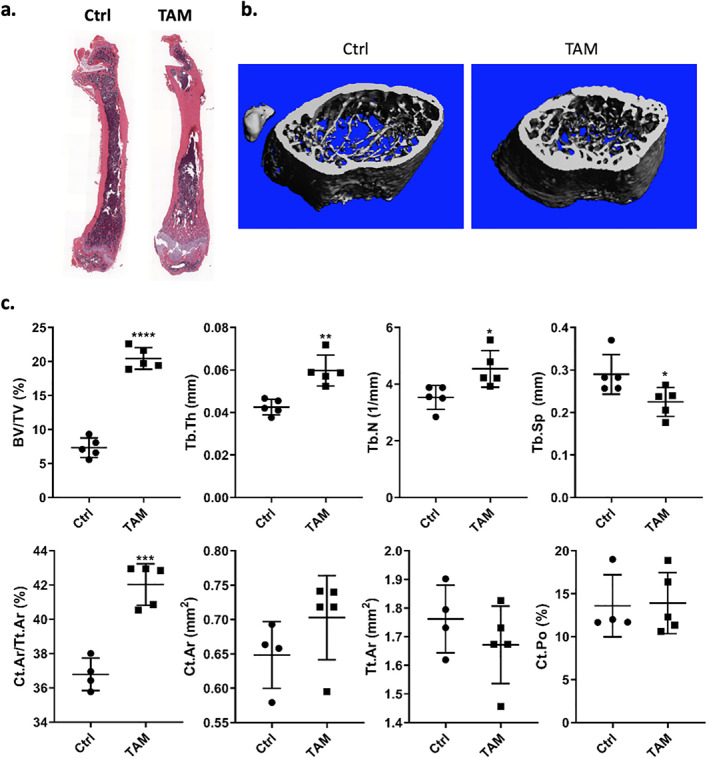
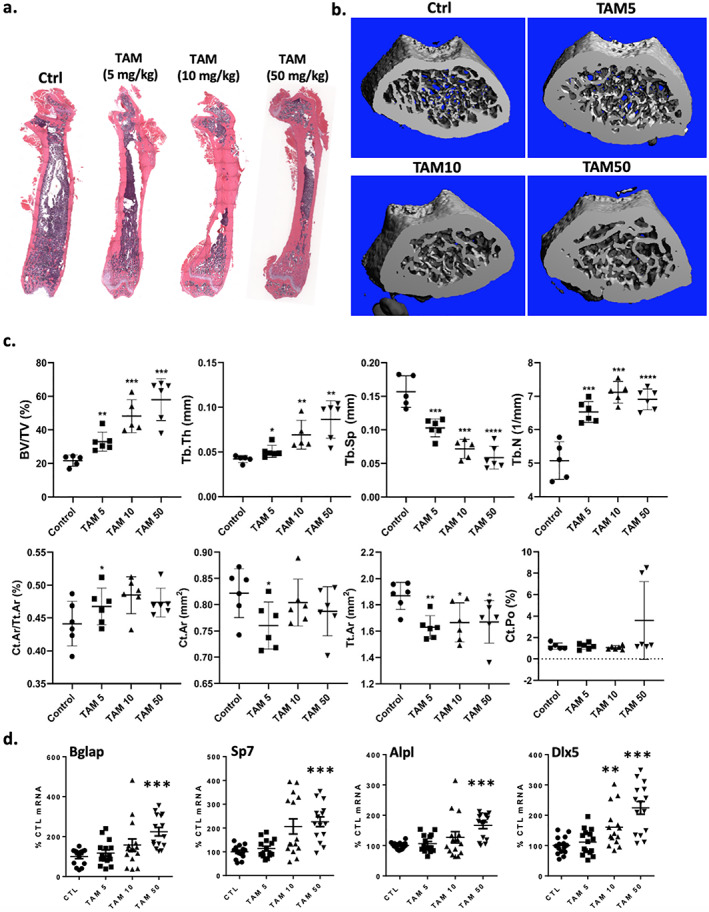
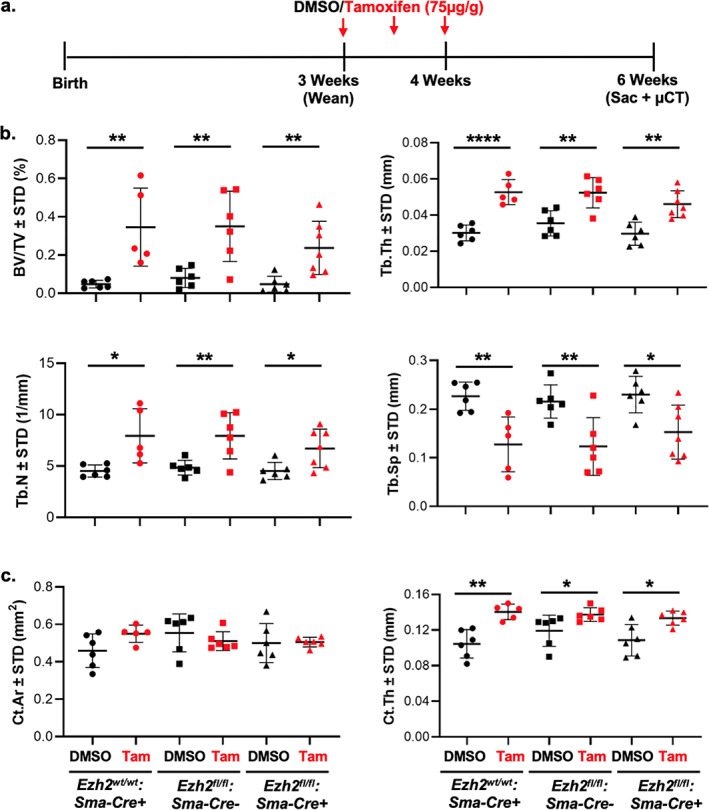
Use of the selective estrogen receptor modulator Tamoxifen (TAM) is a mainstay to induce conditional expression of Cre recombinase in transgenic laboratory mice. To excise β-catenin in 28-day-old male and female Prrx1-CreER/β-catenin mice (C57BL/6), we utilized TAM at 150 mg/kg; despite β-catenin knockout in MSC, we found a significant increase in trabecular and cortical bone volume in all genders. Because TAM was similarly anabolic in KO and control mice, we investigated a dose effect on bone formation by treating wild-type mice (WT C57BL/6, 4 weeks) with TAM (total dose 0, 20, 40, 200 mg/kg via four injections). TAM increased bone in a dose-dependent manner analyzed by micro-computed tomography (μCT), which showed that, compared to control, 20 mg/kg TAM increased femoral bone volume fraction (bone volume/total volume [BV/TV]) (21.6% ± 1.5% to 33% ± 2.5%; 153%, < 0.005). With TAM 40 mg/kg and 200 mg/kg, BV/TV increased to 48.1% ± 4.4% (223%, < 0.0005) and 58% ± 3.8% (269%, < 0.0001) respectively, compared to control. Osteoblast markers increased with 200 mg/kg TAM: (224%, < 0.0001), (166%, < 0.0001), (223%, < 0.0001), and (228%, < 0.0001). Osteoclasts per bone surface (Oc#/BS) nearly doubled at the lowest TAM dose (20 mg/kg), but decreased to <20% control with 200 mg/kg TAM. Our data establish that use of TAM at even very low doses to excise a floxed target in postnatal mice has profound effects on trabecular and cortical bone formation. As such, TAM treatment is a major confounder in the interpretation of bone phenotypes in conditional gene knockout mouse models. © 2020 The Authors. published by Wiley Periodicals LLC. on behalf of American Society for Bone and Mineral Research.
使用选择性雌激素受体调节剂他莫昔芬(TAM)是在转基因实验小鼠中诱导Cre重组酶条件性表达的主要方法。为了在28日龄的雄性和雌性Prrx1-CreER/β-连环蛋白小鼠(C57BL/6)中切除β-连环蛋白,我们使用了150mg/kg的TAM;尽管间充质干细胞中的β-连环蛋白被敲除,但我们发现所有性别的小梁骨和皮质骨体积均显著增加。由于TAM在基因敲除小鼠和对照小鼠中具有相似的促合成代谢作用,我们通过用TAM(通过四次注射,总剂量为0、20、40、200mg/kg)处理野生型小鼠(野生型C57BL/6,4周龄)来研究其对骨形成的剂量效应。通过微计算机断层扫描(μCT)分析,TAM以剂量依赖性方式增加骨量,结果显示,与对照组相比,20mg/kg TAM增加了股骨骨体积分数(骨体积/总体积[BV/TV])(从21.6%±1.5%增加到33%±2.5%;增加了153%,P<0.005)。使用40mg/kg和200mg/kg TAM时,BV/TV分别增加到48.1%±4.4%(增加了223%,P<0.0005)和58%±3.8%(增加了269%,P<0.0001),与对照组相比。200mg/kg TAM使成骨细胞标志物增加:(增加了224%,P<0.0001),(增加了166%,P<0.0001),(增加了223%,P<0.0001),以及(增加了228%,P<0.0001)。最低TAM剂量(20mg/kg)时,每骨表面破骨细胞数量(Oc#/BS)几乎增加了一倍,但200mg/kg TAM时降至对照组的<20%。我们的数据表明,即使在极低剂量下使用TAM在出生后小鼠中切除一个floxed靶标,也会对小梁骨和皮质骨形成产生深远影响。因此,在解释条件性基因敲除小鼠模型中的骨表型时,TAM治疗是一个主要的混杂因素。©2020作者。由Wiley Periodicals LLC代表美国骨与矿物质研究学会出版。