Oncology Unit, Azienda Socio Sanitaria Territoriale Bergamo Ovest, Treviglio, Italy.
Oncology Unit, Department of Biotechnology and Applied Clinical Sciences, San Salvatore Hospital, University of L'Aquila, L'Aquila, Italy.
JAMA Netw Open. 2021 Mar 1;4(3):e213520. doi: 10.1001/jamanetworkopen.2021.3520.
Obesity, defined as a body mass index (BMI) greater than 30, is associated with a significant increase in the risk of many cancers and in overall mortality. However, various studies have suggested that patients with cancer and no obesity (ie, BMI 20-25) have worse outcomes than patients with obesity.
To assess the association between obesity and outcomes after a diagnosis of cancer.
PubMed, the Cochrane Library, and EMBASE were searched from inception to January 2020.
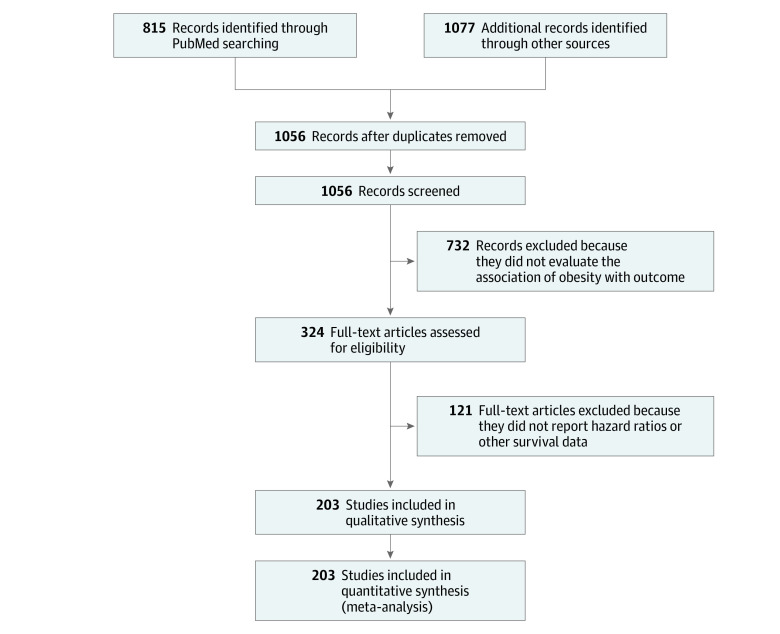
Studies reporting prognosis of patients with obesity using standard BMI categories and cancer were included. Studies that used nonstandard BMI categories, that were limited to children, or that were limited to patients with hematological malignant neoplasms were excluded. Screening was performed independently by multiple reviewers. Among 1892 retrieved studies, 203 (17%) met inclusion criteria for initial evaluation.
The Meta-analysis of Observational Studies in Epidemiology (MOOSE) and Preferred Reporting Items for Systematic Reviews and Meta-analyses (PRISMA) reporting guidelines were reporting guideline was followed. Data were extracted by multiple independent reviewers. Risk of death, cancer-specific mortality, and recurrence were pooled to provide an adjusted hazard ratio (HR) with a 95% CI . A random-effects model was used for the retrospective nature of studies.
The primary outcome of the study was overall survival (OS) in patients with cancer, with and without obesity. Secondary end points were cancer-specific survival (CSS) and progression-free survival (PFS) or disease-free survival (DFS). The risk of events was reported as HRs with 95% CIs, with an HR greater than 1 associated with a worse outcome among patients with obesity vs those without.
A total of 203 studies with 6 320 365 participants evaluated the association of OS, CSS, and/or PFS or DFS with obesity in patients with cancer. Overall, obesity was associated with a reduced OS (HR, 1.14; 95% CI, 1.09-1.19; P < .001) and CSS (HR, 1.17; 95% CI, 1.12-1.23; P < .001). Patients were also at increased risk of recurrence (HR, 1.13; 95% CI, 1.07-1.19; P < .001). Conversely, patients with obesity and lung cancer, renal cell carcinoma, or melanoma had better survival outcomes compared with patients without obesity and the same cancer (lung: HR, 0.86; 95% CI, 0.76-0.98; P = .02; renal cell: HR, 0.74; 95% CI, 0.53-0.89; P = .02; melanoma: HR, 0.74; 95% CI, 0.57-0.96; P < .001).
In this study, obesity was associated with greater mortality overall in patients with cancer. However, patients with obesity and lung cancer, renal cell carcinoma, and melanoma had a lower risk of death than patients with the same cancers without obesity. Weight-reducing strategies may represent effective measures for reducing mortality in these patients.
肥胖(BMI 大于 30)与多种癌症风险显著增加以及总死亡率增加有关。然而,多项研究表明,患有癌症且不肥胖(即 BMI 为 20-25)的患者比肥胖患者的预后更差。
评估癌症诊断后肥胖与预后的关系。
从建库到 2020 年 1 月,在 PubMed、Cochrane 图书馆和 EMBASE 中检索文献。
纳入使用标准 BMI 类别报告肥胖患者预后的研究。排除使用非标准 BMI 类别、仅限于儿童或仅限于血液恶性肿瘤患者的研究。由多名评审员独立进行筛选。在检索到的 1892 篇研究中,有 203 篇(17%)符合初始评估标准。
遵循观察性研究荟萃分析中的 MOOSE 和系统评价和荟萃分析的 PRISMA 报告指南。数据由多名独立评审员提取。死亡风险、癌症特异性死亡率和复发率被汇总以提供调整后的风险比(HR)及其 95%CI。由于研究的回顾性,使用随机效应模型。
本研究的主要结局是肥胖和非肥胖癌症患者的总生存(OS)。次要终点为癌症特异性生存(CSS)和无进展生存(PFS)或无病生存(DFS)。事件风险报告为 HR 及其 95%CI,HR 大于 1 表明肥胖患者的结局比非肥胖患者差。
共有 203 项研究纳入了 6320365 名参与者,评估了 OS、CSS 和/或 PFS 或 DFS 与癌症患者肥胖之间的关系。总体而言,肥胖与 OS 降低(HR,1.14;95%CI,1.09-1.19;P<0.001)和 CSS 降低(HR,1.17;95%CI,1.12-1.23;P<0.001)相关。肥胖患者的复发风险也增加(HR,1.13;95%CI,1.07-1.19;P<0.001)。相反,患有肥胖症且患有肺癌、肾细胞癌或黑色素瘤的患者与不肥胖且患有相同癌症的患者相比,生存结局更好(肺癌:HR,0.86;95%CI,0.76-0.98;P=0.02;肾细胞癌:HR,0.74;95%CI,0.53-0.89;P=0.02;黑色素瘤:HR,0.74;95%CI,0.57-0.96;P<0.001)。
在这项研究中,肥胖与癌症患者的总体死亡率增加有关。然而,患有肥胖症且患有肺癌、肾细胞癌和黑色素瘤的患者的死亡率低于不肥胖且患有相同癌症的患者。减轻体重的策略可能是降低这些患者死亡率的有效措施。