• 文献检索
  • 文档翻译
  • 深度研究
  • 学术资讯
  • Suppr Zotero 插件Zotero 插件
  • 邀请有礼
  • 套餐&价格
  • 历史记录
应用&插件
Suppr Zotero 插件Zotero 插件浏览器插件Mac 客户端Windows 客户端微信小程序
定价
高级版会员购买积分包购买API积分包
服务
文献检索文档翻译深度研究API 文档MCP 服务
关于我们
关于 Suppr公司介绍联系我们用户协议隐私条款
关注我们

Suppr 超能文献

核心技术专利:CN118964589B侵权必究
粤ICP备2023148730 号-1Suppr @ 2026

文献检索

告别复杂PubMed语法,用中文像聊天一样搜索,搜遍4000万医学文献。AI智能推荐,让科研检索更轻松。

立即免费搜索

文件翻译

保留排版,准确专业,支持PDF/Word/PPT等文件格式,支持 12+语言互译。

免费翻译文档

深度研究

AI帮你快速写综述,25分钟生成高质量综述,智能提取关键信息,辅助科研写作。

立即免费体验

肾移植受者免疫抑制药物不依从的流行率:障碍和预测因素。

Prevalence of Non-Adherence to Immunosuppressive Medications in Kidney Transplant Recipients: Barriers and Predictors.

机构信息

Department of Nutrition, King Saud Bin Abdulaziz University for Health Sciences, Jeddah, Saudi Arabia.

King Abdullah International Medical Research Center, Jeddah, Saudi Arabia.

出版信息

Ann Transplant. 2021 Mar 30;26:e928356. doi: 10.12659/AOT.928356.

DOI:10.12659/AOT.928356
PMID:33782377
原文链接:https://pmc.ncbi.nlm.nih.gov/articles/PMC8019265/
Abstract

BACKGROUND Non-adherence to immunosuppressant therapy (IST) is a major risk factor for graft rejection. Limited reports are available regarding the prevalence of non-adherence to IST in kidney transplant recipients (KTRs) as well as the predictors and barriers of non-adherence. MATERIAL AND METHODS The study included ambulatory KTRs, ≥18 years of age, with a functional kidney, from January 2017 to November 2018. The primary outcome was the prevalence of non-adherence, assessed with: 1) A telephone interview to complete the Arabic-translated and validated Immunosuppressant Therapy Adherence Instrument Scale (ITAS) and 2) IST serum blood levels within therapeutic levels. The secondary outcomes were the barriers to adherence using the validated Immunosuppressant Therapy Barriers of Adherence Scale (ITBS). RESULTS We enrolled 102 of 141 patients screened. The mean±SD for age, body mass index, and the baseline of the estimated glomerular filtration rate were 45.5±15.6 years, 29.1±6 kg/m², and 72.7±21.9 ml/min/1.73 m², respectively. The prevalence of non-adherence was 5.9%, 95% CI (2.19-12.36%) and 14.7%, 95% CI (8.47-23.09%) using the ITAS and the average blood serum drug levels, respectively. The concordance of the 2 methods demonstrated an agreement of 81.3%, kappa of 0.01, and 95% CI (-0.16 to 0.18). The median, interquartile range (IQR) for ITBS, and uncontrollable and controllable barriers for adherence were 21, (18-25), 15, (12-18), and 6, (5-8), respectively. CONCLUSIONS The current study demonstrated a low to moderate prevalence of non-adherence to IST in KTRs. The barriers for adherence with IST necessitate additional targeted interventions to manage and optimize therapeutic and clinical outcomes.

摘要

背景

免疫抑制剂治疗(IST)依从性差是移植物排斥的主要危险因素。关于肾移植受者(KTR)IST 依从性的流行率以及不依从的预测因素和障碍,仅有有限的报道。

材料和方法

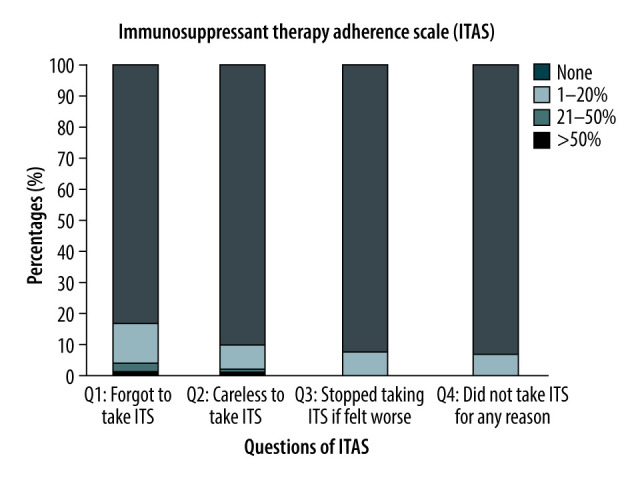
本研究纳入了 2017 年 1 月至 2018 年 11 月期间门诊 KTR,年龄≥18 岁,有功能肾。主要结局是不依从 IST 的发生率,通过以下方法评估:1)电话访谈以完成阿拉伯语翻译并验证免疫抑制剂治疗依从性工具量表(ITAS)和 2)IST 血清血药浓度在治疗水平内。次要结局是使用验证的免疫抑制剂治疗依从性障碍量表(ITBS)评估依从性的障碍。

结果

我们对 141 名筛查患者中的 102 名进行了入组。年龄、体重指数和估计肾小球滤过率基线的平均值±标准差分别为 45.5±15.6 岁、29.1±6kg/m²和 72.7±21.9ml/min/1.73m²。分别使用 ITAS 和平均血清药物水平,不依从 IST 的发生率为 5.9%(95%CI[2.19-12.36%])和 14.7%(95%CI[8.47-23.09%])。两种方法的一致性显示,一致性为 81.3%,kappa 值为 0.01,95%CI(-0.16 至 0.18)。ITBS 的中位数、四分位距(IQR)和依从性的不可控和可控障碍分别为 21(18-25)、15(12-18)和 6(5-8)。

结论

本研究显示 KTR 对 IST 的依从性低至中度。IST 依从性障碍需要额外的针对性干预措施来管理和优化治疗和临床结果。
https://cdn.ncbi.nlm.nih.gov/pmc/blobs/366c/8019265/50e4b52f2ba0/anntransplant-26-e928356-g003.jpg
https://cdn.ncbi.nlm.nih.gov/pmc/blobs/366c/8019265/13dae5fcb568/anntransplant-26-e928356-g001.jpg
https://cdn.ncbi.nlm.nih.gov/pmc/blobs/366c/8019265/22ee62fa6a58/anntransplant-26-e928356-g002.jpg
https://cdn.ncbi.nlm.nih.gov/pmc/blobs/366c/8019265/50e4b52f2ba0/anntransplant-26-e928356-g003.jpg
https://cdn.ncbi.nlm.nih.gov/pmc/blobs/366c/8019265/13dae5fcb568/anntransplant-26-e928356-g001.jpg
https://cdn.ncbi.nlm.nih.gov/pmc/blobs/366c/8019265/22ee62fa6a58/anntransplant-26-e928356-g002.jpg
https://cdn.ncbi.nlm.nih.gov/pmc/blobs/366c/8019265/50e4b52f2ba0/anntransplant-26-e928356-g003.jpg

相似文献

1
Prevalence of Non-Adherence to Immunosuppressive Medications in Kidney Transplant Recipients: Barriers and Predictors.肾移植受者免疫抑制药物不依从的流行率:障碍和预测因素。
Ann Transplant. 2021 Mar 30;26:e928356. doi: 10.12659/AOT.928356.
2
Prevalence and correlates of medication non-adherence among kidney transplant recipients more than 6 months post-transplant: a cross-sectional study.肾移植后 6 个月以上的肾移植受者药物不依从的流行率及其相关因素:一项横断面研究。
BMC Nephrol. 2013 Dec 1;14:261. doi: 10.1186/1471-2369-14-261.
3
Development and validation of an immunosuppressant therapy adherence barrier instrument.免疫抑制剂治疗依从性障碍工具的开发与验证
Nephrol Dial Transplant. 2005 Jan;20(1):181-8. doi: 10.1093/ndt/gfh576. Epub 2004 Nov 30.
4
Factors that determine self-reported immunosuppressant adherence in kidney transplant recipients: a correlational study.影响肾移植受者自我报告免疫抑制剂依从性的因素:一项相关性研究。
J Adv Nurs. 2017 Jan;73(1):228-239. doi: 10.1111/jan.13106. Epub 2016 Sep 16.
5
A study of prevalence and correlates of nonadherence to immunosuppressive medications in renal transplant recipients of South Indian population and their impact on long-term graft function.一项关于南印度人群肾移植受者免疫抑制药物治疗依从性的患病率、相关因素及其对长期移植肾功能影响的研究。
Saudi J Kidney Dis Transpl. 2019 May-Jun;30(3):686-693. doi: 10.4103/1319-2442.261345.
6
Rurality and other factors associated with adherence to immunosuppressant medications in community-dwelling solid-organ transplant recipients.农村环境和其他因素与社区居住的实体器官移植受者对免疫抑制剂药物的依从性相关。
Res Social Adm Pharm. 2012 May-Jun;8(3):228-39. doi: 10.1016/j.sapharm.2011.04.001.
7
Patient factors associated with adherence to immunosuppressant therapy in renal transplant recipients.肾移植受者中与免疫抑制剂治疗依从性相关的患者因素。
Am J Health Syst Pharm. 2005 Sep 1;62(17):1775-81. doi: 10.2146/ajhp040541.
8
Determining the effect of immunosuppressant adherence on graft failure risk among renal transplant recipients.确定免疫抑制剂依从性对肾移植受者移植失败风险的影响。
Clin Transplant. 2014 Jan;28(1):96-104. doi: 10.1111/ctr.12283. Epub 2013 Dec 11.
9
Investigating barriers to immunosuppressant medication adherence in renal transplant patients.调查肾移植患者免疫抑制剂药物依从性的障碍。
Nephrology (Carlton). 2019 Jan;24(1):102-110. doi: 10.1111/nep.13214.
10
A Randomized Trial of a Multicomponent Intervention to Promote Medication Adherence: The Teen Adherence in Kidney Transplant Effectiveness of Intervention Trial (TAKE-IT).一项多组分干预措施促进药物依从性的随机试验:青少年肾移植干预试验的依从性有效性(TAKE-IT)。
Am J Kidney Dis. 2018 Jul;72(1):30-41. doi: 10.1053/j.ajkd.2017.12.012. Epub 2018 Mar 27.

引用本文的文献

1
Self-Management Interventions for Kidney Transplant Recipients: A Systematic Review.肾移植受者的自我管理干预措施:一项系统综述
Healthcare (Basel). 2025 Aug 5;13(15):1918. doi: 10.3390/healthcare13151918.
2
The effectiveness of remote interventions based on digital health technology in kidney transplant recipients: a systematic review.基于数字健康技术的远程干预对肾移植受者的有效性:一项系统综述。
World J Urol. 2025 Mar 27;43(1):193. doi: 10.1007/s00345-025-05582-9.
3
A patient-centered interactive voice response system for supporting self-management in kidney transplantation: design and field testing.

本文引用的文献

1
Improving medication adherence in adult kidney transplantation (IMAKT): A pilot randomised controlled trial.改善成人肾移植患者的药物依从性(IMAKT):一项先导随机对照试验。
Sci Rep. 2019 May 22;9(1):7734. doi: 10.1038/s41598-019-44002-y.
2
Medication adherence in renal transplant recipients: A latent variable model of psychosocial and neurocognitive predictors.肾移植受者的药物依从性:心理社会和神经认知预测因素的潜在变量模型。
PLoS One. 2018 Sep 28;13(9):e0204219. doi: 10.1371/journal.pone.0204219. eCollection 2018.
3
Analyses of the short- and long-term graft survival after kidney transplantation in Europe between 1986 and 2015.
一种用于支持肾移植自我管理的以患者为中心的交互式语音应答系统:设计与现场测试
Front Digit Health. 2025 Feb 7;6:1386012. doi: 10.3389/fdgth.2024.1386012. eCollection 2024.
4
Medication Adherence Among Pediatric Post-Heart Transplant Patients in a Tertiary Care Hospital.三级护理医院中儿童心脏移植术后患者的药物依从性
Ann Transplant. 2025 Feb 4;30:e946905. doi: 10.12659/AOT.946905.
5
Impact of text message reminders on immunosuppressive medication adherence among kidney transplant recipients: A randomized controlled study.短信提醒对肾移植受者免疫抑制药物依从性的影响:一项随机对照研究。
J Eval Clin Pract. 2025 Feb;31(1):e14178. doi: 10.1111/jep.14178. Epub 2024 Oct 16.
6
International Variability of Barriers to Adherence to Immunosuppressive Medication in Adult Heart Transplant Recipients. A Secondary Data Analysis of the BRIGHT Study.成人心脏移植受者免疫抑制药物依从性障碍的国际差异。BRIGHT 研究的二次数据分析。
Transpl Int. 2024 Aug 29;37:12874. doi: 10.3389/ti.2024.12874. eCollection 2024.
7
Evaluation of the use of a Renal Health application by kidney transplant recipients.肾移植受者对肾脏健康应用程序使用情况的评估。
Rev Lat Am Enfermagem. 2023 Jan-Dec;31:e3822. doi: 10.1590/1518-8345.6039.3822.
8
Assessment of the Effectiveness of Patient Education and Interviews in Improving Medication Adherence of Renal Transplant Recipients.评估患者教育与访谈对提高肾移植受者用药依从性的有效性
Cureus. 2022 Dec 27;14(12):e33010. doi: 10.7759/cureus.33010. eCollection 2022 Dec.
9
Characteristic of medication compliance behavior in renal transplantation patients.肾移植患者用药依从性行为特征。
Zhong Nan Da Xue Xue Bao Yi Xue Ban. 2022 Jun 28;47(6):762-770. doi: 10.11817/j.issn.1672-7347.2022.210666.
1986 年至 2015 年欧洲肾移植后的短期和长期移植物存活率分析。
Kidney Int. 2018 Nov;94(5):964-973. doi: 10.1016/j.kint.2018.05.018. Epub 2018 Jul 24.
4
The global burden of kidney disease and the sustainable development goals.全球肾脏疾病负担与可持续发展目标
Bull World Health Organ. 2018 Jun 1;96(6):414-422D. doi: 10.2471/BLT.17.206441. Epub 2018 Apr 20.
5
Prevalence and correlates of non-adherence to immunosuppressants and to health behaviours in patients after kidney transplantation in Brazil - the ADHERE BRAZIL multicentre study: a cross-sectional study protocol.巴西肾移植患者免疫抑制剂及健康行为依从性差的患病率及其相关因素——巴西ADHERE多中心研究:一项横断面研究方案
BMC Nephrol. 2018 Feb 20;19(1):41. doi: 10.1186/s12882-018-0840-6.
6
Meeting report: FDA public meeting on patient-focused drug development and medication adherence in solid organ transplant patients.会议报告:FDA 关于实体器官移植患者以患者为中心的药物开发和药物依从性的公开会议。
Am J Transplant. 2018 Mar;18(3):564-573. doi: 10.1111/ajt.14635. Epub 2018 Jan 25.
7
Investigating barriers to immunosuppressant medication adherence in renal transplant patients.调查肾移植患者免疫抑制剂药物依从性的障碍。
Nephrology (Carlton). 2019 Jan;24(1):102-110. doi: 10.1111/nep.13214.
8
Understanding Medication Nonadherence after Kidney Transplant.肾移植后药物治疗不依从性的理解
J Am Soc Nephrol. 2017 Aug;28(8):2290-2301. doi: 10.1681/ASN.2017020216. Epub 2017 Jun 19.
9
Factors relevant to medication non-adherence in kidney transplant: a systematic review.肾移植中与药物不依从性相关的因素:一项系统综述
Int J Clin Pharm. 2017 Jun;39(3):582-593. doi: 10.1007/s11096-017-0436-4. Epub 2017 Apr 3.
10
Patient-reported non-adherence and immunosuppressant trough levels are associated with rejection after renal transplantation.患者报告的不依从性和免疫抑制剂谷浓度与肾移植后的排斥反应相关。
BMC Nephrol. 2017 Mar 29;18(1):107. doi: 10.1186/s12882-017-0517-6.