Department of Psychology, University of Miami, Miami, Florida, USA.
Department of Psychology, University of California, Davis, California, USA.
Hum Brain Mapp. 2021 Jul;42(10):3228-3252. doi: 10.1002/hbm.25430. Epub 2021 Mar 30.
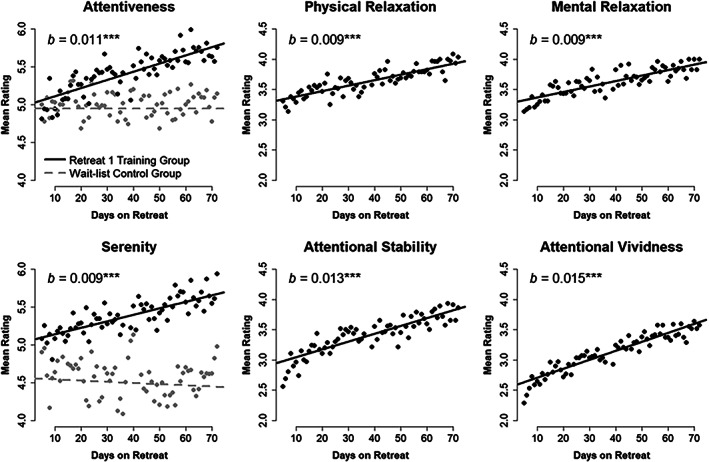
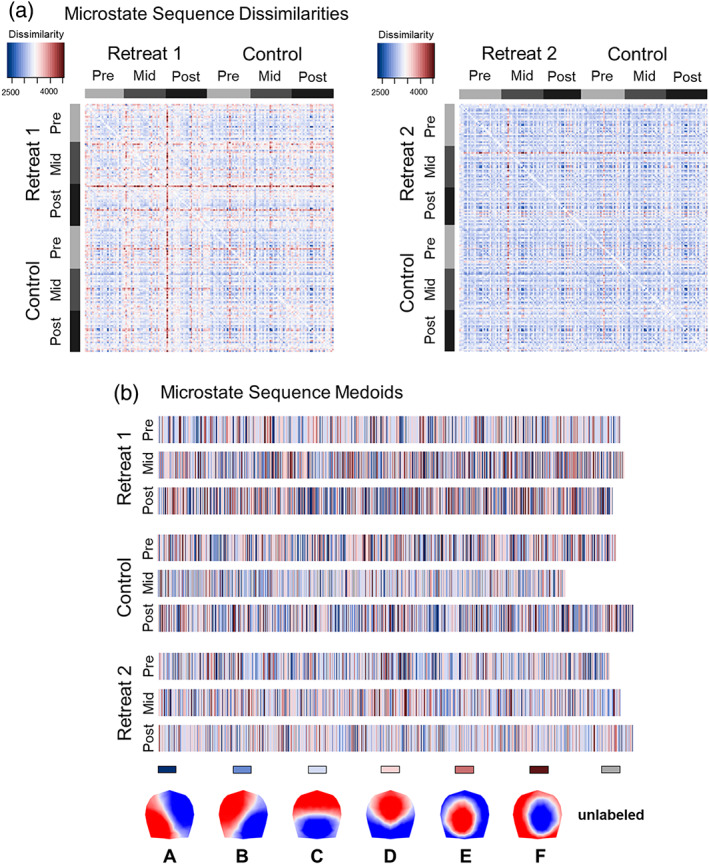
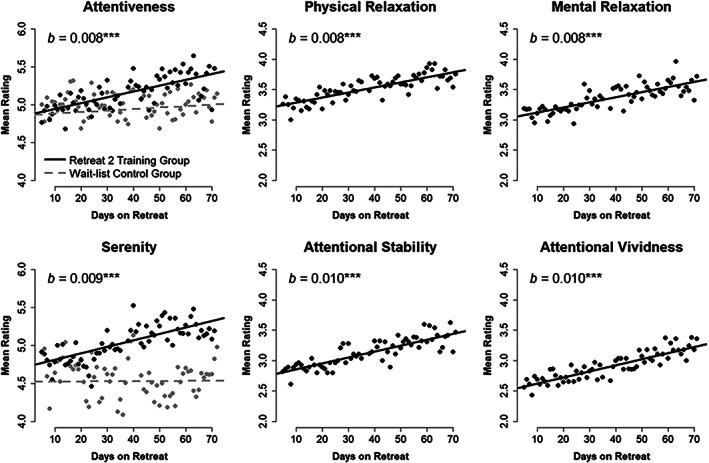
Meditation practice is believed to foster states of mindful awareness and mental quiescence in everyday life. If so, then the cultivation of these qualities with training ought to leave its imprint on the activity of intrinsic functional brain networks. In an intensive longitudinal study, we investigated associations between meditation practitioners' experiences of felt mindful awareness and changes in the spontaneous electrophysiological dynamics of functional brain networks. Experienced meditators were randomly assigned to complete 3 months of full-time training in focused-attention meditation (during an initial intervention) or to serve as waiting-list controls and receive training second (during a later intervention). We collected broadband electroencephalogram (EEG) during rest at the beginning, middle, and end of the two training periods. Using a data-driven approach, we segmented the EEG into a time series of transient microstate intervals based on clustering of topographic voltage patterns. Participants also provided daily reports of felt mindful awareness and mental quiescence, and reported daily on four experiential qualities of their meditation practice during training. We found that meditation training led to increases in mindful qualities of awareness, which corroborate contemplative accounts of deepening mental calm and attentional focus. We also observed reductions in the strength and duration of EEG microstates across both interventions. Importantly, changes in the dynamic sequencing of microstates were associated with daily increases in felt attentiveness and serenity during training. Our results connect shifts in subjective qualities of meditative experience with the large-scale dynamics of whole brain functional EEG networks at rest.
冥想练习被认为可以培养日常生活中的正念意识和心理宁静状态。如果是这样,那么通过训练来培养这些品质应该会在内在功能大脑网络的活动中留下印记。在一项密集的纵向研究中,我们调查了冥想练习者对感知到的正念意识的体验与功能大脑网络自发的电生理动力学变化之间的关联。经验丰富的冥想者被随机分配到专注冥想(在初始干预期间)或作为候补控制组,并在后期干预期间接受训练。我们在两个训练期间的开始、中间和结束时,在休息时采集宽带脑电图(EEG)。我们使用基于拓扑电压模式聚类的时间序列暂态微状态间隔对 EEG 进行分割。参与者还提供了对感知到的正念意识和心理宁静的日常报告,并在训练期间报告了他们的冥想练习的四个体验品质。我们发现冥想训练导致了意识的正念品质的增加,这与沉思中关于深化心理平静和注意力集中的说法相吻合。我们还观察到在两个干预过程中,脑电图微状态的强度和持续时间都有所减少。重要的是,微状态动态序列的变化与训练期间日常感知注意力和宁静感的增加有关。我们的研究结果将冥想体验的主观品质的变化与休息时整个大脑功能 EEG 网络的大规模动力学联系起来。