Kim Kwangrae, Kim Hoon, Kim Jonghwan, Kwon Changil, Kim Jun Sung, Kim B J
Department of Physics, Pohang University of Science and Technology, Pohang, South Korea.
Center for Artificial Low Dimensional Electronic Systems, Institute for Basic Science (IBS), Pohang, South Korea.
Nat Commun. 2021 Mar 30;12(1):1969. doi: 10.1038/s41467-021-22133-z.
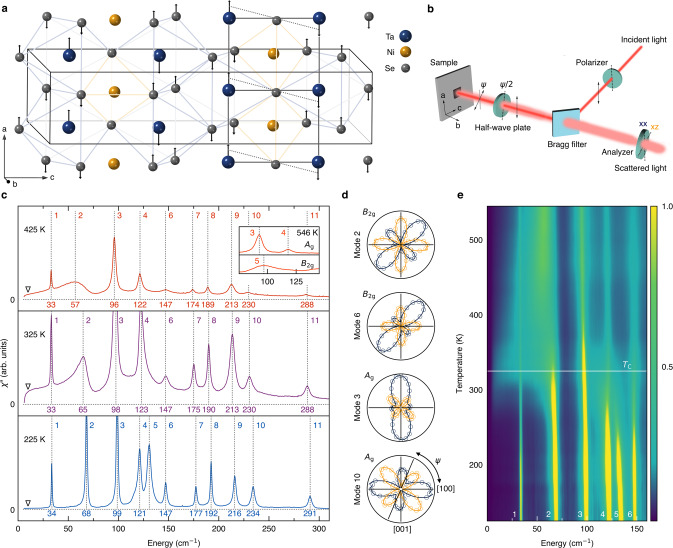
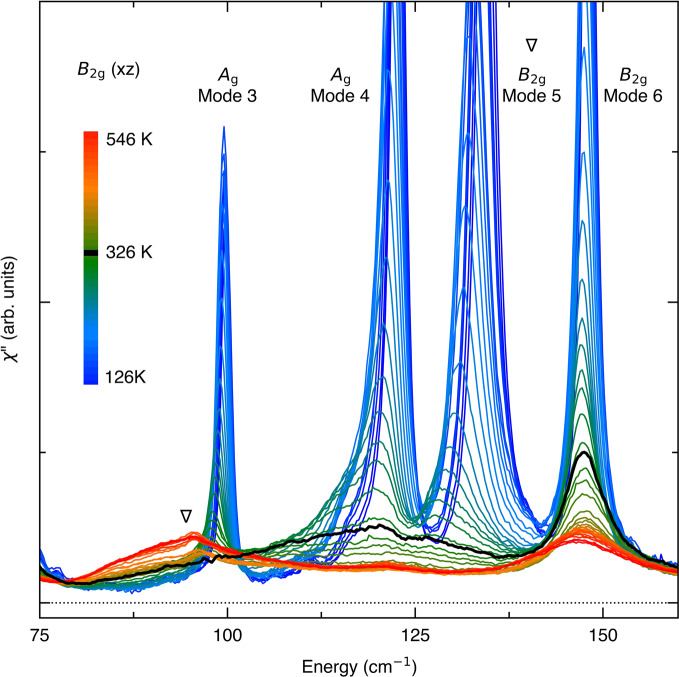
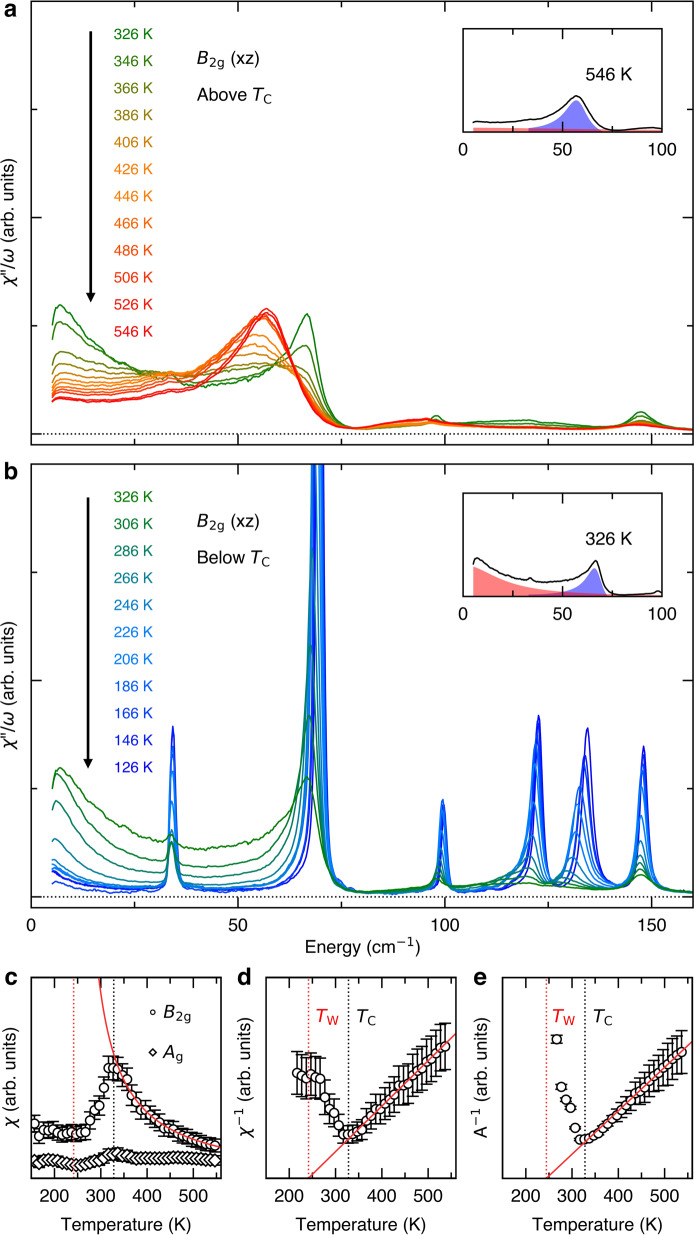
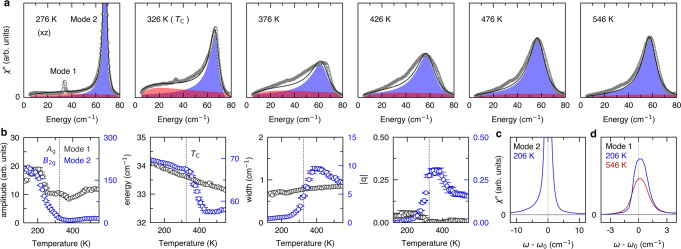
Coulomb attraction between electrons and holes in a narrow-gap semiconductor or a semimetal is predicted to lead to an elusive phase of matter dubbed excitonic insulator. However, direct observation of such electronic instability remains extremely rare. Here, we report the observation of incipient divergence in the static excitonic susceptibility of the candidate material TaNiSe using Raman spectroscopy. Critical fluctuations of the excitonic order parameter give rise to quasi-elastic scattering of B symmetry, whose intensity grows inversely with temperature toward the Weiss temperature of T ≈ 237 K, which is arrested by a structural phase transition driven by an acoustic phonon of the same symmetry at T = 325 K. Concurrently, a B optical phonon becomes heavily damped to the extent that its trace is almost invisible around T, which manifests a strong electron-phonon coupling that has obscured the identification of the low-temperature phase as an excitonic insulator for more than a decade. Our results unambiguously reveal the electronic origin of the phase transition.
在窄带隙半导体或半金属中,电子与空穴之间的库仑引力预计会导致一种难以捉摸的物质相,即激子绝缘体。然而,对这种电子不稳定性的直接观测仍然极为罕见。在此,我们报告利用拉曼光谱对候选材料TaNiSe静态激子磁化率初始发散的观测结果。激子序参量的临界涨落会引发B对称性的准弹性散射,其强度随着温度向约237 K的魏斯温度降低而呈反比增长,在325 K时,这种增长被由相同对称性的声学声子驱动的结构相变所抑制。同时,一个B光学声子被严重阻尼,以至于在该温度附近其踪迹几乎不可见,这表明存在强电子 - 声子耦合,这种耦合使得在十多年的时间里一直难以将低温相识别为激子绝缘体。我们的结果明确揭示了该相变的电子起源。