Legesse Abayneh, Negash Mesele
Forest and Rangeland Plants Biodiversity Directorate, Ethiopian Biodiversity Institute, Addis Ababa, Ethiopia.
Wondo Genet College of Forestry and Natural Resources, Hawassa University, Wondo Genet, Ethiopia.
Heliyon. 2021 Mar 15;7(3):e06477. doi: 10.1016/j.heliyon.2021.e06477. eCollection 2021 Mar.
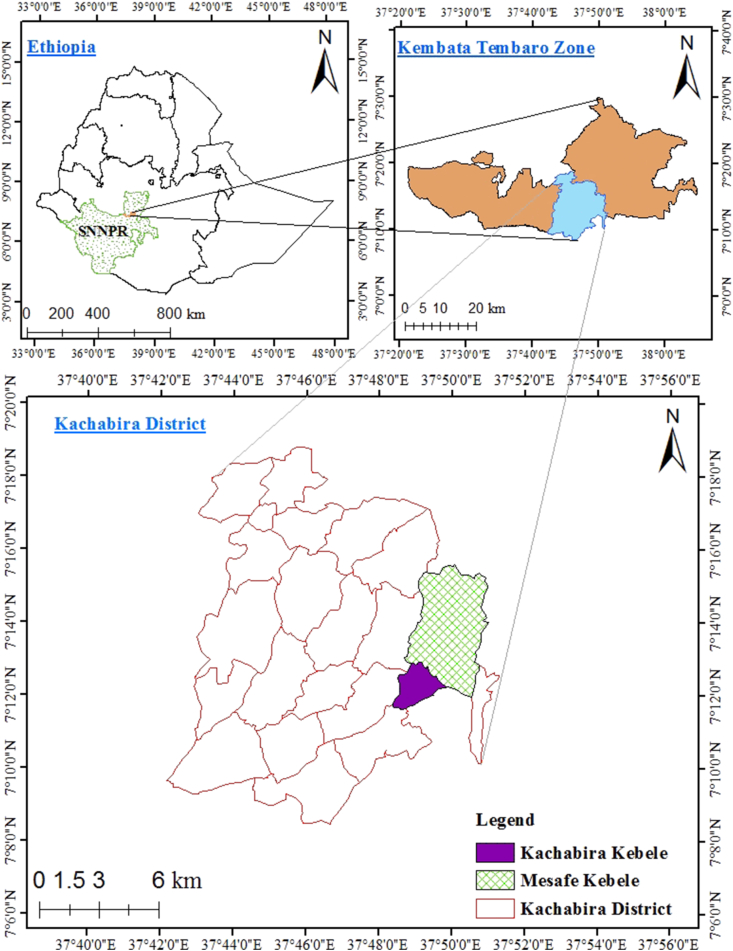
Agroforestry is increasingly being identified as an integrated land use enhancing plant diversity while reducing habitat loss and fragmentation. This paper examined species diversity, composition, structure and management in agroforestry systems Two Kebeles (Kachabira and Mesafe) were purposively selected for this study. Then, farmers who dominantly practiced agroforestry practices such as home garden, parkland and live fence were stratified based on wealth categories. Ten percent of the sample households were randomly selected from each wealth category. Accordingly, a total of 83 households were selected. Inventories of plant species were done by sampling one plot of each farm management type. A total of 59 plant species, belonging to 56 genera and 36 families were recorded across the home gardens, parklands and live fences in the study area. Among the plant species, trees constituted 42%, shrubs 27%, herbs 29% and climber 2%. From recorded plant species, 66% were native and the remainders 34% were introduced species. From the native species recorded in this study, and were endemic to Ethiopia. The mean Shannon diversity index of rich, medium and poor households in the three different agroforestry practices were 1.75, 1.57 and 1.62 in home garden, 0.36, 0.30 and 0.49 in parkland and 0.84, 0.99 and 1.00 in live fence respectively. The largest tree basal area was recorded in the live fence (14.7 mha), followed by home garden and parkland. The study revealed that agroforestry plays an important role in the conservation of biodiversity, and also by providing food, income and a wide range of other products such as fuel wood, construction material, fodder, spices and medicinal plants. Farm household landholding size, species preference and management found to be the most important influencing factors that affect the diversity of plant species. Further detailed study of explicit examining of the factors such as socio-ecological effects that determine species diversity and the contribution of different functional groups to livelihood is needed to fully understand the agroforestry system.
农林业越来越被视为一种综合土地利用方式,它能增加植物多样性,同时减少栖息地丧失和破碎化。本文研究了农林业系统中的物种多样性、组成、结构和管理。为此,特意选择了两个行政区(卡查比拉和梅萨费)进行此项研究。然后,根据财富类别对主要从事家庭菜园、农田防护林和活篱笆等农林业活动的农民进行分层。从每个财富类别中随机抽取10%的样本家庭。据此,共选取了83户家庭。通过对每种农场管理类型的一块样地进行抽样,完成了植物物种清查。研究区域内的家庭菜园、农田防护林和活篱笆中,共记录了59种植物,分属56属36科。在这些植物物种中,乔木占42%,灌木占27%,草本占29%,藤本占2%。在记录的植物物种中,66%为本地物种,其余34%为引进物种。在本研究记录的本地物种中,[此处原文缺失部分内容]是埃塞俄比亚特有的。在三种不同的农林业活动中,富裕、中等和贫困家庭的平均香农多样性指数在家庭菜园分别为1.75、1.57和1.62,在农田防护林分别为0.36、0.30和0.49,在活篱笆分别为0.84、0.99和1.00。活篱笆的树木基部面积最大(14.7公顷),其次是家庭菜园和农田防护林。研究表明,农林业在生物多样性保护方面发挥着重要作用,还能提供食物、收入以及多种其他产品,如薪柴、建筑材料、饲料、香料和药用植物。农户的土地持有规模、物种偏好和管理被发现是影响植物物种多样性的最重要因素。需要进一步详细研究明确考察决定物种多样性的社会生态效应等因素,以及不同功能组对生计的贡献,以便全面了解农林业系统。