Department of Thoracic Surgery, Qilu Hospital, Cheeloo College of Medicine, Shandong University, Jinan, Shandong 250012, P.R. China.
Department of Thoracic Surgery, Weifang People's Hospital, Weifang, Shandong 261000
Int J Oncol. 2021 May;58(5). doi: 10.3892/ijo.2021.5203. Epub 2021 Mar 31.
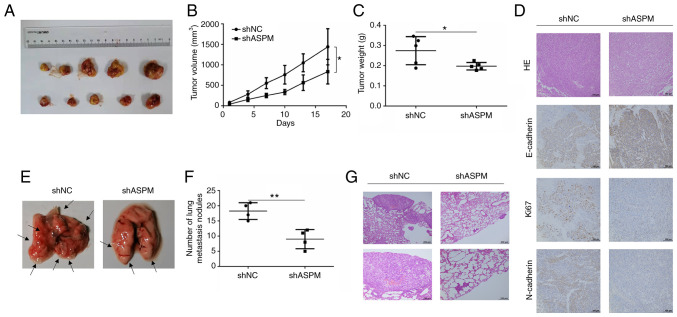
Lung adenocarcinoma (LUAD) is a common malignant cancer worldwide. It is urgent to explore its underlying molecular mechanism and identify novel diagnostic biomarkers. Abnormal spindle‑like microcephaly (ASPM) has recently received considerable attention due to its function in tumor progression. However, its role in LUAD is unclear. The present study aimed to explore the clinical role of ASPM in LUAD. Seven pairs of LUAD and adjacent normal tissues were collected to identify potential LUAD biomarkers using transcriptome sequencing. The association between ASPM expression and LUAD progression was evaluated using bioinformatics analysis and data obtained from clinical specimens. Using small interfering RNA technology, the function of ASPM was analyzed in the LUAD H1299 and A549 cell lines. Transcriptional profiling of ASPM‑deficient H1299 cells was then performed to determine the downstream targets of ASPM. Using databases and clinical specimens, it was revealed that ASPM expression was frequently elevated in LUAD tissues, and this upregulation was highly associated with LUAD progression. ASPM served as an oncogenic regulator of LUAD cell proliferation and metastasis. Mechanistically, ASPM facilitated epithelial‑mesenchymal transition (EMT) via the PI3K/AKT signaling pathway and 740 Y‑P, an activator of this pathway, restored the migratory ability of ASPM‑knockdown LUAD cells. The current study identified ASPM as an independent prognostic biomarker of LUAD that served an important oncogenic role in regulating LUAD cell metastasis by promoting EMT via the PI3K/AKT signaling pathway. Targeting ASPM may therefore be a therapeutic strategy for treating LUAD.
肺腺癌 (LUAD) 是一种常见的恶性肿瘤,在全球范围内发病率较高。探索其潜在的分子机制并确定新的诊断生物标志物迫在眉睫。异常纺锤体微管相关蛋白 (ASPM) 因其在肿瘤进展中的作用而受到广泛关注。然而,其在 LUAD 中的作用尚不清楚。本研究旨在探讨 ASPM 在 LUAD 中的临床作用。收集了 7 对 LUAD 和相邻正常组织,使用转录组测序来鉴定潜在的 LUAD 生物标志物。通过生物信息学分析和临床标本数据评估 ASPM 表达与 LUAD 进展的相关性。使用小干扰 RNA 技术在 LUAD H1299 和 A549 细胞系中分析 ASPM 的功能。然后对 ASPM 缺陷的 H1299 细胞进行转录谱分析,以确定 ASPM 的下游靶标。使用数据库和临床标本揭示了 ASPM 在 LUAD 组织中频繁上调,并且这种上调与 LUAD 进展高度相关。ASPM 作为 LUAD 细胞增殖和转移的致癌调节剂。在机制上,ASPM 通过 PI3K/AKT 信号通路促进上皮间质转化 (EMT),而该通路的激活剂 740 Y-P 恢复了 ASPM 敲低的 LUAD 细胞的迁移能力。本研究将 ASPM 鉴定为 LUAD 的独立预后生物标志物,通过促进 EMT 来调节 LUAD 细胞转移,在调节 LUAD 细胞转移方面发挥重要的致癌作用。因此,靶向 ASPM 可能是治疗 LUAD 的一种治疗策略。