Division of Geriatric Medicine, Department of Medicine, Faculty of Medicine, Ramathibodi Hospital, Mahidol University, Bangkok, 10400, Thailand.
Department of Psychiatry, Faculty of Medicine, Ramathibodi Hospital, Mahidol University, Bangkok, Thailand.
BMC Geriatr. 2021 Mar 31;21(1):215. doi: 10.1186/s12877-021-02160-7.
Delirium is a common disorder among hospitalized older patients and results in increased morbidity and mortality. The prevention of delirium is still challenging in older patient care. The role of antipsychotics in delirium prevention has been limited. Therefore, we conducted a trial to investigate the efficacy of quetiapine use to prevent delirium in hospitalized older medical patients.
This study was a randomized double-blind controlled trial conducted at Ramathibodi Hospital, Bangkok, Thailand. Patients aged ≥65 years hospitalized in the internal medicine service were randomized to quetiapine 12.5 mg or placebo once daily at bedtime for a maximum 7-day duration. The primary end point was delirium incidence. Secondary end points were delirium duration, length of hospital stay, ICU admission, rehospitalization and mortality within 30 and 90 days.
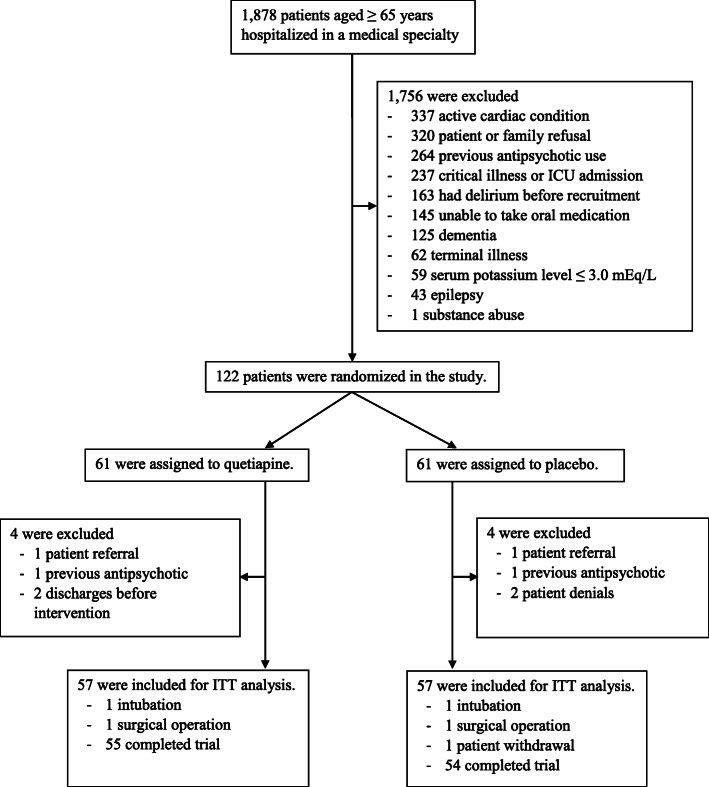
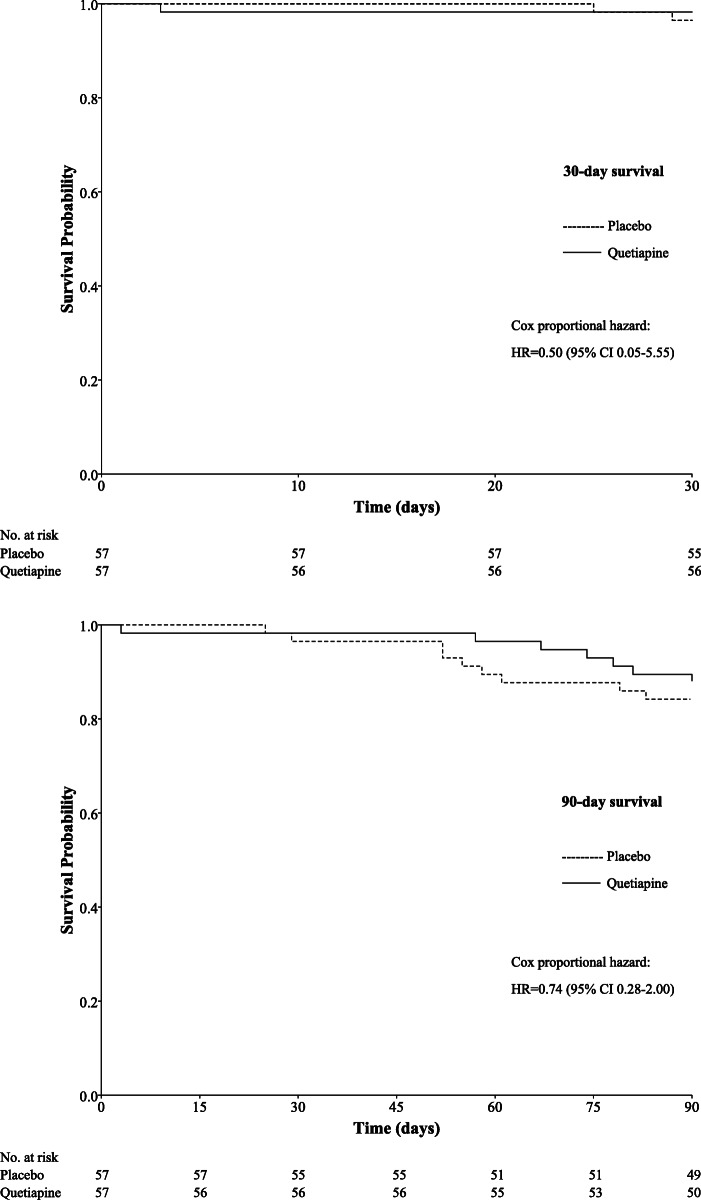
A total of 122 patients were enrolled in the study. Eight (6.6%) left the trial before receiving the first dose of the intervention, whereas 114 (93.4%) were included in an intention-to-treat analysis allocated to the quetiapine or placebo group (n = 57 each). The delirium incidence rates in the quetiapine and placebo groups were 14.0 and 8.8% (OR = 1.698, 95% CI 0.520-5.545, P = 0.381), respectively. Other endpoints in the quetiapine and placebo groups were the median length of hospital stay, 6 (4-8) days versus 5 (4-8) days (P = 0.133), respectively; delirium duration, 4 (2.3-6.5) versus 3 (1.5-4.0) days (P = 0.557), respectively; ICU admission, 3 (5.3%) patients from both groups (P = 1.000); and mortality in the quetiapine and placebo groups, 1 (1.8%) versus 2 (3.5%) at 30 days (P = 0.566) and 7 (12.3%) versus 9 (15.8%) days at 90 days (P = 0.591). There were no significant differences in other outcomes. None of the participants reported adverse events.
Quetiapine prophylaxis did not reduce delirium incidence in hospitalized older medical patients. The use of quetiapine to prevent delirium in this population group should not be recommended.
This trial was retrospectively registered with the Thai clinical trials registry (TCTR) at clinicaltrials.in.th (TCTR20190927001) on September 26, 2019.
谵妄是住院老年患者中常见的疾病,会导致发病率和死亡率增加。预防谵妄在老年患者护理中仍然具有挑战性。抗精神病药物在预防谵妄方面的作用有限。因此,我们进行了一项试验,以研究喹硫平在预防住院老年内科患者谵妄中的疗效。
这是一项在泰国曼谷 Ramathibodi 医院进行的随机双盲对照试验。年龄≥65 岁、因内科疾病住院的患者被随机分配至喹硫平 12.5mg 或安慰剂组,每晚睡前服用,最多持续 7 天。主要终点是谵妄发生率。次要终点是谵妄持续时间、住院时间、入住 ICU、30 天和 90 天内再住院和死亡率。
共有 122 名患者入组本研究。8 名(6.6%)在接受首次干预前退出试验,114 名(93.4%)按意向治疗分析被分配至喹硫平或安慰剂组(n=57 名)。喹硫平组和安慰剂组的谵妄发生率分别为 14.0%和 8.8%(OR=1.698,95%CI 0.520-5.545,P=0.381)。喹硫平组和安慰剂组的其他结局分别为:中位住院时间,6(4-8)天比 5(4-8)天(P=0.133);谵妄持续时间,4(2.3-6.5)天比 3(1.5-4.0)天(P=0.557);入住 ICU 的患者人数,两组均为 3 例(5.3%)(P=1.000);喹硫平组和安慰剂组的 30 天死亡率分别为 1(1.8%)和 2(3.5%)(P=0.566),90 天死亡率分别为 7(12.3%)和 9(15.8%)(P=0.591)。其他结局无显著差异。所有参与者均未报告不良反应。
喹硫平预防不能降低住院老年内科患者的谵妄发生率。不建议在该人群中使用喹硫平预防谵妄。
该试验于 2019 年 9 月 26 日在泰国临床试验注册中心(TCTR)以(TCTR20190927001)进行了回顾性注册。