Department of Pharmacy, The First Hospital Affiliated with Hunan Normal University, Changsha, Hunan, China (mainland).
Department of Pharmacy, Changsha Stomatological Hospital, Changsha, Hunan, China (mainland).
Med Sci Monit. 2021 Apr 1;27:e930166. doi: 10.12659/MSM.930166.
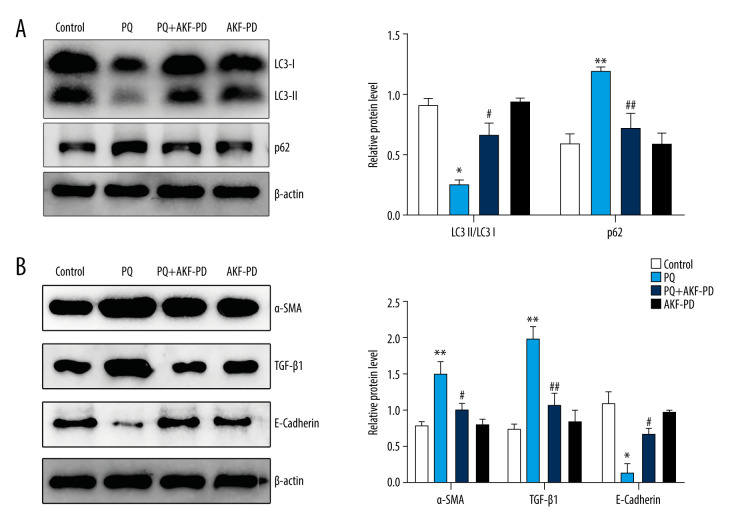
BACKGROUND Fluorofenidone (AKF-PD) is an anti-fibrotic small-molecule compound. Its mechanism of action on paraquat (PQ)-induced pulmonary fibrosis is still unclear. MATERIAL AND METHODS Forty-eight SD rats were divided into 4 groups: control group, PQ group, PQ+AKF-PD group, and AKF-PD group. The pathological changes of lung tissues were observed by Masson and HE staining. The UPLC-QTOF-MS analysis was performed to detect the differences in metabolites among groups, then the possible mechanisms of the anti-pulmonary fibrosis effects of fluorofenidone were further revealed by network pharmacology analysis. Biological methods were used to verify the results of the network pharmacology analysis. RESULTS The results showed that fluorofenidone treatment significantly alleviated paraquat-induced pulmonary fibrosis. Metabolomics analysis showed that 18 metabolites were disordered in the serum of paraquat-poisoned rats, of which 13 were restored following fluorofenidone treatment. Network pharmacology analysis showed that the drug screened a total of 12 targets and mainly involved multiple signaling pathways and metabolic pathways to jointly exert anti-pulmonary fibrosis effects. Autophagy is the main pathway of fluorofenidone in treatment pulmonary fibrosis. The western blot results showed that fluorofenidone upregulated the expression of LC3-II/I and E-cadherin, and downregulated the expression of p62, alpha-SMA, and TGF-ß1, which validated that fluorofenidone could inhibit the development of paraquat-induced pulmonary fibrosis by increasing autophagy. CONCLUSIONS In conclusion, metabolomics combined with network pharmacology research strategy revealed that fluorofenidone has a multi-target and multi-path mechanism of action in the treatment of pulmonary fibrosis.
氟苯尼酮(AKF-PD)是一种抗纤维化的小分子化合物。其对抗百草枯(PQ)诱导的肺纤维化的作用机制尚不清楚。
将 48 只 SD 大鼠分为 4 组:对照组、PQ 组、PQ+AKF-PD 组和 AKF-PD 组。通过 Masson 和 HE 染色观察肺组织的病理变化。采用 UPLC-QTOF-MS 分析检测各组间代谢物的差异,然后通过网络药理学分析进一步揭示氟苯尼酮抗肺纤维化作用的可能机制。采用生物学方法验证网络药理学分析的结果。
结果表明,氟苯尼酮治疗可显著减轻百草枯诱导的肺纤维化。代谢组学分析表明,百草枯中毒大鼠血清中 18 种代谢物紊乱,氟苯尼酮治疗后其中 13 种得到恢复。网络药理学分析表明,该药物共筛选出 12 个靶标,主要涉及多种信号通路和代谢途径,共同发挥抗肺纤维化作用。自噬是氟苯尼酮治疗肺纤维化的主要途径。Western blot 结果显示,氟苯尼酮上调 LC3-II/I 和 E-cadherin 的表达,下调 p62、α-SMA 和 TGF-β1 的表达,验证了氟苯尼酮通过增加自噬抑制百草枯诱导的肺纤维化的发展。
总之,代谢组学结合网络药理学研究策略揭示了氟苯尼酮在治疗肺纤维化中具有多靶点、多途径的作用机制。