Jia Xin, Mao Ke, Wang Ping, Wang Yu, Jia Xumei, Huo Liuqing, Sun Xun, Che Runmin, Gong Xiaoqing, Ma Fengwang
State Key Laboratory of Crop Stress Biology for Arid Areas/Shaanxi Key Laboratory of Apple, College of Horticulture, Northwest A&F University, 712100, Yangling, Shaanxi, China.
Center of Pear Engineering Technology Research, State Key Laboratory of Crop Genetics and Germplasm Enhancement, College of Horticulture, Nanjing Agricultural University, 210095, Nanjing, China.
Hortic Res. 2021 Apr 1;8(1):81. doi: 10.1038/s41438-021-00521-2.
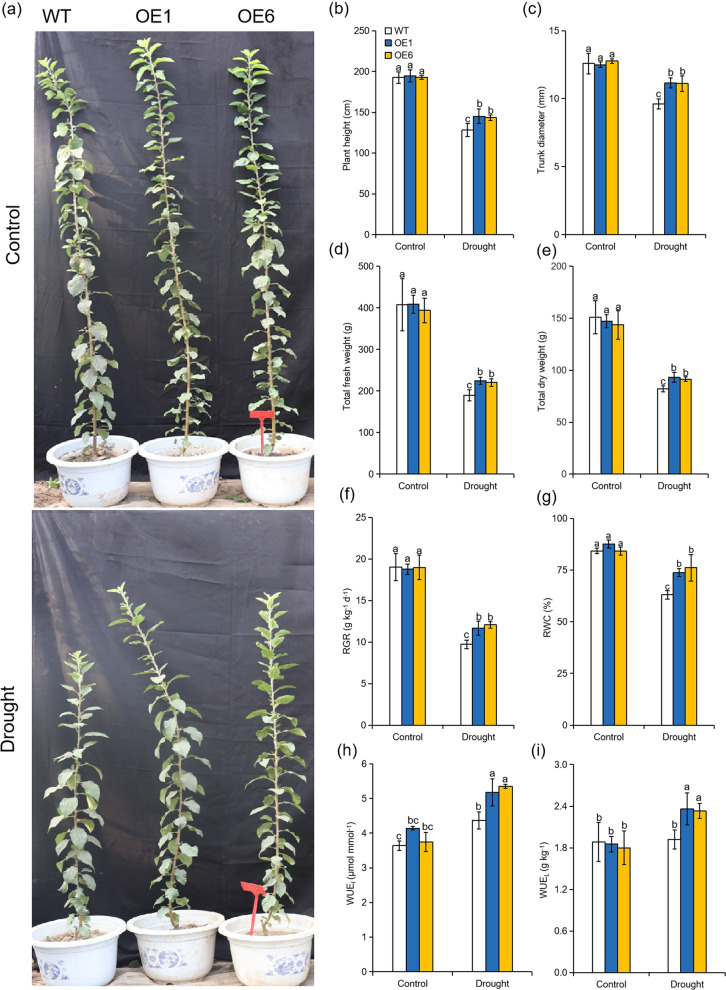
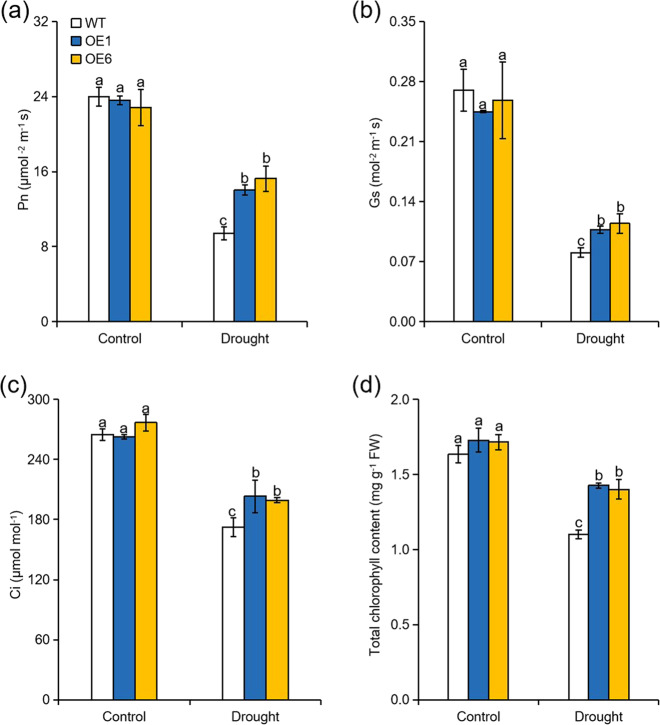
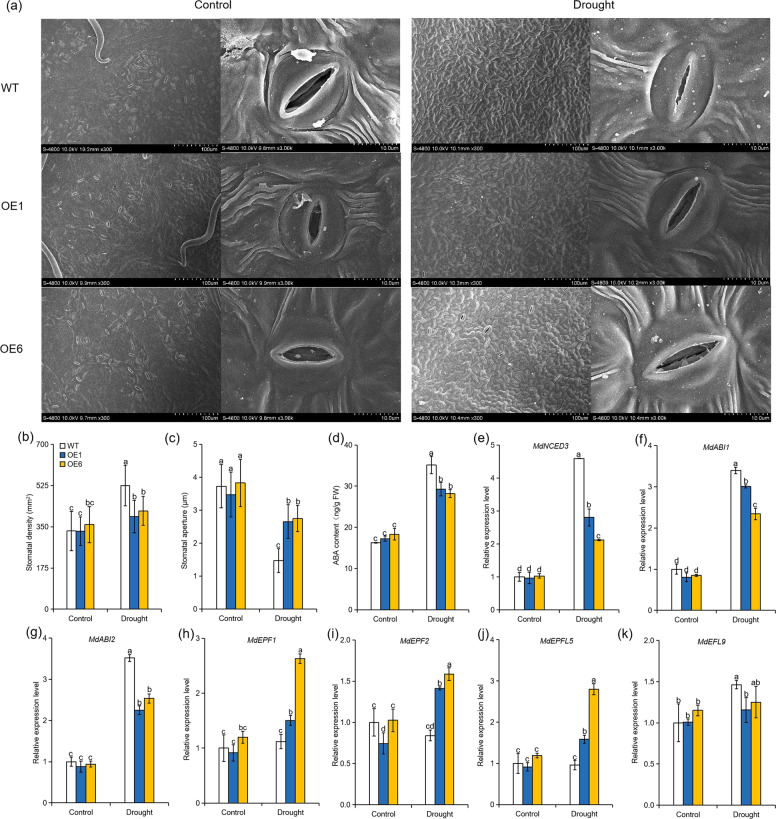
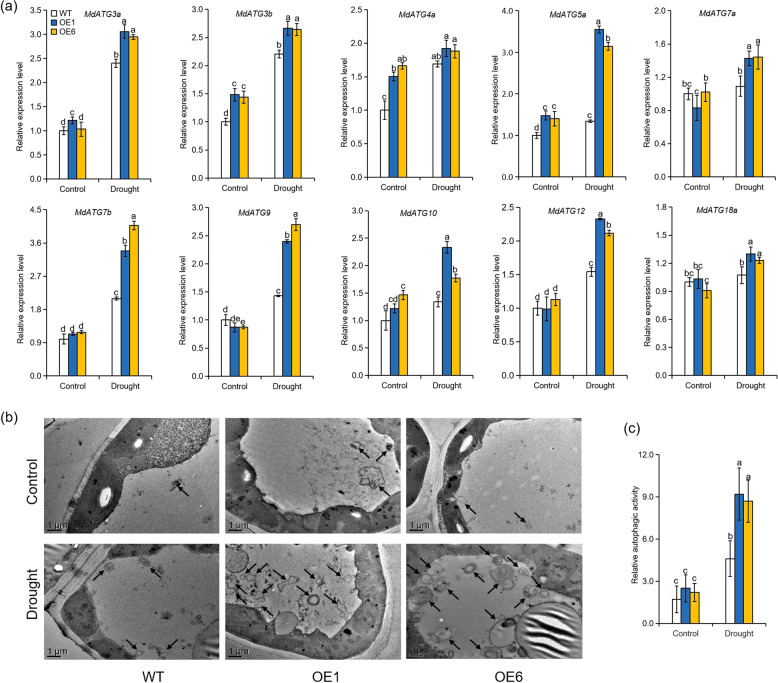
Water deficit is one of the major limiting factors for apple (Malus domestica) production on the Loess Plateau, a major apple cultivation area in China. The identification of genes related to the regulation of water use efficiency (WUE) is a crucial aspect of crop breeding programs. As a conserved degradation and recycling mechanism in eukaryotes, autophagy has been reported to participate in various stress responses. However, the relationship between autophagy and WUE regulation has not been explored. We have shown that a crucial autophagy protein in apple, MdATG8i, plays a role in improving salt tolerance. Here, we explored its biological function in response to long-term moderate drought stress. The results showed that MdATG8i-overexpressing (MdATG8i-OE) apple plants exhibited higher WUE than wild-type (WT) plants under long-term moderate drought conditions. Plant WUE can be increased by improving photosynthetic efficiency. Osmoregulation plays a critical role in plant stress resistance and adaptation. Under long-term drought conditions, the photosynthetic capacity and accumulation of sugar and amino acids were higher in MdATG8i-OE plants than in WT plants. The increased photosynthetic capacity in the OE plants could be attributed to their ability to maintain optimal stomatal aperture, organized chloroplasts, and strong antioxidant activity. MdATG8i overexpression also promoted autophagic activity, which was likely related to the changes described above. In summary, our results demonstrate that MdATG8i-OE apple lines exhibited higher WUE than WT under long-term moderate drought conditions because they maintained robust photosynthesis, effective osmotic adjustment processes, and strong autophagic activity.
水分亏缺是中国主要苹果种植区黄土高原苹果(Malus domestica)生产的主要限制因素之一。鉴定与水分利用效率(WUE)调控相关的基因是作物育种计划的关键环节。作为真核生物中一种保守的降解和循环机制,自噬已被报道参与各种应激反应。然而,自噬与WUE调控之间的关系尚未得到探索。我们已经表明,苹果中的一种关键自噬蛋白MdATG8i在提高耐盐性方面发挥作用。在此,我们探讨了其在响应长期中度干旱胁迫时的生物学功能。结果表明,在长期中度干旱条件下,过表达MdATG8i(MdATG8i-OE)的苹果植株比野生型(WT)植株表现出更高的WUE。提高光合效率可以提高植物的WUE。渗透调节在植物抗逆性和适应性中起关键作用。在长期干旱条件下,MdATG8i-OE植株的光合能力以及糖和氨基酸的积累均高于WT植株。OE植株光合能力的提高可归因于它们维持最佳气孔孔径、有序叶绿体和强大抗氧化活性的能力。MdATG8i的过表达还促进了自噬活性,这可能与上述变化有关。总之,我们的结果表明,在长期中度干旱条件下,MdATG8i-OE苹果株系比WT表现出更高的WUE,因为它们维持了强大的光合作用、有效的渗透调节过程和强大的自噬活性。