Li Qian, Fu Lei, Han Lili, Li Shuai, Zhang Yanling, Wang Jufeng
Department of Oncology, The Affiliated Cancer Hospital of Zhengzhou University, Henan Cancer Hospital, Zhengzhou, 450008, Henan, People's Republic of China.
Department of Oncology, People's Hospital of Zhengzhou University, Henan Provincial People's Hospital, Zhengzhou, 450003, Henan, People's Republic of China.
Cancer Manag Res. 2021 Mar 23;13:2745-2753. doi: 10.2147/CMAR.S297868. eCollection 2021.
Long noncoding RNAs (lncRNAs) have been reported as important molecules in cholangiocarcinoma (CCA) occurrence and development. A previous study showed that lncRNA GAS5 (GAS5) was an oncogene in some tumors. But the role of GAS5 in CCA progression reminds unclear. This research was designed to study the expression and potential effects of GAS5 in the progression of CCA.
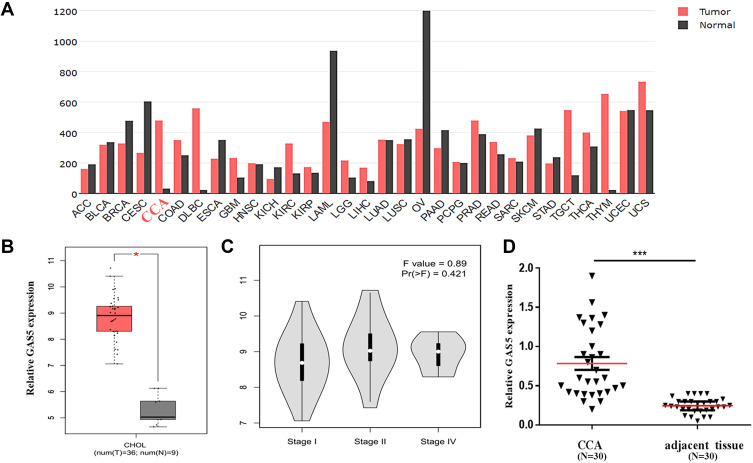
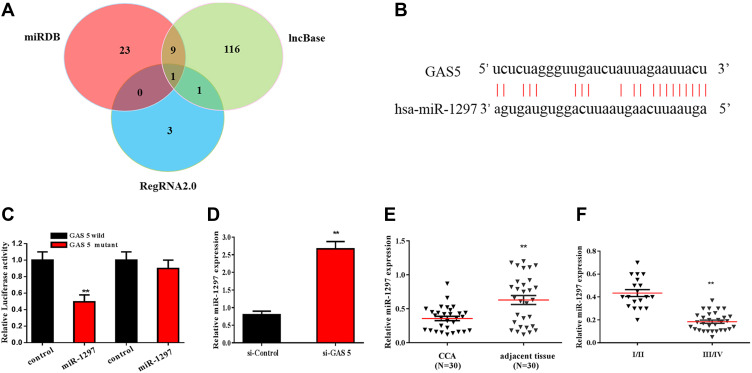
The expression of GAS5 in CCA tissues was evaluated through mining of the TCGA and GEPIA databases. qRT-PCR was applied to validate the results in our clinical samples. test was used to analyze the association between the expression level of tissue GAS5 and different clinicopathological parameters of CCA patients. The target gene of GAS5 was predicted by bioinformatic databases, and further verified by luciferase reporter assays. Finally, the role of GAS5 in CCA cells invasion and proliferation was detected by Transwell assay and CCK-8 assay.
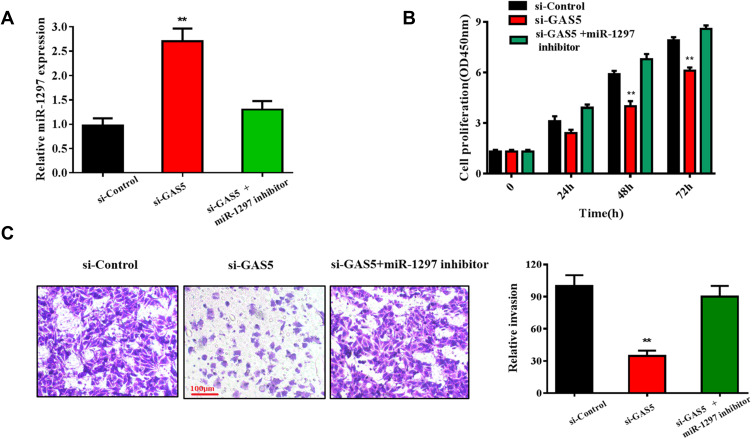
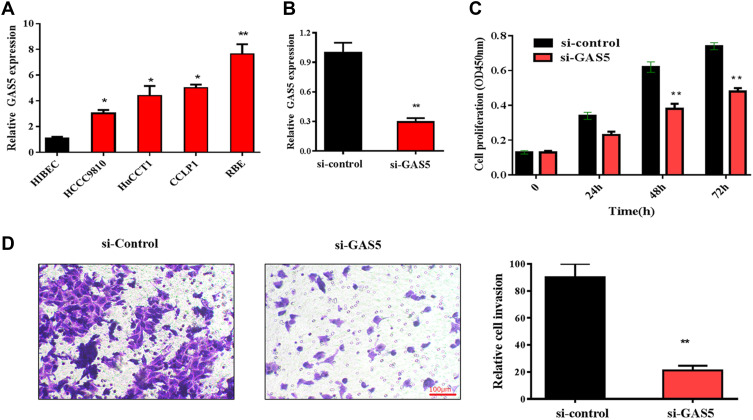
Compared to the adjacent nontumor tissues and the normal human intrahepatic biliary epithelial cell, the expression of GAS5 was markedly increased in CCA tissues (p<0.001) and cell lines (p<0.01), respectively. CCA patients with high GAS5 expression tended to present lymph node metastasis (p<0.001) and had advanced clinical stage (p=0.006). The bioinformatics analysis predicted that hsa-miR-1297 was the potential target gene of GAS5, which was validated by luciferase reporter assays. In addition, the function study showed that GAS5 acted as a "sponge" to downregulate hsa-miR-1297, thus modulating CCA cell proliferation and invasion.
GAS5 acts as an endogenous sponge of hsa-miR-1297 to promote CCA cell proliferation and invasion, which might be a potential biomarker and therapeutic target for CCA.
长链非编码RNA(lncRNAs)已被报道为胆管癌(CCA)发生发展中的重要分子。先前的一项研究表明,lncRNA GAS5(GAS5)在某些肿瘤中是一种癌基因。但GAS5在CCA进展中的作用仍不清楚。本研究旨在探讨GAS5在CCA进展中的表达及潜在作用。
通过挖掘TCGA和GEPIA数据库评估GAS5在CCA组织中的表达。应用qRT-PCR验证我们临床样本中的结果。采用检验分析组织GAS5表达水平与CCA患者不同临床病理参数之间的相关性。通过生物信息学数据库预测GAS5的靶基因,并通过荧光素酶报告基因检测进一步验证。最后,通过Transwell检测和CCK-8检测检测GAS5在CCA细胞侵袭和增殖中的作用。
与癌旁非肿瘤组织和正常人肝内胆管上皮细胞相比,GAS5在CCA组织(p<0.001)和细胞系(p<0.01)中的表达均显著增加。GAS5高表达的CCA患者倾向于出现淋巴结转移(p<0.001)且临床分期较晚(p=0.006)。生物信息学分析预测hsa-miR-1297是GAS5的潜在靶基因,荧光素酶报告基因检测验证了这一结果。此外,功能研究表明,GAS5作为一种“海绵”下调hsa-miR-1297,从而调节CCA细胞的增殖和侵袭。
GAS5作为hsa-miR-1297的内源性海绵促进CCA细胞增殖和侵袭,可能是CCA的潜在生物标志物和治疗靶点。