Liang Pei, Jiang Jiayu, Chen Jie, Wei Liuqing
Department of Psychology, Faculty of Education, Hubei University, Hubei, China.
Brain and Cognition Research Center (BCRC), Faculty of Education, Hubei University, Hubei, China.
Front Psychol. 2021 Mar 12;12:644704. doi: 10.3389/fpsyg.2021.644704. eCollection 2021.
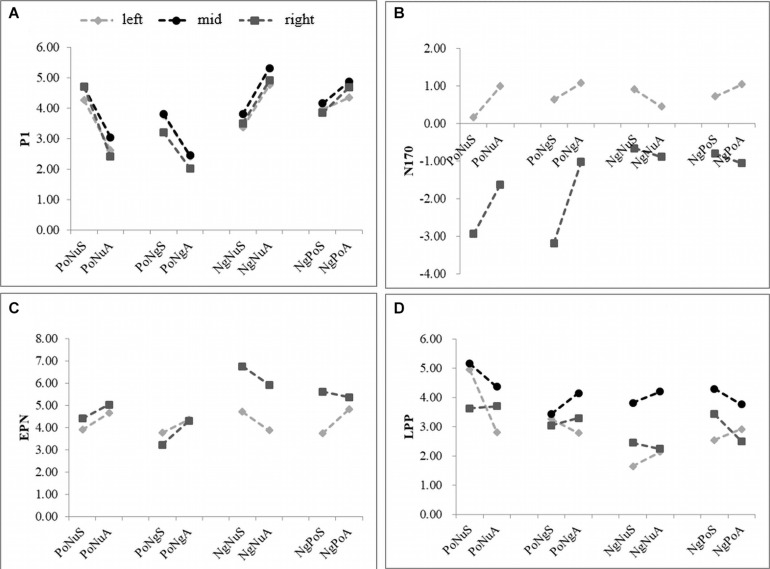
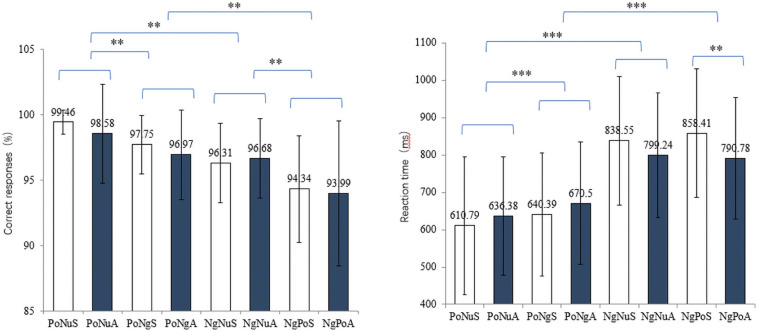
Facial emotional recognition is something used often in our daily lives. How does the brain process the face search? Can taste modify such a process? This study employed two tastes (sweet and acidic) to investigate the cross-modal interaction between taste and emotional face recognition. The behavior responses (reaction time and correct response ratios) and the event-related potential (ERP) were applied to analyze the interaction between taste and face processing. Behavior data showed that when detecting a negative target face with a positive face as a distractor, the participants perform the task faster with an acidic taste than with sweet. No interaction effect was observed with correct response ratio analysis. The early (P1, N170) and mid-stage [early posterior negativity (EPN)] components have shown that sweet and acidic tastes modified the ERP components with the affective face search process in the ERP results. No interaction effect was observed in the late-stage (LPP) component. Our data have extended the understanding of the cross-modal mechanism and provided electrophysiological evidence that affective facial processing could be influenced by sweet and acidic tastes.
面部情绪识别在我们的日常生活中经常被用到。大脑是如何处理面部搜索的?味觉能否改变这一过程?本研究采用两种味觉(甜味和酸味)来探究味觉与情绪面部识别之间的跨模态交互作用。运用行为反应(反应时间和正确反应比率)以及事件相关电位(ERP)来分析味觉与面部处理之间的交互作用。行为数据表明,当以正面脸作为干扰物来检测负面目标脸时,参与者在酸味条件下比在甜味条件下执行任务的速度更快。正确反应比率分析未观察到交互作用效应。早期(P1、N170)和中期[早期后负波(EPN)]成分表明,在ERP结果中,甜味和酸味改变了情感面部搜索过程中的ERP成分。后期(LPP)成分未观察到交互作用效应。我们的数据扩展了对跨模态机制的理解,并提供了电生理证据,证明情感面部处理可能会受到甜味和酸味的影响。