Cattaneo Daniele, Croci Giorgio Alberto, Bucelli Cristina, Tabano Silvia, Cannone Marta Giulia, Gaudioso Gabriella, Barbanti Maria Chiara, Barbullushi Kordelia, Bianchi Paola, Fermo Elisa, Fabris Sonia, Baldini Luca, Gianelli Umberto, Iurlo Alessandra
Hematology Division, Foundation IRCCS Ca' Granda Ospedale Maggiore Policlinico, Milan, Italy.
Department of Pathophysiology and Transplantation, University of Milan, Milan, Italy.
Front Oncol. 2021 Mar 12;11:637116. doi: 10.3389/fonc.2021.637116. eCollection 2021.
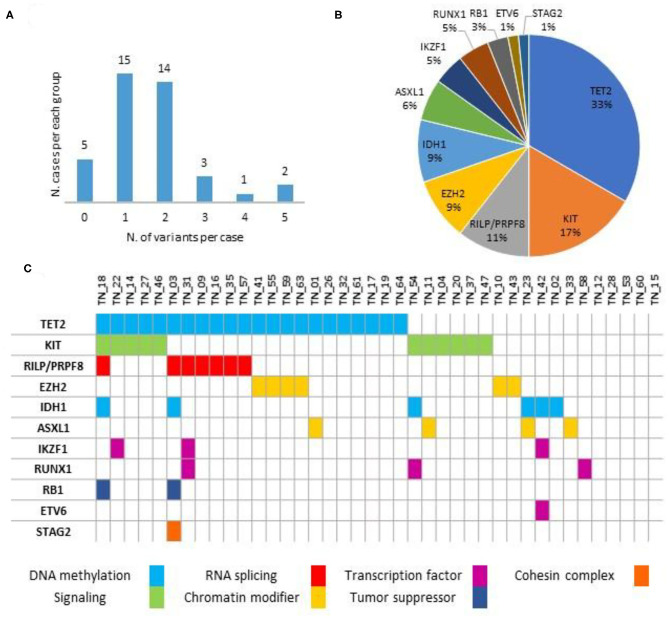
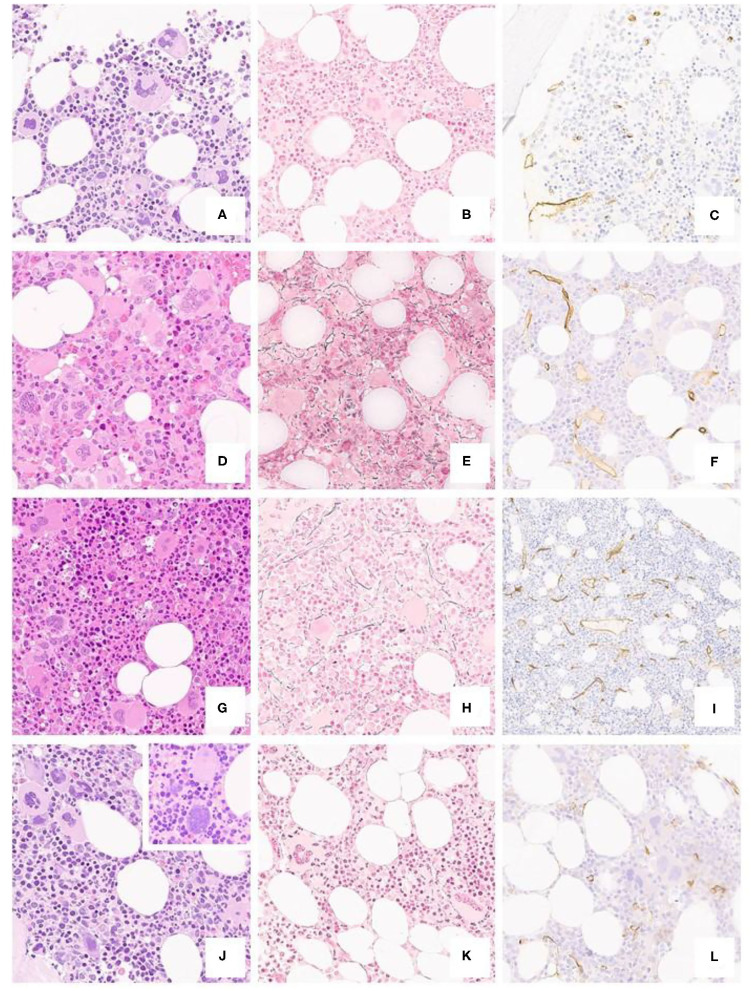
Lack of demonstrable mutations affecting , or driver genes within the spectrum of -negative myeloproliferative neoplasms (MPNs) is currently referred to as a triple-negative genotype, which is found in about 10% of patients with essential thrombocythemia (ET) and 5-10% of those with primary myelofibrosis (PMF). Very few papers are presently available on triple-negative ET, which is basically described as an indolent disease, differently from triple-negative PMF, which is an aggressive myeloid neoplasm, with a significantly higher risk of leukemic evolution. The aim of the present study was to evaluate the bone marrow morphology and the clinical-laboratory parameters of triple-negative ET patients, as well as to determine their molecular profile using next-generation sequencing (NGS) to identify any potential clonal biomarkers. We evaluated a single-center series of 40 triple-negative ET patients, diagnosed according to the 2017 WHO classification criteria and regularly followed up at the Hematology Unit of our Institution, between January 1983 and January 2019. In all patients, NGS was performed using the Illumina Ampliseq Myeloid Panel; morphological and immunohistochemical features of the bone marrow trephine biopsies were also thoroughly reviewed. Nucleotide variants were detected in 35 out of 40 patients. In detail, 29 subjects harbored one or two variants and six cases showed three or more concomitant nucleotide changes. The most frequent sequence variants involved the gene (55.0%), followed by (27.5%). Histologically, most of the cases displayed a classical ET morphology. Interestingly, prevalent megakaryocytes morphology was more frequently polymorphic with a mixture of giant megakaryocytes with hyperlobulated nuclei, normal and small sized maturing elements, and naked nuclei. Finally, in five cases a mild degree of reticulin fibrosis (MF-1) was evident together with an increase in the micro-vessel density. By means of NGS we were able to identify nucleotide variants in most cases, thus we suggest that a sizeable proportion of triple-negative ET patients do have a clonal disease. In analogy with driver genes-mutated MPNs, these observations may prevent issues arising concerning triple-negative ET treatment, especially when a cytoreductive therapy may be warranted.
在阴性骨髓增殖性肿瘤(MPN)范围内,缺乏可证明的影响驱动基因的突变,目前被称为三阴性基因型,在约10%的原发性血小板增多症(ET)患者和5 - 10%的原发性骨髓纤维化(PMF)患者中发现。目前关于三阴性ET的论文很少,其基本上被描述为一种惰性疾病,这与三阴性PMF不同,后者是一种侵袭性髓系肿瘤,白血病进展风险显著更高。本研究的目的是评估三阴性ET患者的骨髓形态和临床实验室参数,并使用下一代测序(NGS)确定其分子谱,以识别任何潜在的克隆生物标志物。我们评估了根据2017年世界卫生组织分类标准诊断的40例三阴性ET患者的单中心系列病例,这些患者于1983年1月至2019年1月在我们机构的血液科定期随访。所有患者均使用Illumina Ampliseq Myeloid Panel进行NGS;还对骨髓活检组织的形态学和免疫组化特征进行了全面复查。40例患者中有35例检测到核苷酸变异。具体而言,29名受试者有一个或两个变异,6例显示三个或更多伴随的核苷酸变化。最常见的序列变异涉及基因(55.0%),其次是(27.5%)。组织学上,大多数病例表现出典型的ET形态。有趣的是,普遍的巨核细胞形态更常见的是多形性,伴有核分叶过多的巨大巨核细胞、正常和小尺寸的成熟细胞以及裸核的混合。最后,在5例病例中,可见轻度网状纤维纤维化(MF - 1)以及微血管密度增加。通过NGS,我们能够在大多数病例中识别核苷酸变异,因此我们认为相当一部分三阴性ET患者确实患有克隆性疾病。与驱动基因突变的MPN类似,这些观察结果可能有助于解决三阴性ET治疗中出现的问题,特别是在可能需要进行细胞减灭治疗时。