• 文献检索
  • 文档翻译
  • 深度研究
  • 学术资讯
  • Suppr Zotero 插件Zotero 插件
  • 邀请有礼
  • 套餐&价格
  • 历史记录
应用&插件
Suppr Zotero 插件Zotero 插件浏览器插件Mac 客户端Windows 客户端微信小程序
定价
高级版会员购买积分包购买API积分包
服务
文献检索文档翻译深度研究API 文档MCP 服务
关于我们
关于 Suppr公司介绍联系我们用户协议隐私条款
关注我们

Suppr 超能文献

核心技术专利:CN118964589B侵权必究
粤ICP备2023148730 号-1Suppr @ 2026

文献检索

告别复杂PubMed语法,用中文像聊天一样搜索,搜遍4000万医学文献。AI智能推荐,让科研检索更轻松。

立即免费搜索

文件翻译

保留排版,准确专业,支持PDF/Word/PPT等文件格式,支持 12+语言互译。

免费翻译文档

深度研究

AI帮你快速写综述,25分钟生成高质量综述,智能提取关键信息,辅助科研写作。

立即免费体验

鲶鱼头骨的多个自由度及其与鲶鱼猎物水力运输的关系。

Multiple Degrees of Freedom in the Fish Skull and Their Relation to Hydraulic Transport of Prey in Channel Catfish.

作者信息

Olsen A M, Hernandez L P, Brainerd E L

机构信息

Department of Ecology and Evolutionary Biology, Brown University, 171 Meeting St, Box G-B 204, Providence, RI 02912, USA.

Department of Biological Sciences, Science and Engineering Hall, The George Washington University, 800 22nd Street NW, Suite 6000, Washington, DC 20052, USA.

出版信息

Integr Org Biol. 2020 Nov 10;2(1):obaa031. doi: 10.1093/iob/obaa031. eCollection 2020.

DOI:10.1093/iob/obaa031
PMID:33791570
原文链接:https://pmc.ncbi.nlm.nih.gov/articles/PMC7671092/
Abstract

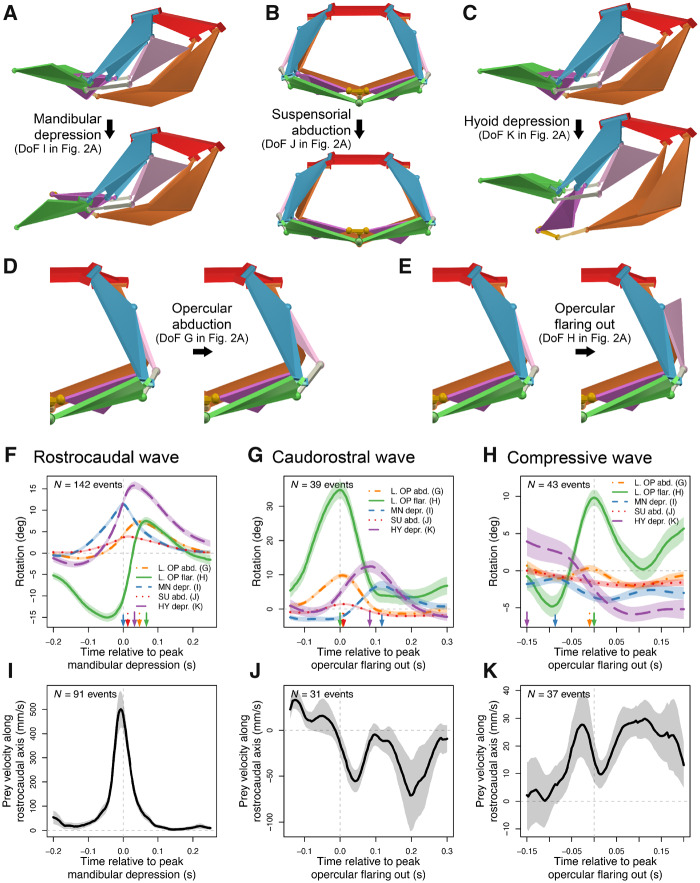
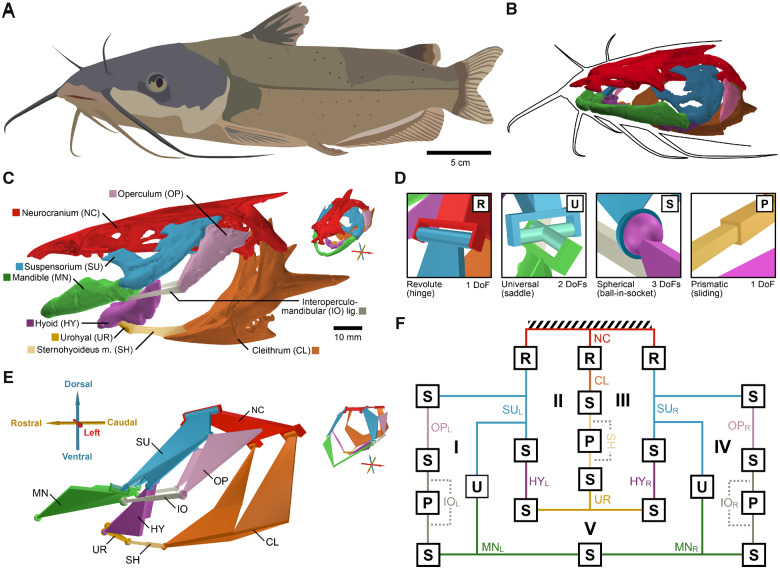
Fish perform many complex manipulation behaviors without hands or flexible muscular tongues, instead relying on more than 20 movable skeletal elements in their highly kinetic skulls. How fish use their skulls to accomplish these behaviors, however, remains unclear. Most previous mechanical models have represented the fish skull using one or more planar four-bar linkages, which have just a single degree of freedom (DoF). In contrast, truncated-cone hydrodynamic models have assumed up to five DoFs. In this study, we introduce and validate a 3D mechanical linkage model of a fish skull that incorporates the pectoral girdle and mandibular and hyoid arches. We validate this model using an motion dataset of suction feeding in channel catfish and then use this model to quantify the DoFs in the fish skull, to categorize the motion patterns of the cranial linkage during feeding, and to evaluate the association between these patterns and food motion. We find that the channel catfish skull functions as a 17-link, five-loop parallel mechanism. Despite having 19 potential DoFs, we find that seven DoFs are sufficient to describe most of the motion of the cranial linkage, consistent with the fish skull functioning as a multi-DoF, manipulation system. Channel catfish use this linkage to generate three different motion patterns (rostrocaudal wave, caudorostral wave, and compressive wave), each with its own associated food velocity profile. These results suggest that biomechanical manipulation systems must have a minimum number of DoFs to effectively control objects, whether in water or air.

摘要

鱼类在没有手或灵活的肌肉舌头的情况下能执行许多复杂的操作行为,而是依靠其高度灵活的头骨中20多个可移动的骨骼元素。然而,鱼类如何利用其头骨完成这些行为仍不清楚。以前的大多数力学模型都用一个或多个平面四杆连杆机构来表示鱼头骨,这些机构只有一个自由度(DoF)。相比之下,截头圆锥体水动力模型假设最多有五个自由度。在本研究中,我们引入并验证了一个包含胸带以及下颌和舌弓的鱼头骨三维机械连杆模型。我们使用斑点叉尾鮰的吸食摄食运动数据集来验证该模型,然后用这个模型来量化鱼头骨的自由度,对摄食过程中颅骨连杆的运动模式进行分类,并评估这些模式与食物运动之间的关联。我们发现斑点叉尾鮰的头骨起到了一个由17个连杆、五个回路的并联机构的作用。尽管有19个潜在的自由度,但我们发现七个自由度足以描述颅骨连杆的大部分运动,这与鱼头骨作为一个多自由度操纵系统的功能一致。斑点叉尾鮰利用这个连杆机构产生三种不同的运动模式(头-尾波、尾-头波和压缩波),每种模式都有其相关的食物速度分布。这些结果表明,生物力学操纵系统必须有最少数量的自由度才能有效地控制物体,无论是在水中还是在空气中。
https://cdn.ncbi.nlm.nih.gov/pmc/blobs/be2a/7671092/02b1a8182e13/obaa031f3.jpg
https://cdn.ncbi.nlm.nih.gov/pmc/blobs/be2a/7671092/bf5a1d0efb03/obaa031f1.jpg
https://cdn.ncbi.nlm.nih.gov/pmc/blobs/be2a/7671092/369f2fd48488/obaa031f2.jpg
https://cdn.ncbi.nlm.nih.gov/pmc/blobs/be2a/7671092/02b1a8182e13/obaa031f3.jpg
https://cdn.ncbi.nlm.nih.gov/pmc/blobs/be2a/7671092/bf5a1d0efb03/obaa031f1.jpg
https://cdn.ncbi.nlm.nih.gov/pmc/blobs/be2a/7671092/369f2fd48488/obaa031f2.jpg
https://cdn.ncbi.nlm.nih.gov/pmc/blobs/be2a/7671092/02b1a8182e13/obaa031f3.jpg

相似文献

1
Multiple Degrees of Freedom in the Fish Skull and Their Relation to Hydraulic Transport of Prey in Channel Catfish.鲶鱼头骨的多个自由度及其与鲶鱼猎物水力运输的关系。
Integr Org Biol. 2020 Nov 10;2(1):obaa031. doi: 10.1093/iob/obaa031. eCollection 2020.
2
Channel catfish use higher coordination to capture prey than to swallow.鲶鱼在捕捉猎物时比在吞咽时需要更高的协调性。
Proc Biol Sci. 2019 Apr 24;286(1901):20190507. doi: 10.1098/rspb.2019.0507.
3
The opercular mouth-opening mechanism of largemouth bass functions as a 3D four-bar linkage with three degrees of freedom.大口黑鲈的鳃盖开口机制作为一种具有三个自由度的三维四杆机构发挥作用。
J Exp Biol. 2017 Dec 15;220(Pt 24):4612-4623. doi: 10.1242/jeb.159079.
4
An XROMM Study of Food Transport and Swallowing in Channel Catfish.斑点叉尾鮰食物运输与吞咽的XROMM研究
Integr Org Biol. 2020 Jun 19;2(1):obaa018. doi: 10.1093/iob/obaa018. eCollection 2020.
5
Linkage mechanisms in the vertebrate skull: Structure and function of three-dimensional, parallel transmission systems.脊椎动物头骨中的联动机制:三维平行传输系统的结构与功能
J Morphol. 2016 Dec;277(12):1570-1583. doi: 10.1002/jmor.20596. Epub 2016 Aug 31.
6
Optimal combination of minimum degrees of freedom to be actuated in the lower limbs to facilitate arm-free paraplegic standing.在下肢中驱动的最小自由度的最佳组合,以促进无臂截瘫患者站立。
J Biomech Eng. 2007 Dec;129(6):838-47. doi: 10.1115/1.2800767.
7
Kinematics of suction feeding in the seahorse Hippocampus reidi.拟海龙 Hippocampus reidi 的吸吮摄食运动学。
J Exp Biol. 2009 Nov;212(Pt 21):3490-8. doi: 10.1242/jeb.033050.
8
Biting releases constraints on moray eel feeding kinematics.咬噬解除了海鳗捕食运动学的限制。
J Exp Biol. 2007 Feb;210(Pt 3):495-504. doi: 10.1242/jeb.02663.
9
Finding the weakest link: mechanical sensitivity in a fish cranial linkage system.寻找最薄弱环节:鱼类颅骨连接系统中的机械敏感性
R Soc Open Sci. 2018 Oct 17;5(10):181003. doi: 10.1098/rsos.181003. eCollection 2018 Oct.
10
Epaxial and hypaxial co-contraction: a mechanism for modulating strike pressure and accuracy during suction feeding in channel catfish.轴上肌和轴下肌共同收缩:一种调节沟鲶吸食式摄食时攻击压力和准确性的机制。
J Exp Biol. 2023 Feb 15;226(4). doi: 10.1242/jeb.244714. Epub 2023 Feb 24.

引用本文的文献

1
Four-bar Geometry is Shared among Ecologically DivergentFish Species.四种生态不同的鱼类共享四杆几何结构。
Integr Org Biol. 2024 Jun 14;6(1):obae019. doi: 10.1093/iob/obae019. eCollection 2024.
2
Three-dimensional kinematics of leaf-cutter ant mandibles: not all dicondylic joints are simple hinges.切叶蚁下颚的三维运动学:并非所有的双关节都是简单铰链。
Philos Trans R Soc Lond B Biol Sci. 2023 Dec 4;378(1891):20220546. doi: 10.1098/rstb.2022.0546. Epub 2023 Oct 16.

本文引用的文献

1
Fishes can use axial muscles as anchors or motors for powerful suction feeding.鱼类可以利用轴向肌肉作为强大的吸食式进食的锚或动力源。
J Exp Biol. 2020 Sep 18;223(Pt 18):jeb225649. doi: 10.1242/jeb.225649.
2
A mobility-based classification of closed kinematic chains in biomechanics and implications for motor control.基于运动的生物力学中闭链运动学分类及其对运动控制的影响。
J Exp Biol. 2019 Nov 6;222(Pt 21):jeb195735. doi: 10.1242/jeb.195735.
3
Channel catfish use higher coordination to capture prey than to swallow.鲶鱼在捕捉猎物时比在吞咽时需要更高的协调性。
Proc Biol Sci. 2019 Apr 24;286(1901):20190507. doi: 10.1098/rspb.2019.0507.
4
Feeding mechanics of teleost fishes (Labridae; Perciformes): A test of four-bar linkage models.硬骨鱼类(隆头鱼科;鲈形目)的摄食机制:四连杆模型的检验
J Morphol. 1990 Sep;205(3):269-295. doi: 10.1002/jmor.1052050304.
5
Aquatic-terrestrial transitions of feeding systems in vertebrates: a mechanical perspective.脊椎动物取食系统的水生-陆生转变:力学视角。
J Exp Biol. 2018 Apr 25;221(Pt 8):jeb154427. doi: 10.1242/jeb.154427.
6
Conserved spatio-temporal patterns of suction-feeding flows across aquatic vertebrates: a comparative flow visualization study.水生脊椎动物吸式摄食水流的保守时空模式:一项比较性流动可视化研究。
J Exp Biol. 2018 Apr 12;221(Pt 7):jeb174912. doi: 10.1242/jeb.174912.
7
The opercular mouth-opening mechanism of largemouth bass functions as a 3D four-bar linkage with three degrees of freedom.大口黑鲈的鳃盖开口机制作为一种具有三个自由度的三维四杆机构发挥作用。
J Exp Biol. 2017 Dec 15;220(Pt 24):4612-4623. doi: 10.1242/jeb.159079.
8
Functional correlates of the position of the axis of rotation of the mandible during chewing in non-human primates.非人灵长类动物咀嚼时下颌旋转轴位置的功能相关性。
Zoology (Jena). 2017 Oct;124:106-118. doi: 10.1016/j.zool.2017.08.006. Epub 2017 Aug 23.
9
How pigeons couple three-dimensional elbow and wrist motion to morph their wings.鸽子如何将三维的肘部和腕部运动相结合来塑造它们的翅膀。
J R Soc Interface. 2017 Aug;14(133). doi: 10.1098/rsif.2017.0224.
10
THE EVOLUTION OF TETRAPOD FEEDING BEHAVIOR: KINEMATIC HOMOLOGIES IN PREY TRANSPORT.四足动物摄食行为的演化:猎物运输中的运动同源性
Evolution. 1990 Sep;44(6):1542-1557. doi: 10.1111/j.1558-5646.1990.tb03845.x.