Duncan Christine A, Cohick Wendie S, John-Alder Henry B
Graduate Program in Endocrinology and Animal Biosciences, Rutgers University, 84 Lipman Drive, New Brunswick, NJ 08901, USA.
Integr Org Biol. 2020 Oct 28;2(1):obaa036. doi: 10.1093/iob/obaa036. eCollection 2020.
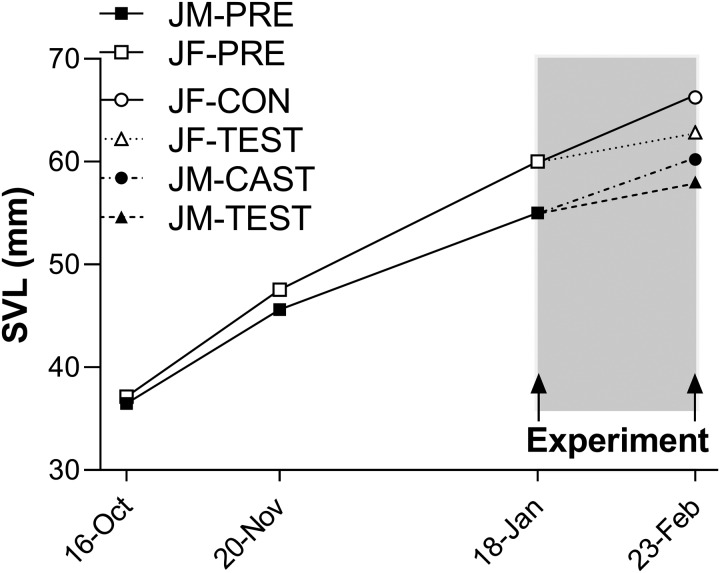
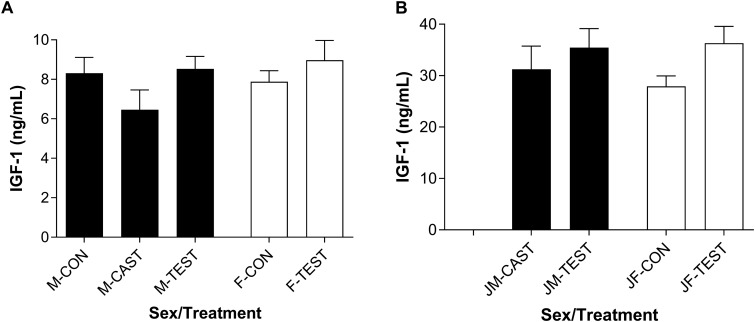
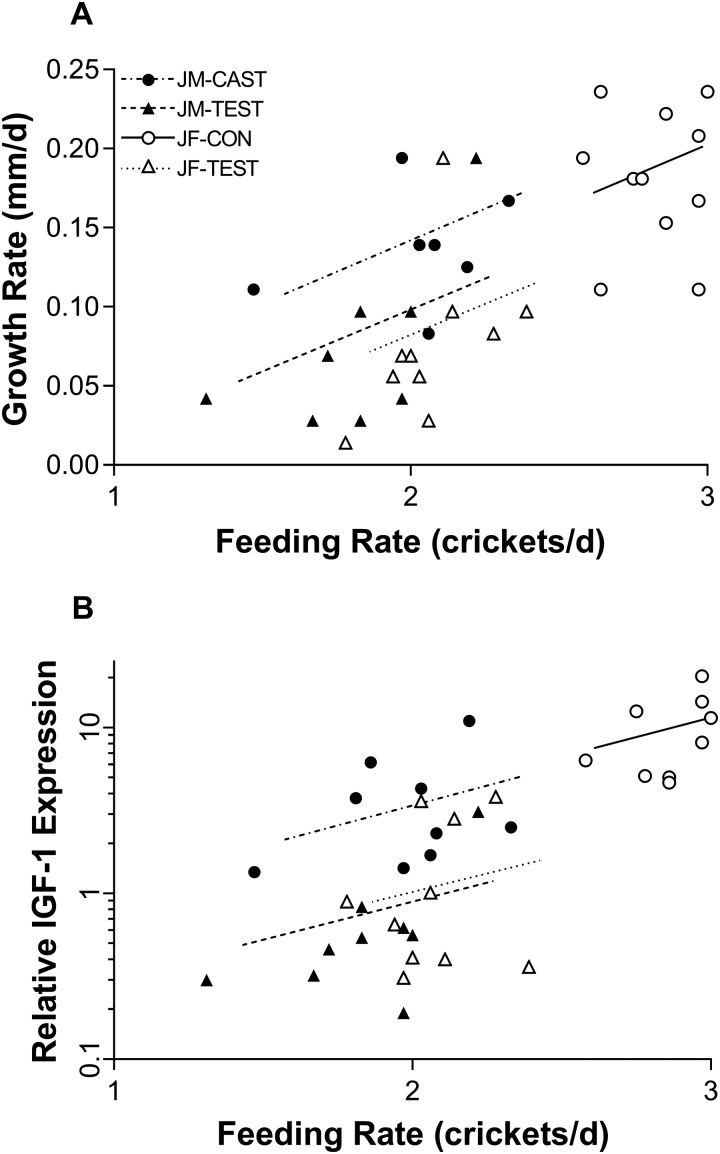
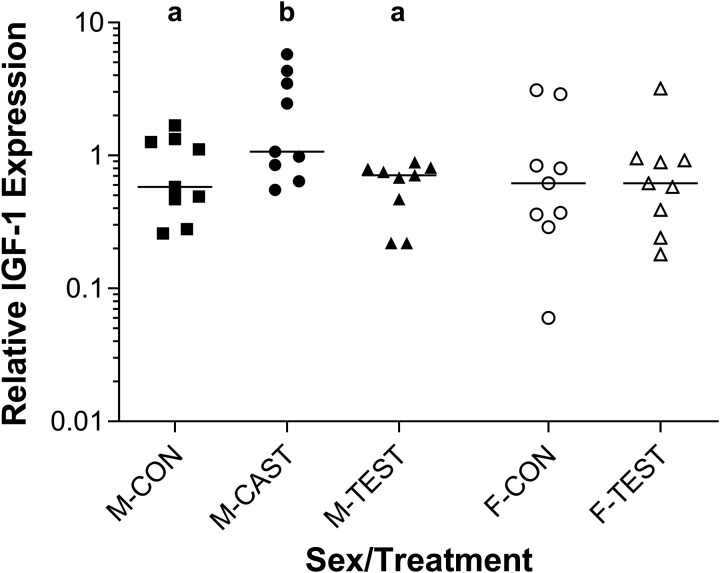
Previous research has demonstrated that testosterone (T) can inhibit growth in female-larger species and stimulate growth in male-larger species, but the underlying mechanisms of this regulatory bipotentiality have not been investigated. In this study, we investigated the effects of T on the expression of hepatic insulin-like growth factor-1 () mRNA and circulating IGF-1 hormone in , a species of lizard in which females grow faster to become larger than males and in which T inhibits growth. Experiments were performed in captivity on mature female and male adults in the asymptotic phase of their growth curve and on actively growing, pre-reproductive juveniles. In adult males, the expression of hepatic mRNA increased following surgical castration and returned to control levels with T replacement; in intact adult females, exogenous T had no effect on mRNA expression. In juveniles, T significantly reduced both growth and the expression of hepatic mRNA to similar extents in intact females and in castrated males. The relative inhibitory effects of T on mRNA expression were greater in juveniles than in adults. Plasma IGF-1 hormone was about four times higher in juveniles than in adults, but T had no significant effect on IGF-1 hormone in either sex or in either age group. Our finding of inhibition of the expression of hepatic mRNA stands in contrast to the stimulatory effects of T in the published body of literature. We attribute our novel finding to our use of a species in which T inhibits rather than stimulates growth. Our findings begin to explain how T has the regulatory bipotentiality to be stimulatory in some species and inhibitory in others, requiring only an evolutionary reversal in the molecular regulation of growth-regulatory genes including . Further comparative transcriptomic studies will be required to fully resolve the molecular mechanism of growth inhibition.
先前的研究表明,睾酮(T)可抑制雌性体型较大物种的生长,并刺激雄性体型较大物种的生长,但这种调节双潜能的潜在机制尚未得到研究。在本研究中,我们研究了T对鬃狮蜥肝脏胰岛素样生长因子1(IGF-1)mRNA表达和循环IGF-1激素的影响,在该蜥蜴物种中,雌性生长更快,体型比雄性大,且T会抑制生长。实验在圈养条件下对处于生长曲线渐近期的成年雌性和雄性以及处于活跃生长、未生殖的幼年鬃狮蜥进行。在成年雄性中,手术去势后肝脏IGF-1 mRNA的表达增加,用T替代后恢复到对照水平;在完整的成年雌性中,外源性T对IGF-1 mRNA表达没有影响。在幼年鬃狮蜥中,T显著降低了完整雌性和去势雄性的生长以及肝脏IGF-1 mRNA的表达,且降低程度相似。T对mRNA表达的相对抑制作用在幼年鬃狮蜥中比在成年鬃狮蜥中更大。幼年鬃狮蜥的血浆IGF-1激素水平约为成年鬃狮蜥的四倍,但T对任何性别或年龄组的IGF-1激素均无显著影响。我们发现肝脏IGF-1 mRNA表达受到抑制,这与已发表文献中T的刺激作用形成对比。我们将这一新发现归因于我们使用了一种T抑制而非刺激生长的物种。我们的研究结果开始解释T如何具有在某些物种中起刺激作用而在其他物种中起抑制作用的调节双潜能,这只需要包括IGF-1在内的生长调节基因的分子调控发生进化逆转。需要进一步的比较转录组学研究来全面解析生长抑制的分子机制。