Li Xintong, Ostropolets Anna, Makadia Rupa, Shaoibi Azza, Rao Gowtham, Sena Anthony G, Martinez-Hernandez Eugenia, Delmestri Antonella, Verhamme Katia, Rijnbeek Peter R, Duarte-Salles Talita, Suchard Marc, Ryan Patrick, Hripcsak George, Prieto-Alhambra Daniel
Centre for Statistics in Medicine, NDORMS, University of Oxford, Oxford, United Kingdom.
Department of Biomedical Informatics, Columbia University Irving Medical Center, New York, NY, USA.
medRxiv. 2021 Apr 17:2021.03.25.21254315. doi: 10.1101/2021.03.25.21254315.
As large-scale immunization programs against COVID-19 proceed around the world, safety signals will emerge that need rapid evaluation. We report population-based, age- and sex-specific background incidence rates of potential adverse events of special interest (AESI) in eight countries using thirteen databases.
This multi-national network cohort study included eight electronic medical record and five administrative claims databases from Australia, France, Germany, Japan, Netherlands, Spain, the United Kingdom, and the United States, mapped to a common data model. People observed for at least 365 days before 1 January 2017, 2018, or 2019 were included. We based study outcomes on lists published by regulators: acute myocardial infarction, anaphylaxis, appendicitis, Bell's palsy, deep vein thrombosis, disseminated intravascular coagulation, encephalomyelitis, Guillain-Barre syndrome, hemorrhagic and non-hemorrhagic stroke, immune thrombocytopenia, myocarditis/pericarditis, narcolepsy, pulmonary embolism, and transverse myelitis. We calculated incidence rates stratified by age, sex, and database. We pooled rates across databases using random effects meta-analyses. We classified meta-analytic estimates into Council of International Organizations of Medical Sciences categories: very common, common, uncommon, rare, or very rare.
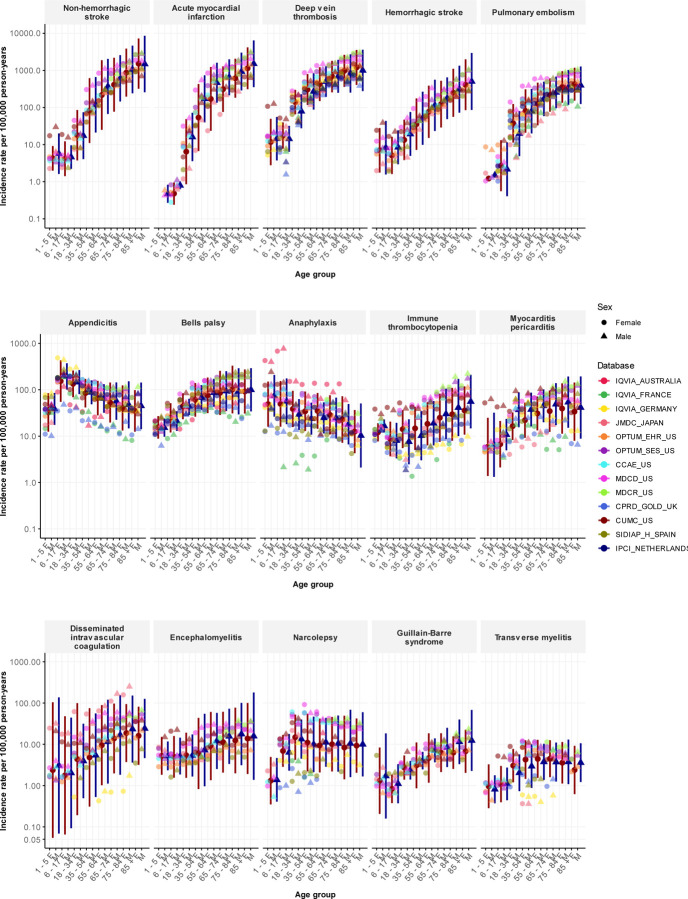
We analysed 126,661,070 people. Rates varied greatly between databases and by age and sex. Some AESI (e.g., myocardial infarction, Guillain-Barre syndrome) increased with age, while others (e.g., anaphylaxis, appendicitis) were more common in young people. As a result, AESI were classified differently according to age. For example, myocardial infarction was very rare in children, rare in women aged 35-54 years, uncommon in men and women aged 55-84 years, and common in those aged ≥85 years.
We report robust baseline rates of prioritised AESI across 13 databases. Age, sex, and variation between databases should be considered if background AESI rates are compared to event rates observed with COVID-19 vaccines.
随着全球范围内针对2019冠状病毒病(COVID-19)的大规模免疫计划的推进,将会出现需要快速评估的安全信号。我们利用13个数据库报告了8个国家中基于人群的、按年龄和性别划分的特殊关注潜在不良事件(AESI)的背景发病率。
这项多国网络队列研究纳入了来自澳大利亚、法国、德国、日本、荷兰、西班牙、英国和美国的8个电子病历数据库和5个行政索赔数据库,并映射到一个通用数据模型。纳入在2017年、2018年或2019年1月1日前至少观察365天的人群。我们将研究结果基于监管机构公布的列表:急性心肌梗死、过敏反应、阑尾炎、贝尔麻痹、深静脉血栓形成、弥散性血管内凝血、脑脊髓炎、吉兰-巴雷综合征、出血性和非出血性中风、免疫性血小板减少症、心肌炎/心包炎、发作性睡病、肺栓塞和横贯性脊髓炎。我们计算了按年龄、性别和数据库分层的发病率。我们使用随机效应荟萃分析汇总了各数据库的发病率。我们将荟萃分析估计值分类为国际医学科学组织理事会的类别:非常常见、常见、不常见、罕见或非常罕见。
我们分析了126,661,070人。发病率在不同数据库之间以及按年龄和性别有很大差异。一些AESI(如心肌梗死、吉兰-巴雷综合征)随年龄增加,而其他一些(如过敏反应、阑尾炎)在年轻人中更常见。因此,AESI根据年龄分类不同。例如,心肌梗死在儿童中非常罕见,在35 - 54岁女性中罕见,在55 - 84岁男性和女性中不常见,在≥85岁人群中常见。
我们报告了13个数据库中优先AESI的可靠基线发病率。如果将背景AESI发病率与COVID-19疫苗观察到的事件发病率进行比较,应考虑年龄、性别和数据库之间的差异。