Sueyoshi Eijun, Sakamoto Ichiro, Uetani Masataka
Department of Radiological Sciences, Graduate School of Biomedical Sciences, Nagasaki University, 1-7-1 Sakamoto, Nagasaki, 852-8501, Japan.
CVIR Endovasc. 2021 Apr 1;4(1):33. doi: 10.1186/s42155-021-00219-5.
Spontaneous rupture of the iliac vein has rarely been reported. Its associated hypovolemic shock-related symptoms and signs, including syncope and hypotension, have been observed in most of these cases. Successful transcatheter venous embolization for massive bleeding due to spontaneous rupture of the external iliac vein was herein reported.
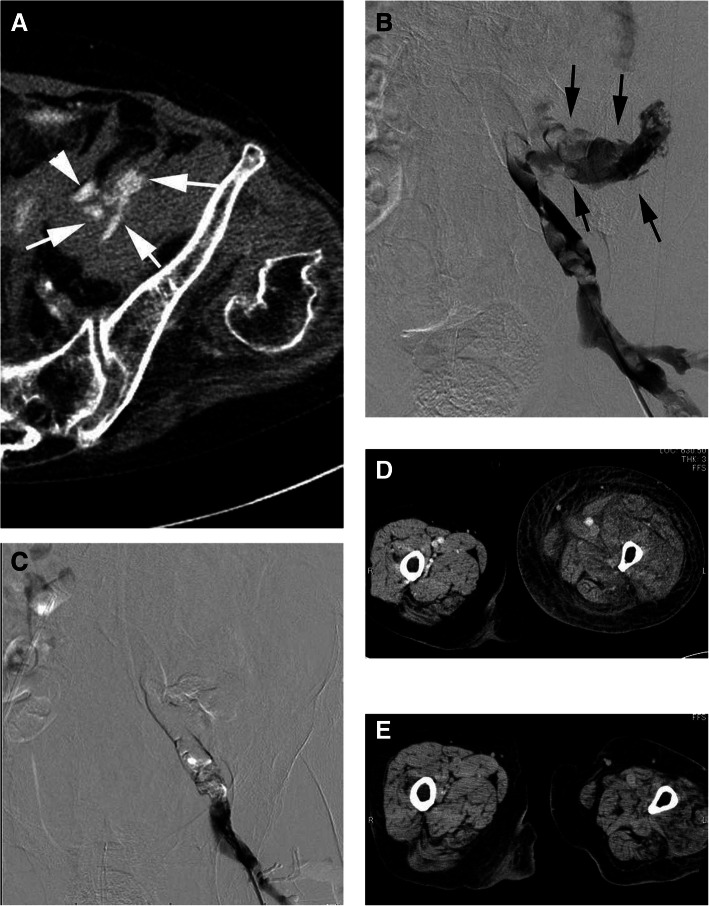
An 82-year-old female patient developed sudden left lower abdominal and back pain. Immediately, she lost consciousness and went into shock. CT images of her abdomen revealed a huge retroperitoneal hematoma, with leakage of contrast medium in the hematoma in the left flank. These findings suggested left external iliac vein rupture. Open surgery was considered; however, since the patient's condition may have deteriorated further due to the time needed to prepare for surgery, including general anesthesia, transcatheter venous embolization of the left iliac vein was selected. A 5.2-Fr compliant balloon catheter (nominal diameter of 10 mm) was inflated at the distal site of the external iliac vein to reduce extravasation. N-butyl-2-cyanoacrylate (NBCA) was mixed with Lipiodol at a ratio of 1:2. The left Iliac vein was filled and completely embolized with the NBCA/Lipiodol mixture (total injected volume, 5 mL) using a 1.8-Fr microcatheter. After embolization, the patient quickly. An inferior vena cava filter was placed 1 day after embolization.
Spontaneous rupture of the iliac vein is a very rare and lethal condition. Transcatheter venous embolization may control potentially life-threatening bleeding. Rapid bleeding control in a critical condition is facilitated by this minimally invasive approach.
髂静脉自发性破裂鲜有报道。在大多数此类病例中均观察到了其相关的低血容量性休克相关症状和体征,包括晕厥和低血压。本文报道了因髂外静脉自发性破裂导致大量出血而成功进行经导管静脉栓塞术的病例。
一名82岁女性患者突发左下腹及背部疼痛。随即,她失去意识并陷入休克。其腹部CT图像显示巨大的腹膜后血肿,左侧腰部血肿内有造影剂外漏。这些发现提示左髂外静脉破裂。考虑进行开放手术;然而,由于包括全身麻醉在内的手术准备所需时间可能会使患者病情进一步恶化,故选择对左髂静脉进行经导管静脉栓塞术。将一根5.2F顺应性球囊导管(标称直径10毫米)在髂外静脉远端部位充盈以减少外渗。正丁基-2-氰基丙烯酸酯(NBCA)与碘油按1:2的比例混合。使用一根1.8F微导管将NBCA/碘油混合物(总注射量5毫升)注入并完全栓塞左髂静脉。栓塞后,患者很快恢复。栓塞术后1天放置下腔静脉滤器。
髂静脉自发性破裂是一种非常罕见且致命的病症。经导管静脉栓塞术可控制可能危及生命的出血。这种微创方法有助于在危急情况下迅速控制出血。