Gu Xi, Chen Ing-Gin, Harding Scott A, Nyamdari Batbayar, Ortega Maria A, Clermont Kristen, Westwood James H, Tsai Chung-Jui
Institute of Bioinformatics, University of Georgia, Athens, GA 30602, USA.
School of Forestry and Natural Resources, University of Georgia, Athens, GA 30602, USA.
Plant Physiol. 2021 Apr 23;185(4):1443-1456. doi: 10.1093/plphys/kiab031.
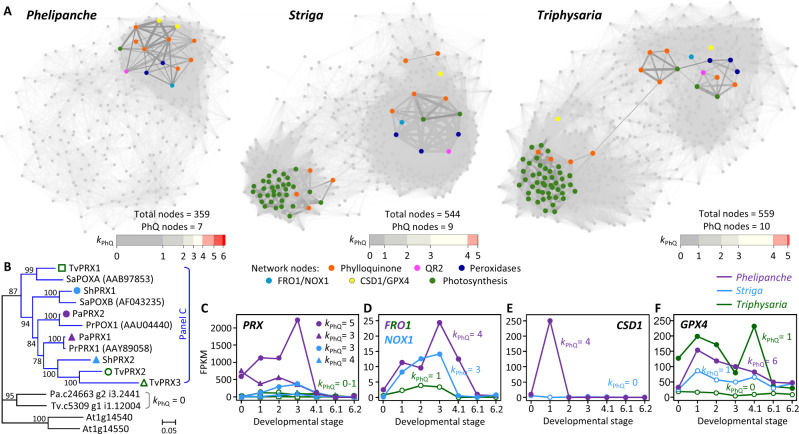
Nonphotosynthetic holoparasites exploit flexible targeting of phylloquinone biosynthesis to facilitate plasma membrane redox signaling. Phylloquinone is a lipophilic naphthoquinone found predominantly in chloroplasts and best known for its function in photosystem I electron transport and disulfide bridge formation of photosystem II subunits. Phylloquinone has also been detected in plasma membrane (PM) preparations of heterotrophic tissues with potential transmembrane redox function, but the molecular basis for this noncanonical pathway is unknown. Here, we provide evidence of PM phylloquinone biosynthesis in a nonphotosynthetic holoparasite Phelipanche aegyptiaca. A nonphotosynthetic and nonplastidial role for phylloquinone is supported by transcription of phylloquinone biosynthetic genes during seed germination and haustorium development, by PM-localization of alternative terminal enzymes, and by detection of phylloquinone in germinated seeds. Comparative gene network analysis with photosynthetically competent parasites revealed a bias of P. aegyptiaca phylloquinone genes toward coexpression with oxidoreductases involved in PM electron transport. Genes encoding the PM phylloquinone pathway are also present in several photoautotrophic taxa of Asterids, suggesting an ancient origin of multifunctionality. Our findings suggest that nonphotosynthetic holoparasites exploit alternative targeting of phylloquinone for transmembrane redox signaling associated with parasitism.
非光合全寄生植物利用叶绿醌生物合成的灵活靶向作用来促进质膜氧化还原信号传导。叶绿醌是一种亲脂性萘醌,主要存在于叶绿体中,因其在光系统I电子传递和光系统II亚基二硫键形成中的作用而最为人所知。在具有潜在跨膜氧化还原功能的异养组织的质膜(PM)制剂中也检测到了叶绿醌,但这种非经典途径的分子基础尚不清楚。在这里,我们提供了非光合全寄生植物埃及列当质膜叶绿醌生物合成的证据。种子萌发和吸器发育过程中叶绿醌生物合成基因的转录、替代末端酶的质膜定位以及发芽种子中叶绿醌的检测,都支持了叶绿醌在非光合和非质体中的作用。与具有光合能力的寄生植物进行比较基因网络分析发现,埃及列当的叶绿醌基因倾向于与参与质膜电子传递的氧化还原酶共表达。编码质膜叶绿醌途径的基因也存在于菊类植物的几个光合自养类群中,这表明多功能性具有古老的起源。我们的研究结果表明,非光合全寄生植物利用叶绿醌的替代靶向作用进行与寄生相关的跨膜氧化还原信号传导。