Shah AnChetan, Ramanujan Vishnu, Muralidharan Krishna, AnRaja Anand
Department of Surgical Oncology, Cancer Institute (WIA), Chennai, India.
Department of Vascular Surgery, Government Multi Super Speciality Hospital, Chennai, India.
Vasc Specialist Int. 2021 Mar 31;37(1):22-28. doi: 10.5758/vsi.200064.
This study aimed to evaluate and analyze the feasibility and the oncological and functional outcomes of limb salvage surgery in extremity soft tissue sarcomas (ESTS) and bone tumors invading vessels.
This single-center retrospective analysis included patients with ESTS encasing or invading major blood vessels that were treated by limb salvage surgery with vascular resection and reconstruction between January 1995 and December 2019. Patients with contiguous involvement of major blood vessels and nerves and patients requiring amputation were excluded from the study.
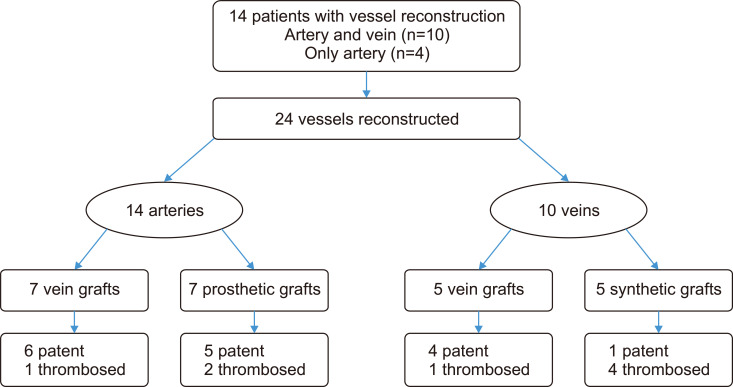
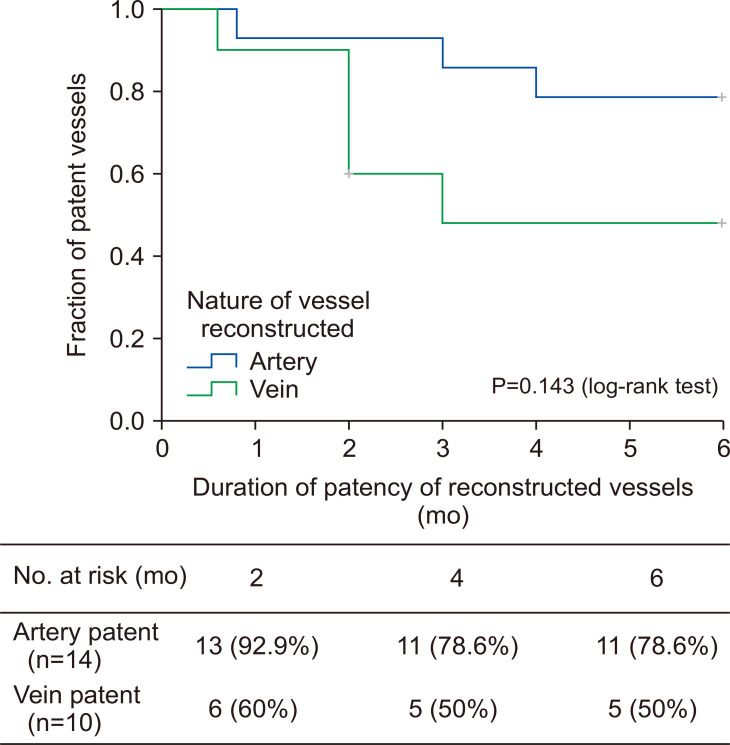
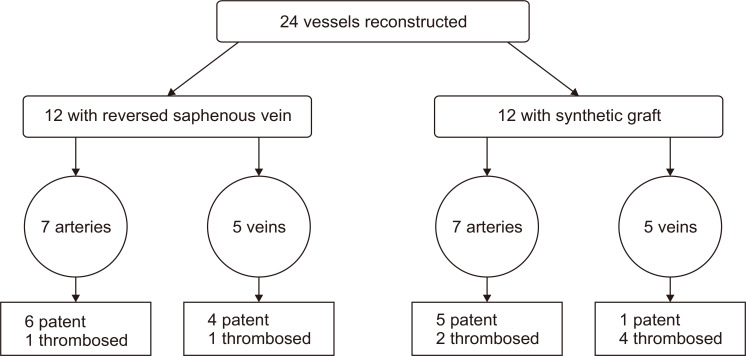
A total of 24 vessels (14 arteries and 10 veins) in 14 patients were reconstructed. Ten (71.4%) patients underwent both arterial and venous reconstruction, and four (28.6%) underwent only arterial reconstruction. Reconstruction was performed with a reversed saphenous vein (RSV) graft in 12 patients and with a synthetic graft (SG) in the other 12 patients. At a median follow-up of 27 months, RSV grafts were patent in 10 of 12 (83.3%) vessels and SGs were patent in 6 of 12 (50.0%) vessels (log-rank test, P=0.083). Out of 14 arteries and 10 veins, 11 arteries and 5 veins were patent, respectively. No patient developed local recurrence, and 2 (14.3%) patients developed distant metastases. Limb salvage rate was 13/14 (92.9%). The mean Musculoskeletal Tumor Society score was 83.3%. The 5- and 10-year overall survival rates were 80% and 50%, respectively.
Limb salvage surgery in ESTS with vascular resection and reconstruction is feasible and provides favorable oncological and functional outcomes.
本研究旨在评估和分析肢体挽救手术在肢体软组织肉瘤(ESTS)及侵犯血管的骨肿瘤中的可行性、肿瘤学及功能学结果。
本单中心回顾性分析纳入了1995年1月至2019年12月期间因ESTS包裹或侵犯主要血管而接受了血管切除重建的肢体挽救手术的患者。主要血管和神经连续受累的患者以及需要截肢的患者被排除在研究之外。
14例患者共重建了24条血管(14条动脉和10条静脉)。10例(71.4%)患者同时进行了动脉和静脉重建,4例(28.6%)仅进行了动脉重建。12例患者采用大隐静脉反转(RSV)移植物进行重建,另外12例患者采用人工合成移植物(SG)进行重建。中位随访27个月时,12条RSV移植物中有10条(83.3%)通畅,12条SG移植物中有6条(50.0%)通畅(对数秩检验,P=0.083)。14条动脉和10条静脉中,分别有11条动脉和5条静脉通畅。无患者发生局部复发,2例(14.3%)患者发生远处转移。肢体挽救率为13/14(92.9%)。肌肉骨骼肿瘤学会平均评分为83.3%。5年和10年总生存率分别为80%和50%。
ESTS行血管切除重建的肢体挽救手术是可行的,并能提供良好的肿瘤学及功能学结果。