Peking University HuiLongGuan Clinical Medical School, Beijing Huilongguan Hospital, Beijing, China.
Department of Pharmacy, Peking University First Hospital, Beijing, China.
Transl Psychiatry. 2021 Apr 1;11(1):198. doi: 10.1038/s41398-021-01311-z.
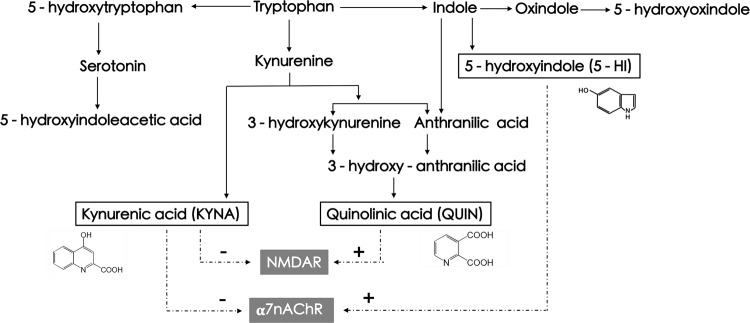
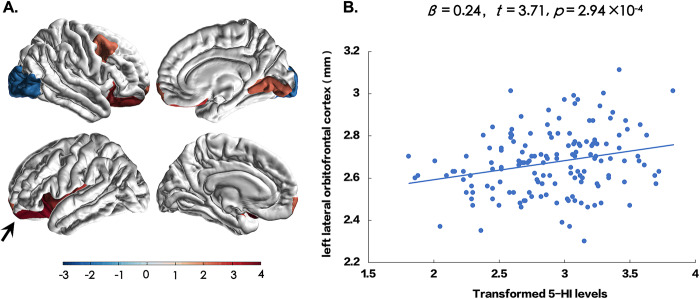
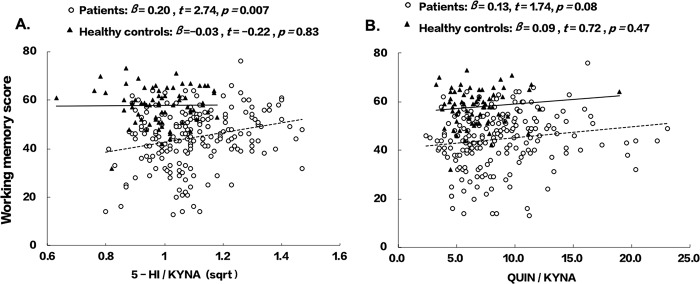
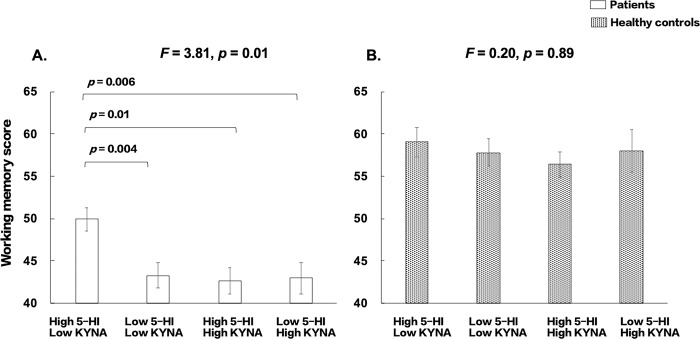
A number of tryptophan metabolites known to be neuroactive have been examined for their potential associations with cognitive deficits in schizophrenia. Among these metabolites, kynurenic acid (KYNA), 5-hydroxyindole (5-HI), and quinolinic acid (QUIN) are documented in their diverse effects on α-7 nicotinic acetylcholine receptor (α7nAChR) and/or N-methyl-D-aspartate receptor (NMDAR), two of the receptor types thought to contribute to cognitive impairment in schizophrenia. In this study, serum levels of KYNA, 5-HI, and QUIN were measured in 195 patients with schizophrenia and in 70 healthy controls using liquid chromatography-tandem mass spectrometry; cognitive performance in MATRICS Consensus Cognitive Battery and cortical thickness measured by magnetic resonance imaging were obtained. Patients with schizophrenia had significantly lower serum KYNA (p < 0.001) and QUIN (p = 0.02) levels, and increased 5-HI/KYNA (p < 0.001) and QUIN/KYNA ratios (p < 0.001) compared with healthy controls. Multiple linear regression showed that working memory was positively correlated with serum 5-HI levels (t = 2.10, p = 0.04), but inversely correlated with KYNA concentrations (t = -2.01, p = 0.05) in patients. Patients with high 5-HI and low KYNA had better working memory than other subgroups (p = 0.01). Higher 5-HI levels were associated with thicker left lateral orbitofrontal cortex (t = 3.71, p = 2.94 × 10) in patients. The different effects of 5-HI and KYNA on working memory may appear consistent with their opposite receptor level mechanisms. Our findings appear to provide a new insight into the dynamic roles of tryptophan pathway metabolites on cognition, which may benefit novel therapeutic development that targets cognitive impairment in schizophrenia.
一些已知具有神经活性的色氨酸代谢物已被研究,以探讨它们与精神分裂症认知缺陷的潜在关联。在这些代谢物中,犬尿酸(KYNA)、5-羟吲哚(5-HI)和喹啉酸(QUIN)因其对α-7 烟碱型乙酰胆碱受体(α7nAChR)和/或 N-甲基-D-天冬氨酸受体(NMDAR)的不同影响而被记录在案,这两种受体类型被认为与精神分裂症认知障碍有关。在这项研究中,使用液相色谱-串联质谱法测量了 195 名精神分裂症患者和 70 名健康对照者的血清 KYNA、5-HI 和 QUIN 水平;使用磁共振成像获得了 MATRICS 共识认知电池的认知表现和皮质厚度。与健康对照组相比,精神分裂症患者的血清 KYNA(p<0.001)和 QUIN(p=0.02)水平显著降低,5-HI/KYNA(p<0.001)和 QUIN/KYNA 比值(p<0.001)升高。多元线性回归显示,工作记忆与血清 5-HI 水平呈正相关(t=2.10,p=0.04),但与 KYNA 浓度呈负相关(t=-2.01,p=0.05)。在患者中,5-HI 水平高、KYNA 水平低的患者工作记忆更好(p=0.01)。较高的 5-HI 水平与患者左侧外侧眶额皮质增厚有关(t=3.71,p=2.94×10)。5-HI 和 KYNA 对工作记忆的不同影响似乎与其相反的受体水平机制一致。我们的研究结果似乎为色氨酸代谢物对认知的动态作用提供了新的见解,这可能有助于针对精神分裂症认知障碍的新治疗方法的开发。